

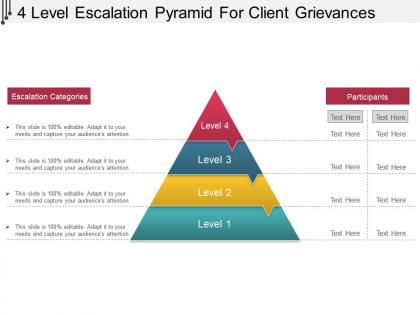
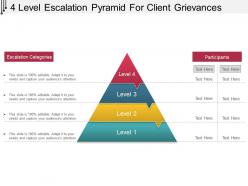
4 level escalation pyramid for client grievances powerpoint layout




Try Before you Buy Download Free Sample Product
 Impress Your
 Audience
 100%
100% Editable
 Save Hours
 of Time


Gift folks good advice with our 4 Level Escalation Pyramid For Client Grievances Powerpoint Layout. They will feel intensely grateful.
People who downloaded this PowerPoint presentation also viewed the following :
4 level escalation pyramid for client grievances powerpoint layout with all 5 slides:
Acquire the best cards with our 4 Level Escalation Pyramid For Client Grievances Powerpoint Layout. They allow you to play a good hand.


FAQs for 4 level escalation pyramid for client
So basically there are four levels in an escalation pyramid. Frontline staff handle the basic stuff first. Above them you've got supervisors, then middle management, and senior leadership sits at the top. Each level can only make certain decisions - like having different access levels in a video game, if that makes sense. Problems only get bumped up when someone can't solve it with their current authority. Pretty straightforward concept, honestly. You'll want to spell out exactly what each level can tackle though. Otherwise people either skip around randomly or everything gets stuck in weird bottlenecks. Trust me on that one.
So the escalation pyramid is pretty straightforward - you start gentle and work your way up. Begin with stuff like actually listening and finding things you agree on. When that fails (and sometimes it will), get more assertive. Set harder boundaries, maybe bring in someone neutral to help mediate. Management might need to get involved eventually. The whole point is not jumping straight to the big guns, even though - let's be honest - that's tempting when someone's being impossible. Give each level a real chance before moving up. Next time you're dealing with drama, figure out where you are on the pyramid and what step comes next.
So basically, the higher up you go, the more formal everything gets. Start with casual desk chats with your manager - no big deal there. Middle management? You'll need actual documentation and can't just wing it anymore. Honestly, that's where most people screw up because they're not ready for the shift. Executive level is totally different - they want crisp summaries with data and business impact, not your whole technical backstory. Three bullet points max or you've lost them. The trick is reading your audience. Save the nerdy details for your teammates and give the C-suite just the bottom line.
So picture an escalation pyramid - you start at the bottom with stuff your team handles daily. Moving up? That's when things get urgent, complex, or could actually hurt the business. Honestly, it's like triage for work drama and random fires. Higher levels need senior people involved. This way you're not bugging the CEO about password resets (been there), but critical stuff gets to decision-makers fast. I'd map out your current problems first - see what fits where on different levels.
Biggest mistake? Making your criteria way too vague. "When things get complicated" tells nobody anything useful. Also don't create like 6 different levels - honestly that just slows everything down. People skip steps when they're panicking, so keep it simple. Train your team on the actual process too! Can't tell you how many places have these fancy charts that nobody knows how to follow. Set clear owners for each level and realistic response times. Oh and document how things currently break down first - you might be surprised where the real issues are.
Honestly, just copy how decisions actually get made at your place. Flat org? Two levels max. Super hierarchical? Add more steps or people get pissy about chain of command. Startups need like 24-hour timelines, big corps need weeks sometimes. I watched a whole team crash because they used Google's escalation model at a 50-person company - made zero sense. Think about the last time something urgent happened. How'd it move through your company? Build your pyramid around that flow, not some template you found online.
Okay so resolution time is huge - measure how long stuff takes at each tier. Track your escalation rate too (like what percentage actually moves up). First-contact resolution matters obviously, plus customer satisfaction scores. The internal metrics are honestly just as important though. Agent utilization, burnout indicators - you don't want tier-1 drowning while your senior people are bored out of their minds. Monthly reviews work well for this kind of thing. Just let the data guide changes to your structure instead of guessing what's broken.
Look, major changes are your biggest trigger - new leadership, team reshuffles, that kind of thing. Bottlenecks at certain levels are another dead giveaway. I've seen so many teams ignore this until it's a mess. Response times dragging? Time to shake things up. Most pyramids go stale in like 6-12 months anyway, which is honestly faster than people think. Role changes are tricky too - suddenly someone's expertise doesn't match where they sit in the structure. New incident types that don't fit? Same deal. Just set a quarterly review reminder and actually stick to it.
So basically, ticketing systems are your best friend here - they'll auto-route stuff based on how urgent it is or how long it's been sitting there. Way better than those email chains that disappear into the void. Some AI tools can even spot which issues are about to blow up and need immediate attention (pretty cool actually). Dashboards help too since you can see where things are getting stuck. Oh, and mapping out your current mess of a process first makes everything way clearer. Then just pick the most annoying handoff points and automate those. Trust me, it's night and day compared to managing everything manually.
So basically, traditional escalation is super rigid - you follow the chain of command step by step even when it's totally pointless. Agile escalation? Way more flexible. You can skip levels, loop in whoever actually knows what they're talking about, or escalate sideways to different teams. Honestly, the agile approach just makes more sense because you're not wasting time going through Bob from accounting when you really need Sarah from engineering. It's all about getting to the right person faster and actually improving the process as you go. I'd map out both formal and informal paths so your team knows their options.
Honestly, role-playing is the way to go here. Forget boring diagrams - just walk your team through actual scenarios from your workplace. Show them when to handle stuff peer-to-peer vs. when management needs to step in. I like throwing in those messy gray-area situations because that's where everyone freezes up. You'll want clear timeframes and criteria for each escalation level. Have them practice figuring out which problems belong where. The repetition thing is huge - do this monthly so it becomes automatic when real drama hits. Trust me, it works way better than theory.
Think of it like this - your frontline people deal with the everyday stuff using their standard playbook. When they hit a wall or need approval for something bigger, that's when supervisors and department heads step in. The executives? They only want to hear about the really messy situations that could hurt the business or cost serious money. Honestly, I've seen people escalate way too quickly and it just annoys everyone. Match the problem size to the right person - nobody wants their CEO getting pinged about password resets, you know?
The escalation pyramid works with pretty much any PM approach you're already using. Map your escalation points to sprint reviews and standups if you're doing Agile. Waterfall? Use your phase gates and milestone reviews. Here's the thing though - most teams escalate stuff informally anyway, so you're really just adding structure to what already happens. Define clear thresholds for when problems jump to the next pyramid level, then build those checkpoints into your regular meetings. I'd start by writing down how you currently escalate issues (might surprise you), then just formalize the triggers and timing.
Zendesk and Shopify do this really well - they start with frontline support, then bump issues up to specialists and engineers based on how complex stuff gets. Amazon's system is crazy intense but works. The trick is making sure everyone knows exactly when to pass things up the chain. Actually, Atlassian made their whole escalation process public which is pretty cool to look at. I'd say start with just 3 levels though. Don't overcomplicate it right away - you can always add more layers once your team figures out the rhythm.
So you know how feedback loops work? Same deal with escalation pyramids - they show you where stuff gets stuck and why things keep getting kicked back down. Track your resolution times per level, how often things escalate, customer satisfaction scores. Your manager will actually leave you alone when they see real data (trust me on this). The cool part is using what you learn to tweak your escalation rules and training. Don't just hoard the numbers though - review them regularly and actually change things based on what's broken.
-
Usefule
-
The content is very helpful from business point of view.
-
Designs have enough space to add content.