

4ps Marketing Mix Framework Of Guide To Develop Advertising Strategy Mkt SS V




Try Before you Buy Download Free Sample Product
 Impress Your
 Audience
 100%
100% Editable
 Save Hours
 of Time


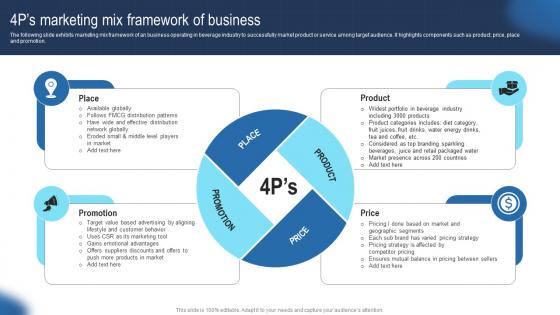
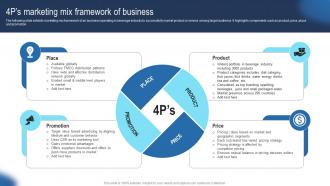
The following slide exhibits marketing mix framework of an business operating in beverage industry to successfully market product or service among target audience. It highlights components such as product, price, place and promotion.
People who downloaded this PowerPoint presentation also viewed the following :
4ps Marketing Mix Framework Of Guide To Develop Advertising Strategy Mkt SS V with all 6 slides:
Use our 4ps Marketing Mix Framework Of Guide To Develop Advertising Strategy Mkt SS V to effectively help you save your valuable time. They are readymade to fit into any presentation structure.





FAQs for 4ps Marketing Mix Framework Of Guide To Develop Advertising Strategy
The 4Ps in the marketing mix are Product, Price, Place, and Promotion, which work together as interconnected strategic elements to create comprehensive market positioning. These components enhance customer value by aligning product features with pricing strategies, distribution channels, and promotional messaging, with many organizations finding that coordinated 4Ps deliver stronger brand recognition and competitive advantage across diverse markets.
Businesses balance product quality and pricing by conducting thorough market research, analyzing competitor positioning, implementing value-based pricing strategies, and segmenting customers based on quality preferences and price sensitivity. This strategic approach enables companies to optimize their value proposition while maintaining competitive margins, with many organizations finding that premium quality paired with transparent pricing ultimately delivers stronger customer loyalty and sustainable market differentiation.
Promotion strategies vary significantly across industries based on regulatory requirements, customer behavior, and product complexity, with healthcare emphasizing educational content while retail focuses on emotional appeals and urgency. These differences should influence your entire 4Ps approach by aligning product positioning, pricing transparency, and distribution channels with industry-specific promotional norms, ultimately delivering cohesive customer experiences and competitive advantage.
Consumer feedback enables marketers to refine the 4Ps by revealing product improvement opportunities, optimizing pricing strategies based on perceived value, identifying effective promotional channels, and determining ideal distribution preferences. Through surveys, reviews, and social media analytics, companies like retailers and hospitality brands continuously adjust their marketing mix elements, ultimately delivering more targeted customer experiences and enhanced competitive positioning.
Distribution directly impacts customer satisfaction by ensuring product accessibility, convenient purchasing options, timely delivery, and seamless customer experiences across all touchpoints. Strategic placement decisions, whether through retail stores, online platforms, or direct sales channels, enable businesses to meet customer expectations for convenience and reliability, while optimizing reach and reducing friction in the purchasing journey, ultimately delivering competitive advantage and enhanced customer loyalty.
Small businesses can leverage the 4Ps by focusing on niche products, competitive pricing strategies, targeted distribution channels, and personalized promotional approaches that larger companies often struggle to match. Through strategic positioning, local market expertise, and agile decision-making, small businesses deliver customized customer experiences, faster service adaptations, and community-focused solutions, ultimately creating competitive advantages in increasingly crowded markets.
Digital marketing trends transforming the 4Ps include personalization engines, omnichannel integration, social commerce, influencer partnerships, and AI-driven pricing optimization. These technologies revolutionize traditional marketing by enabling dynamic product customization, real-time price adjustments, and seamless customer experiences across platforms, with retail and e-commerce businesses finding that strategic digital integration delivers enhanced customer engagement and competitive advantage.
Service-based businesses adapt the 4Ps by emphasizing intangible value delivery through customized service offerings, experience-focused pricing strategies, multi-channel accessibility, and relationship-driven promotional approaches rather than traditional product features. Financial services, healthcare providers, and consulting firms increasingly find that this adaptation streamlines client engagement, enhances service personalization, and ultimately delivers stronger customer retention and competitive differentiation.
Target audience identification drives strategic alignment across all 4Ps by ensuring product features meet specific customer needs, pricing reflects perceived value and purchasing power, promotion channels reach the right demographics, and place strategies align with shopping behaviors. This customer-centric approach enables businesses to optimize resource allocation, enhance marketing effectiveness, and deliver cohesive brand experiences, with many organizations finding that precise audience targeting significantly improves conversion rates and competitive positioning.
Companies can leverage seasonal marketing by adjusting product offerings for holiday demands, implementing dynamic pricing strategies, expanding distribution channels during peak periods, and creating season-specific promotional campaigns. This strategic approach enables businesses to maximize revenue opportunities, enhance customer engagement, and maintain competitive advantage, with many retail and hospitality organizations finding that synchronized seasonal adjustments across all four elements significantly boost profitability.
Marketing mix success metrics include sales revenue, market share, customer acquisition cost, brand awareness, customer satisfaction scores, and profit margins. These measurements enable businesses to evaluate each P's effectiveness across different channels and campaigns, with many organizations finding that combining quantitative data like conversion rates with qualitative feedback ultimately delivers comprehensive insights for strategic optimization.
Cultural and regional differences significantly influence the 4Ps by requiring localized product adaptations, region-specific pricing strategies, culturally appropriate promotional messaging, and distribution channels that align with local consumer behaviors. Companies like McDonald's adjust menu offerings for regional tastes, while luxury brands modify pricing for economic conditions and retailers adapt promotional campaigns for cultural values, ultimately delivering more resonant customer experiences and competitive advantage in diverse global markets.
Innovative promotional tactics include interactive content marketing, AI-powered personalization, influencer partnerships, omnichannel storytelling, and real-time customer engagement platforms. These approaches enhance the traditional 4Ps by creating deeper customer connections, delivering personalized experiences across multiple touchpoints, and enabling data-driven campaign optimization, ultimately driving higher conversion rates and brand loyalty in increasingly competitive markets.
Technology revolutionizes each of the 4Ps by enabling data-driven product development, dynamic pricing algorithms, omnichannel distribution platforms, and personalized promotional campaigns across digital touchpoints. Through AI analytics and automation tools, companies streamline customer targeting, optimize pricing strategies in real-time, and enhance distribution efficiency, ultimately delivering more responsive marketing approaches and competitive advantage in increasingly digital markets.
Companies face integration complexities when aligning traditional 4Ps with digital channels, including dynamic pricing pressures, omnichannel distribution coordination, rapidly evolving consumer expectations, and real-time campaign optimization demands. These challenges require strategic technology investments, data analytics capabilities, and agile marketing frameworks, with many organizations finding that successful digital transformation ultimately delivers enhanced customer targeting, improved operational efficiency, and stronger competitive positioning.
-
The visual appeal of the templates is just unparalleled! I was so worried about the design of my presentation but SlideTeam made it all so easy.
-
A beautiful, professional design paired with high-quality images and content that is sure to impress. It is a must-use PPT template in my opinion.