

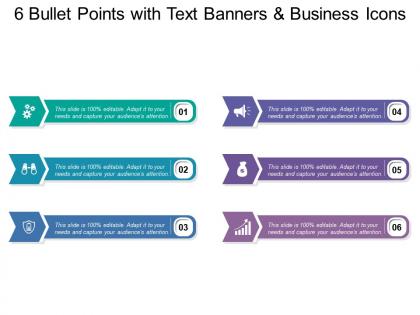
6 bullet points with text banners and business icons




Try Before you Buy Download Free Sample Product
 Impress Your
 Audience
 100%
100% Editable
 Save Hours
 of Time


Expose them to an array of better choices with our 6 Bullet Points With Text Banners And Business Icons. They are great demand drivers.
People who downloaded this PowerPoint presentation also viewed the following :
6 bullet points with text banners and business icons with all 5 slides:
Assessments will be deadly accurate with our 6 Bullet Points With Text Banners And Business Icons. You will get it on the button.

FAQs for 6 bullet points with text banners
**INPUT**: What are the key elements of an effective business presentation? **OUTPUT**: Effective business presentations include a compelling opening, clear value proposition, structured narrative flow, data-driven insights, and strong closing with actionable next steps. These elements work together by capturing audience attention, maintaining engagement through logical progression, and delivering measurable outcomes, with many organizations finding that well-structured presentations significantly enhance stakeholder buy-in and accelerate decision-making processes. [Word count: 58 words]
Visual aids enhance business presentations by simplifying complex data, maintaining audience engagement, improving information retention, and creating memorable experiences that support key messages. Through strategic use of charts, infographics, and multimedia elements, presenters can communicate more effectively with stakeholders, accelerate decision-making processes, and ultimately deliver more persuasive pitches that drive business outcomes.
Effective audience engagement strategies include interactive polls, compelling storytelling, strategic questions, visual demonstrations, and purposeful movement throughout the presentation space. These approaches work by creating participation opportunities, establishing emotional connections, and maintaining attention spans, with many organizations finding that combining multiple engagement techniques ultimately delivers higher retention rates and more persuasive outcomes.
Cultural differences significantly influence business presentation styles through varying communication patterns, hierarchy expectations, decision-making processes, and audience engagement preferences. For example, Japanese presentations often emphasize consensus-building and detailed preparation, while American styles favor direct messaging and interactive elements, with many multinational organizations finding that adapting presentation approaches to local cultural norms ultimately enhances stakeholder engagement and business outcomes.
Storytelling transforms business presentations by creating emotional connections, simplifying complex data, and making key messages memorable through relatable narratives. Through strategic storytelling, organizations enhance audience engagement, facilitate decision-making, and drive action more effectively than traditional fact-based approaches, with many executives finding that narrative structures ultimately deliver stronger stakeholder buy-in and competitive advantage.
Presenters can manage anxiety through thorough preparation, practice sessions, breathing exercises, visualization techniques, and positive self-talk before presenting. These strategies work by building confidence, reducing uncertainty, and creating mental readiness, with many professionals finding that combining preparation with relaxation techniques significantly enhances their delivery performance and audience connection.
Professional presentation template design practices include consistent color schemes, readable typography, strategic white space utilization, standardized slide layouts, and cohesive visual hierarchy. These elements streamline content creation by reducing design decisions, enhancing audience comprehension, and maintaining brand consistency across teams, with many organizations finding that well-designed templates ultimately accelerate presentation development while delivering more polished, impactful communications.
PowerPoint, Keynote, Prezi, Canva, and Google Slides are among the most effective presentation tools, each offering unique strengths in design flexibility, collaboration features, and interactive capabilities. These platforms enhance engagement through dynamic animations, professional templates, and seamless integration with business workflows, with many organizations finding that strategic tool selection significantly improves audience retention and presentation outcomes.
Presenters can tailor their message by adjusting technical depth, focusing on relevant outcomes, emphasizing specific benefits, and adapting communication styles to match audience priorities. Executives respond to strategic overviews and ROI metrics, while technical teams prefer detailed implementation processes, and cross-functional groups benefit from collaborative frameworks that bridge departmental perspectives, ultimately delivering more engaging and persuasive presentations.
Common business presentation pitfalls include overwhelming slides with excessive text, lack of clear structure, poor audience engagement, inadequate preparation, and failure to tailor content to specific audiences. These challenges often result in reduced message retention, decreased stakeholder buy-in, and missed opportunities, with many organizations finding that streamlined, audience-focused presentations significantly enhance decision-making processes and business outcomes.
Presenters can strategically use data by focusing on 2-3 key statistics, employing visual charts instead of dense tables, and connecting numbers directly to business outcomes. Through progressive disclosure techniques, organizations across finance, healthcare, and consulting deliver compelling evidence while maintaining audience engagement, ultimately transforming complex analytics into persuasive narratives that drive decision-making and strategic action.
Effective retention techniques include storytelling with memorable narratives, visual aids that reinforce key points, interactive elements like polls or Q&A sessions, repetition through strategic summaries, and chunking complex information into digestible segments. These approaches work together by engaging multiple learning styles, creating emotional connections, and providing reinforcement opportunities, with many organizations finding that audiences retain up to 65% more information when presentations combine visual, auditory, and interactive elements strategically.
Body language is crucial in business presentations, directly influencing audience engagement, credibility, and message retention through confident posture, purposeful gestures, and strategic eye contact. These non-verbal elements enhance verbal communication by building trust, emphasizing key points, and maintaining audience attention, with many executives finding that strong physical presence ultimately delivers more persuasive outcomes and competitive advantage.
Successful Q&A sessions require preparation, active listening, concise responses, maintaining composure under pressure, and engaging authentically with your audience. These strategies enhance credibility by demonstrating expertise, building trust through transparency, and creating meaningful dialogue, with many presenters finding that well-handled Q&A sessions often become the most memorable and impactful part of their presentations.
Feedback from previous presentations improves future performance by identifying content gaps, delivery weaknesses, and audience engagement patterns through systematic evaluation. This iterative approach enables presenters to refine messaging clarity, enhance visual design effectiveness, and strengthen storytelling techniques, with many business professionals finding that structured feedback loops ultimately deliver more persuasive presentations and measurable audience impact.
-
Excellent products for quick understanding.
-
Understandable and informative presentation.