


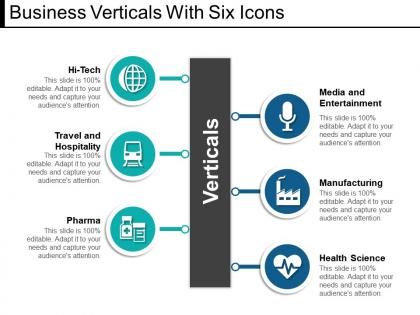
Business verticals with six icons




Try Before you Buy Download Free Sample Product
 Impress Your
 Audience
 100%
100% Editable
 Save Hours
 of Time


Identify discrimination with our Business Verticals With Six Icons. Ensure everyone is assured equal access.
People who downloaded this PowerPoint presentation also viewed the following :
Business verticals with six icons with all 5 slides:
Get ahead in the battle with our Business Verticals With Six Icons. Gain good ground with your effort.




FAQs for Business verticals
So a business vertical is when you focus on one specific industry - like healthcare, finance, whatever. You're selling to companies in just that sector because they have weird specialized needs and regulations. Horizontal is the flip side where you sell the same thing to everyone. Email software works for literally any business, but vertical stuff is custom-built for one industry's particular headaches. Honestly, I'd pick your lane early because your whole pricing and marketing approach changes depending on whether you're going deep in one area or trying to be everything to everyone. Way easier to nail messaging when you know your target.
Honestly, knowing your business verticals is a game changer for marketing. You can ditch the boring generic stuff and actually talk to people's real problems. Take cybersecurity - you'd push compliance to healthcare folks but focus on speed for gaming companies, right? Each industry has its own buying patterns and preferred channels too. I'd start by picking your top 3 verticals and writing down what keeps them up at night. Sounds like extra work but your conversion rates will definitely improve. Worth the effort imo.
Healthcare, finance, retail, and tech are the big ones you see constantly. Manufacturing and real estate are huge too. Energy/utilities have crazy money but you don't notice them as much. Oh and government contracts? That's where the real money is - wild how much they spend. Education's massive too. Thing is, each one's totally different. Healthcare has insane compliance stuff, finance moves slow, tech wants everything yesterday. Don't try to target everyone - you'll go nuts. Pick like 2-3 and actually learn their problems. Way better than spreading yourself thin across every industry.
Look at what your team's actually good at first - what problems can you guys solve better than anyone else? Check out market size and competition from there. Most startups get way too in their heads about this stuff and never actually start anything. Go for verticals where you can easily chat with potential customers and test if people actually want what you're building. Sure, healthcare's massive, but good luck with customer development if you don't know a single person in that world. Pick somewhere you've got connections or at least understand the space, even if it seems smaller at first.
Honestly, the toughest part is your market's just tiny. Losing one client? That really stings when you don't have hundreds of others. Finding people who actually get your industry is a nightmare too - I swear, most of the time you're stuck training someone from zero because there's literally nobody with the right background. But here's the thing: once you're established, competition stays pretty light. New players can't just waltz in easily. My advice? Don't try expanding everywhere at once. Really nail being the go-to expert in your specific niche first.
Dude, every industry's getting hit by new tech right now. AI's taking over finance stuff, IoT is completely changing how manufacturing works, blockchain's messing with supply chains everywhere. It's honestly crazy how quick this is all happening. The thing is, these aren't just making old processes better - they're creating totally new ways to make money. Companies jumping in early usually crush it while the slow ones get left in the dust (kinda harsh but true). I'd start by figuring out which tech could fix your biggest headaches first.
Look, customer segmentation is absolutely key here - you can't just wing it when picking verticals. Pull your customer data and map it against industry codes to see where your revenue actually clusters. Patterns will jump out showing you which industries, company sizes, and use cases are already working. I've watched way too many companies just throw darts at a board instead of doing this first. Once you spot those patterns, you'll understand each vertical's specific pain points. Then you can actually tailor your messaging and sales approach instead of using some generic pitch. Honestly, this step saves you from chasing dead-end markets that look shiny but won't convert.
Yeah totally! Amazon crushed e-commerce, Salesforce owns the CRM space, Netflix murdered Blockbuster (honestly felt bad for those employees). Epic Systems runs like half the hospital software out there, and Zoom became everyone's lifeline during lockdown - though I'm so over video calls now. These companies won by going super deep in one area instead of spreading themselves thin. They actually understood what frustrated their customers and built something way better than the competition. That's really the whole game - pick your lane and dominate it completely.
Dude, regulatory changes can totally flip entire industries upside down. Companies have to scramble and change everything - operations, costs, strategy - basically overnight. Look at healthcare when HIPAA gets updated, or fintech dealing with new banking rules. Environmental standards hit energy companies hard too. Some businesses thrive because they adapt fast and get ahead of competitors. Others? They get crushed by compliance costs. I'd honestly keep an eye on what's coming down the pipeline in your industry - maybe build some flexibility into how you operate so you're not scrambling when new rules drop.
So basically, vertical integration means you control everything from start to finish instead of outsourcing to random vendors. Pretty clutch for niche industries where you can't afford screwups. Like, you're handling raw materials, production, delivery - the whole nine yards. Sure, it's more complex to manage, but you'll cut costs and react faster when the market shifts. Plus nobody understands your customers like you do, right? Just make sure you actually have the bandwidth to run all those operations without burning out your team.
Global trends trickle down and mess with how local businesses work, honestly. Remote work blew up everywhere, right? Suddenly your local real estate market had to scramble, retail spaces got completely reimagined, and restaurants doubled down on delivery. Climate stuff is huge too - it's pushing local manufacturing and shops to change how they do things. You can't really ignore these macro shifts, even if you're just serving people in your area. I'd watch 2-3 big trends in your industry and think through how they might actually play out locally. It's wild how connected everything is now.
Honestly, start with the basics - revenue growth, customer acquisition cost, and lifetime value for each vertical. Market share is massive though, tells you if you're actually crushing it or just getting lucky with timing. I'd track customer retention and average deal size too since they show how solid your relationships really are. Profit margins can't be ignored either, some industries are just way more expensive to serve. Oh and competitive win rates plus sales cycle length are clutch. Pick maybe 3-5 metrics that actually connect to your strategy and check them monthly. Don't overthink it.
Honestly, cross-vertical stuff works because people from different departments see problems totally differently. Your retail folks chat with manufacturing? Boom - customer feedback suddenly improves product design. Finance and marketing meetings get messy but they're usually worth it. You stop doing the same work twice and actually share resources instead of hoarding them. Don't just hope teams will randomly connect though - that never happens. Set up quarterly sessions where different groups tackle specific problems together. Way more effective than keeping everyone in their own bubbles.
Honestly, start by figuring out what you already have that works across different industries - your customer data, systems, whatever core skills transfer over. Then dig into market research to see where there's actual demand that matches your strengths. Test small first though! My buddy's company went all-in on a pivot and it was brutal. Get some partners or hire people who know that space inside out - they'll save you from expensive screw-ups. Most critical part: don't ghost your current customers during this. Be upfront about what you're doing. Run a pilot to prove there's real demand before you bet the farm on it.
Honestly, customer wants are what shape entire industries. Retail's a perfect example - people wanted convenience, so stores had to go from just physical locations to online plus in-store experiences. It's wild how fast that happened. Your customers start wanting something new? You've got two choices: change with them or watch competitors steal your market share. I mean, think about it - preferences create this pressure that forces businesses to completely rethink how they operate. If you're noticing shifts in what people expect from your industry, that's probably a sign bigger changes are coming.
-
Visually stunning presentation, love the content.
-
The Designed Graphic are very professional and classic.