


7 bullet points business ideas with icons




Try Before you Buy Download Free Sample Product
 Impress Your
 Audience
 100%
100% Editable
 Save Hours
 of Time


Our 7 Bullet Points Business Ideas With Icons conform to all the criteria. They fit easily into any bracket.
People who downloaded this PowerPoint presentation also viewed the following :
Content of this Powerpoint Presentation
Description:
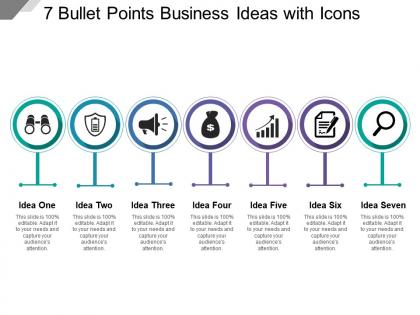
The image displays a PowerPoint slide titled "7 Bullet Points Business Ideas with Icons," which visually represents seven different business concepts or areas of focus, each accompanied by an icon. The icons include binoculars, a shield, a megaphone, a money bag, a growth chart, a document, and a magnifying glass, representing different business themes or areas such as vision and planning, protection and security, communication, finance, growth, documentation, and analysis or research. Each idea has a placeholder text, "This slide is 100% editable.
Use Cases:
This type of slide can be used across various industries to illustrate key concepts or strategic focuses:
1. Technology:
Use: Outlining new product development stages
Presenter: Technology Officer
Audience: Investors, Team Members
2. Finance:
Use: Describing financial services and investment strategies
Presenter: Financial Planner
Audience: Clients, Stakeholders
3. Healthcare:
Use: Presenting healthcare initiatives and compliance protocols
Presenter: Healthcare Administrator
Audience: Medical Staff, Regulatory Agencies
4. Marketing:
Use: Showcasing marketing campaigns and communication plans
Presenter: Marketing Director
Audience: Marketing Team, Sales Force
5. Real Estate:
Use: Detailing property investment opportunities and market research
Presenter: Real Estate Developer
Audience: Investors, Agents
6. Education:
Use: Illustrating educational programs and research focus areas
Presenter: Academic Dean
Audience: Faculty, Education Boards
7. Retail:
Use: Explaining retail management strategies and customer engagement methods
Presenter: Retail Manager
Audience: Store Managers, Staff
7 bullet points business ideas with icons with all 5 slides:
Our 7 Bullet Points Business Ideas With Icons have the background on everything. You will find all applicable facts.
FAQs for 7 bullet points business
Honestly, everyone's obsessed with sustainability right now - green tech is where the money's flowing. AI stuff is huge too, obviously. Remote work tools aren't going anywhere since companies realized people can actually work from their kitchen tables without the world ending. Personalization is another goldmine. People want their apps to know them better than their own mothers do. Health and wellness keeps growing too, which makes sense I guess. But here's the thing - whatever trend you pick, make sure you're genuinely into it. You'll be stuck with it for years, so don't just chase what looks profitable on paper.
Honestly, I'd start with AI tools that can dig through your customer feedback - they're surprisingly good at finding gaps you missed. Cloud platforms are perfect for testing new features without breaking the bank. Social media analytics will show you what people actually want (spoiler: it's usually not what we assume). Automation helps personalize stuff at scale, which is huge. Oh, and partnering with tech startups is smart - they get the innovation, you know the market. Just pick one tool first, see if it works, then build from there. Don't try to do everything at once or you'll go crazy.
Honestly, start by talking to people who'd actually buy this thing - their feedback beats any fancy business plan. Market demand is huge - are folks willing to pay for what you're selling? Check out your competition too and figure out what makes you different. The money stuff is boring but crucial: startup costs, when you'll break even, all that. I've watched friends skip this step and totally regret it. Also be real about whether you've got the skills and time for this. Oh, and connections help more than you'd think.
Honestly, you don't need to blow everything up to make more money. Start with your customer experience - can you gamify something or add those little surprise moments that make people smile? Your marketing probably sounds like every other boring company out there (most of it does, let's be real). Try weird partnerships with other businesses or bundle products in ways nobody expects. Even boring internal stuff can get a creative makeover. Pick one area this week and brainstorm three totally unconventional ideas. Sometimes the weirdest approaches work best.
Honestly, customer feedback is like your sanity check before you blow all your money on something nobody wants. I learned this the hard way once! You'll think you've nailed what people need, but we're usually way off. Their feedback shows you what features actually matter and which parts of your idea are total flops. Ask them specific stuff about their problems and how your thing would fit into their day. Don't wait until you've built everything - start with surveys, quick interviews, or just ask people casually. Way better than guessing and crossing your fingers.
Honestly, social media is a game-changer for startups. Test your ideas with quick polls, get instant feedback on products, and start building your community way before launch. It's ridiculously cheap compared to old-school marketing too. You can chat directly with potential customers and show off your brand's personality - my cousin found her co-founder through Twitter, which is wild. The trick is don't spread yourself thin across every platform. Pick maybe two where your people actually spend time and post regularly. Way better than trying to be everywhere at once.
Dude, talk to actual people first - like real phone calls or coffee meetings with potential customers. Boring but necessary. Build a simple landing page and see if anyone actually signs up or wants to pre-order. That tells you way more than your friends saying "cool idea!" Run some basic tests with a prototype if you can swing it. Social media polls are okay but people lie less when money's involved, you know? The whole point is figuring out if strangers will pay for this thing before you blow your savings on it. Skip the surveys honestly - just watch what people do, not what they say they'll do.
Start by looking at who's already buying from you - what do they have in common? Check out their demographics and what problems you're solving for them. I'd also peek at what competitors are doing, but honestly, don't get too caught up in that rabbit hole. The real trick is actually testing your ideas instead of just theorizing. Run some surveys or chat with potential customers directly. Most people skip this step and wonder why their marketing falls flat later. Once you've got a clear picture, focus on one specific group first. Way easier than trying to appeal to everyone at once, and you'll see results faster.
Honestly, there's tons you can do without much money upfront. Got any skills like writing or design? Freelancing just needs your laptop. Virtual assistant stuff is blowing up right now - everyone needs help with random tasks. Service businesses are where it's at though. Tutoring, dog walking, cleaning houses, yard work. You're basically trading time for money with minimal supplies. Dropshipping's an option too but man, everyone and their mom is doing it now. I'd start by writing down what you're actually good at, then pick something you could handle on weekends while keeping your real job. No point jumping in headfirst.
Dude, sustainability isn't optional anymore. Younger consumers especially will straight up avoid brands that don't care about the environment - and they'll actually pay more for the eco-friendly stuff. Pretty wild how much that's changed, right? It's driving major decisions in product design, supply chains, all of it. Companies ignoring this are missing out on serious revenue. My advice? Build sustainable practices into your business from the start instead of trying to add them later. Trust me, retrofitting is a nightmare and way more expensive.
Look at your numbers first - what's your customer feedback saying? Check your sales data and see what's actually trending. From there, you've got options: switch up your target audience, tweak product features, or maybe flip your whole business model (like going from product to service). Honestly, sometimes the best move is using what you already know to solve a totally different problem. Don't panic though - tons of huge companies pivoted like crazy before they figured it out. Just test whatever new direction you're thinking with a small group first. No point going all-in blind.
Honestly, partnerships can be a game-changer for your startup. You'll get access to their customer base, split marketing costs, and - this part's huge - someone else believing in your idea gives you serious validation when you're doubting yourself at 2am. Look for people whose skills fill your gaps. Like if you're creative but terrible with logistics (guilty), find an operations wizard. Don't just partner with anyone though. Their goals need to match yours or it'll get messy fast. Start by figuring out what you suck at, then hunt for people who crush those areas.
Don't go crazy with financial projections - honestly, investors have seen it all and can spot BS from a mile away. Keep it short too, like nobody's reading your 50-page novel. Always include competition analysis (saying you have zero competitors is basically admitting you didn't do homework). Focus on what problem you're actually solving instead of just listing cool features. Oh, and please don't say "everyone" is your target market - that's not a thing. I'd start with just a one-pager first. You can always expand the important stuff later once you know what people care about.
Honestly, data beats guessing every time - saves you from blowing money on dumb moves. Look at demographics to see if your target market actually exists. Test different prices with A/B experiments. Track which marketing channels work versus the ones that just eat your budget (spoiler: most social media ads are garbage for new businesses). Google Analytics is free and will show you customer patterns you'd never spot otherwise. My advice? Pick one big decision you're stuck on and find the cheapest way to get some real data first. Even basic surveys work.
Dude, networking is seriously everything when you're starting a business. Your connections become your customers, partners, maybe even investors down the line. I can't tell you how many brilliant ideas I've watched crash because the founder just stayed isolated. Getting feedback from people who've actually done this stuff before? Game changer. Plus warm intros work like 10x better than random LinkedIn spam - though honestly I still send those too sometimes. The key is building relationships before you desperately need favors. Start now while there's no pressure.
-
Excellent work done on template design and graphics.
-
Professional and unique presentations.