


Seven point infographic elements of a business plan




Try Before you Buy Download Free Sample Product
 Impress Your
 Audience
 100%
100% Editable
 Save Hours
 of Time


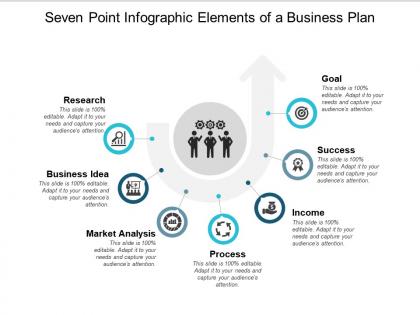
Business plan is the most crucial aspect of the business management as it ensures whether you are going to achieve or not. Our seven point elements of a business plan presentation infographic help you to work on an effective business strategy that can make an impact on the end user. When you plan to start a new business, there are some aspects that you need to consider if you want to achieve success. The seven points that are highlighted in this PowerPoint slide are research, business idea, market analysis, process, income, success and goal. These seven key points that are pillars of a successful business, you can share the information with your team managers, executives and other business associate to make them understand as how a business should be managed. Getting an effective presentation design is important to make your audience understand the message and this is what our designing experts have considered while working on this slide. Download this amazing PPT graphic to present your business. Be exact in your assessment of indications with our Seven Point Infographic Elements Of A Business Plan. It facilitates accurate interpretations.
People who downloaded this PowerPoint presentation also viewed the following :
Content of this Powerpoint Presentation
Description:
The image is a slide from a presentation, depicting the seven key elements of a business plan in an infographic format. Starting from the central hub which represents the process, the elements radiate outwards, suggesting a sequential or interconnected relationship among them.
1. The Research segment emphasizes the importance of tailoring the presentation to the audience's needs and capturing their attention.
2. The Business Idea section suggests the same level of customization, indicating that the strategic direction or proposition of the business should be clear and engaging.
3. In Market Analysis, there's a focus on providing an in-depth look at market trends, competition, and the target market.
4. Process indicates the operational aspects, workflows, or methodologies that the business will employ.
5. Goal implies setting strategic objectives that are tailored to the audience's understanding.
6. Success denotes the outcome metrics or success indicators relevant to the business idea.
7. Lastly, Income likely refers to the financial objectives, revenue models, or profitability targets of the business.
Use Cases:
Here are seven industries where such a slide could be particularly relevant and the potential use cases for each:
1. Technology:
Use: To articulate a new software development plan
Presenter: CTO or Product Manager
Audience: Stakeholders or investors
2. Healthcare:
Use: Presenting a healthcare facility expansion strategy
Presenter: Healthcare Administrator
Audience: Board members
3. Retail:
Use: Showcasing a retail chain's rollout of new stores
Presenter: Retail Operations Manager
Audience: Business partners or franchisees
4. Education:
Use: Outlining a new educational program or curriculum
Presenter: Academic Dean or Program Coordinator
Audience: Educational staff and curriculum committee
5. Financial Services:
Use: Explaining a new investment product or financial service
Presenter: Financial Advisor or Product Developer
Audience: Potential clients or investors
6. Manufacturing:
Use: Launching a new product line or manufacturing process improvement
Presenter: Operations Manager or Product Engineer
Audience: Internal management team or external stakeholders
7. Food and Beverage:
Use: Introducing a strategy for a new restaurant concept or product line
Presenter: Entrepreneur or Food and Beverage Manager
Audience: Investors or business partners
Seven point infographic elements of a business plan with all 5 slides:
Factors causing ill fortune get addressed by our Seven Point Infographic Elements Of A Business Plan. It ensures the jinx disappears.

FAQs for Seven point infographic elements of
So you'll need seven main parts: executive summary, market analysis, competitive analysis, marketing strategy, operations plan, management team, and financial projections. The exec summary matters most - investors basically decide if they're gonna keep reading after that. For market analysis, actually prove people want your thing. So many founders just assume demand exists (spoiler: bad idea). Keep your financial projections grounded in reality, not fantasy land. Oh, and start with just one page to brain dump everything first. Way less overwhelming. Then flesh out each section once you've got the bones down.
Look, market analysis shows investors you're not just throwing darts at a wall. Do your research on customers, competitors, and trends - it'll save you from embarrassing surprises later (like finding out someone's already building your "genius" idea). The data makes your financial projections way more credible too, since they're grounded in reality instead of pure optimism. Honestly, I've seen too many people skip this step and regret it. You'll spot opportunities you didn't know existed. Threats too. So yeah, actually read those industry reports and talk to potential customers before you pitch anything.
Honestly, the financial plan is like your reality check - it proves your idea can actually make money instead of just burning through cash. You need revenue projections, expenses, cash flow, all that fun stuff. Investors always flip to this section first anyway (I mean, who doesn't want to see the numbers?). It forces you to think through what things actually cost and how long you'll take to turn a profit. Even brilliant ideas look pretty sketchy without solid financials backing them up. Start conservative with your estimates - you can always adjust up later, but being overly optimistic early on usually bites you.
Dude, you gotta totally switch up your business plan depending on who's reading it. Investors want the money stuff - projections, market size, how they'll make bank. Internal team needs the actual nuts and bolts of how things will work day-to-day. I've watched so many people crash and burn using identical presentations for everyone (honestly painful to witness). Keep investor versions tight and sexy, but your internal docs can be way more detailed with all the boring operational stuff. Oh, and don't recreate the whole thing each time - just swap out sections from a master version.
Honestly, write your exec summary last even though it goes first - sounds backwards but trust me on this. Start with your biggest hook - what problem you're solving and why people should care. Think elevator pitch but the person's finger is already on their floor button. Your solution, target market, and money projections need to be in there too. Don't load it up with industry buzzwords that make people's eyes roll. I see this mistake all the time. Keep it tight, skip the fluff, and end with exactly what you want from them.
Dude, yes - competitive analysis is huge, probably top 3 sections honestly. Investors want to see you actually know your market exists and isn't some fantasy land. Skipping it makes you look either clueless or lazy, both terrible. Here's the thing though - don't just make a boring list of competitors. Dig into their strengths and weaknesses. Show how you'll actually steal customers from them. Be real about the competition but nail your differentiators. I've seen so many pitches fall flat because founders pretend they have zero competition. That's just not how business works.
Okay so first thing - you need revenue projections split by each product line, then all your operating costs like salaries, rent, marketing stuff. Cash flow statements are huge too. Do at least 3 years of forecasts, but honestly the monthly breakdown for year one is where you'll catch any scary cash problems before they happen. Break-even analysis is non-negotiable since investors obsess over when you'll be profitable. Throw in your key ratios - gross margin, customer acquisition cost, lifetime value if it fits your business. Oh and document every assumption you make because someone's definitely gonna grill you on how you got those numbers!
Look, you definitely need a risk section that covers your biggest threats - market shifts, competition, supply chain stuff, funding issues. Be brutally honest because investors spot fake optimism instantly. Map out mitigation strategies for each risk. Show financial scenarios too - what happens if revenue tanks or costs explode? Here's the thing though: don't just dump a list of problems on them. Actually walk through your solutions and backup plans. The whole point is proving you're prepared without seeming paranoid. Focus on risks that could genuinely kill your business, not random what-ifs.
Honestly, your mission statement is like the backbone of your whole business plan. It's what tells investors, employees, and customers why you actually exist - not just what you sell. I always think of it as your company's "why" wrapped up in one solid sentence. When you're stuck making hard decisions later, you can look back at it for direction. Investors love seeing if your mission matches their values too. The cool thing is it makes everything else in your plan way more connected since it all flows from that main purpose. Just make sure it's specific enough to mean something but not so narrow you'll outgrow it in two years.
Okay so first thing - just explain how you actually make money. That's literally the whole point. Your value prop, who you're selling to, revenue streams, partnerships. Think of it like you're telling someone at a coffee shop what you do (but don't make it too casual obviously). Walk them through the customer journey - how people find you, buy from you, etc. Pricing and costs are huge too. Honestly, specifics matter way more than being vague. Include real numbers and timelines if you've got them. Someone should read it and actually get how your business works day-to-day, not just the big picture stuff.
For the marketing section, nail down your target audience first - demographics, what they care about, all that. Then map out how you'll actually reach them. Social media, partnerships, paid ads, whatever makes sense for your thing. Pricing strategy is massive too, don't skip that part. Show what sets you apart from competitors because honestly, every business thinks they're unique but investors want proof you've done your homework. Brand positioning should tie it all together. Just keep those projections realistic - nothing screams amateur like claiming you'll capture 50% market share in year one.
Honestly, visuals are a game-changer for business plans. Charts make financial stuff way clearer than blocks of numbers. Infographics work great for market data too. Don't go crazy with fancy graphics though - I've seen people make theirs look like a Vegas billboard, which is just... no. Clean fonts, consistent spacing, simple diagrams for your business model. The whole point is helping investors grasp complex info quickly. They're already buried in boring text documents, so yours will actually get read. Start with your key data points and ask yourself what would be easier to understand as a visual.
Honestly, most people get way too rosy with their numbers - like claiming they'll grab 5% market share without explaining how. Do your homework on the actual market first. Keep it short too, nobody wants to read a book. I've seen so many plans that are super vague or completely ignore competition (huge red flag). Start with your executive summary and make it killer - if you can't nail that in two pages, the rest probably sucks too. Oh and don't be one of those founders who thinks they have zero competitors, that's just delusional.
Look, I'd say quarterly at minimum, but honestly? Depends on your space. Tech moves crazy fast so maybe monthly makes more sense there. Major stuff should trigger updates too - new competitors popping up, funding changes, or when your numbers are way off from what you predicted. Don't get all precious about it like it's written in stone or something. The whole point is adapting as you go. I just set a calendar reminder to check the important metrics and assumptions. If something's not working, change it. That's literally the point of having a plan in the first place.
Dude, you NEED feedback on your business plan - it's like having someone check your blind spots. Get perspectives from potential customers, industry people, investors, maybe even your neighbor who knows nothing about your space (sometimes outsiders catch obvious stuff). I've watched too many founders fall in love with their own ideas and miss glaring problems. Don't get defensive when people poke holes in your financial projections or market assumptions. Write down what you keep hearing over and over. That's usually where you need to fix things before it actually matters.
No Reviews