


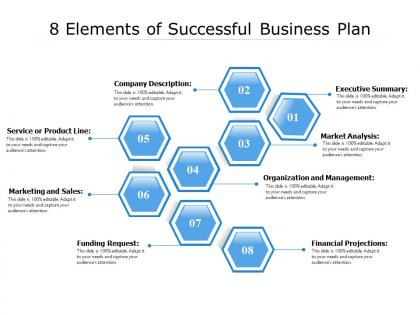
8 elements of successful business plan




Try Before you Buy Download Free Sample Product
 Impress Your
 Audience
 100%
100% Editable
 Save Hours
 of Time


Identify inflammatory attempts with our 8 Elements Of Successful Business Plan. Caution folks about giving in to anger.
People who downloaded this PowerPoint presentation also viewed the following :
8 elements of successful business plan with all 2 slides:
Caution folks about giving in to anger with our 8 Elements Of Successful Business Plan. Identify any inflammatory attempts.
FAQs for 8 elements of
Key components of a successful business plan include executive summary, market analysis, competitive landscape, financial projections, marketing strategy, operational framework, and management structure. These elements work together by providing investors and stakeholders with comprehensive insights into market opportunities, revenue potential, and growth strategies, with many organizations finding that well-structured plans significantly enhance funding success and strategic decision-making.
Market analysis enhances business plan effectiveness by providing data-driven insights into customer demographics, competitor strategies, industry trends, and market size projections. This comprehensive research enables entrepreneurs to make informed decisions about pricing, positioning, and resource allocation, while demonstrating to investors that strategic planning is grounded in realistic market conditions, ultimately delivering stronger competitive advantage.
The executive summary serves as the critical first impression that determines whether investors will read further, presenting your business concept, market opportunity, competitive advantages, financial projections, and funding requirements concisely. This strategic overview enables investors to quickly assess your venture's viability and growth potential, with many finding that a compelling executive summary significantly increases meeting requests and ultimately delivers the competitive advantage needed in today's increasingly crowded investment landscape.
Financial forecasts should include revenue projections, expense breakdowns, cash flow statements, profit and loss projections, and break-even analysis over three to five years. These components work together by demonstrating financial viability, supporting funding requests, and guiding strategic decisions, with many investors and lenders finding that detailed monthly projections for the first year, followed by quarterly or annual forecasts, ultimately deliver the credibility and planning framework essential for business success.
Developing compelling value propositions involves identifying unique customer pain points, quantifying specific benefits, conducting competitive differentiation analysis, and crafting clear messaging that resonates with target audiences. Through customer interviews, market research, and iterative testing, businesses can refine propositions that demonstrate measurable outcomes like cost savings or efficiency gains, ultimately delivering competitive advantage and stronger market positioning.
Business plans can be tailored by emphasizing different elements: financial projections and ROI for investors, operational strategies and market positioning for partners, and growth metrics and competitive advantages for stakeholders. Through strategic customization, organizations highlight relevant sections, adjust technical depth, and emphasize specific outcomes, with many finding that audience-focused presentations ultimately deliver stronger engagement and more successful funding or partnership negotiations.
Common business plan mistakes include unrealistic financial projections, insufficient market research, vague target audience definitions, weak competitive analysis, and overly optimistic timelines. These oversights undermine credibility with investors and stakeholders, with many entrepreneurs finding that thorough validation, conservative projections, and detailed implementation strategies ultimately deliver stronger funding opportunities and strategic clarity.
Effectively communicating your company's mission and vision requires clear, concise statements that connect purpose to market opportunity, defining what you do, why you exist, and where you're heading. These statements should align with your business model, target audience, and competitive strategy, while demonstrating how your vision translates into measurable goals, ultimately providing investors and stakeholders with compelling reasons to support your venture.
Legal considerations in a business plan include business structure selection, intellectual property protection, regulatory compliance requirements, employment law adherence, and liability management strategies. These elements safeguard operations by establishing proper corporate governance, securing patents and trademarks, and ensuring regulatory alignment, with many organizations finding that comprehensive legal planning ultimately delivers risk mitigation and competitive protection.
Competitive analysis strengthens business plans by identifying market gaps, revealing pricing strategies, and uncovering operational best practices that inform strategic positioning. Through comprehensive competitor research, businesses can differentiate their offerings, anticipate market trends, and develop more realistic financial projections, ultimately delivering competitive advantages and reducing investment risks for stakeholders.
A marketing plan establishes how businesses will reach target customers, differentiate from competitors, and generate revenue through strategic positioning, pricing strategies, and promotional activities. It provides the roadmap for customer acquisition and retention, ultimately determining market penetration success, with many organizations finding that comprehensive marketing planning directly correlates with faster growth and sustainable competitive advantage.
Business objectives are defined through specific, measurable goals with clear timelines, success metrics, and resource requirements that align with your overall strategy. Effective measurement involves tracking key performance indicators like revenue growth, market share expansion, and operational efficiency, with many organizations finding that quarterly reviews and milestone assessments ultimately deliver accountability and strategic focus.
An operational plan should include staffing requirements, production processes, supply chain management, quality control measures, technology infrastructure, and facility specifications. These elements work together to demonstrate how the business will deliver products or services efficiently, with many organizations finding that detailed operational planning streamlines execution, reduces costs, and enhances scalability while providing investors confidence in implementation capabilities.
Risk assessment integrates into business plans through market analysis, financial projections, operational contingencies, competitive landscape evaluation, and regulatory compliance frameworks. Strategic integration enables businesses to identify potential disruptions early, develop mitigation strategies, and allocate resources effectively, with many organizations finding that proactive risk management ultimately delivers stronger investor confidence and sustainable competitive advantage.
Best practices for updating business plans include conducting quarterly performance reviews, incorporating market changes and customer feedback, revising financial projections based on actual data, and adjusting strategic goals as the business evolves. These practices enable organizations to maintain relevance and accuracy, with many successful companies finding that regular updates enhance decision-making, improve investor confidence, and ultimately deliver better strategic alignment and competitive positioning.
No Reviews