


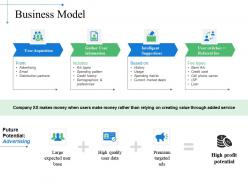
Business model ppt example





Try Before you Buy Download Free Sample Product
 Impress Your
 Audience
 100%
100% Editable
 Save Hours
 of Time


Appreciation grows with our Business Model Ppt Example. They generate a bigger applause.
People who downloaded this PowerPoint presentation also viewed the following :
Business model ppt example with all 5 slides:
Complete the change effectively with our Business Model Ppt Example. Inform folks on how to implement decisions.
FAQs for Business
Focus on your value prop first - what problem are you actually solving? Then cover your target market, revenue streams, and key partnerships. Honestly, investors eat up the financial stuff, so nail your cost structure and what makes you different from everyone else. Your go-to-market strategy is huge too because brilliant ideas die without customers, right? Keep each part short but punchy. Practice connecting the sections smoothly so it flows like a story instead of just rattling off a checklist.
Honestly, visuals are a game-changer for explaining business models. People just get it faster when they can see charts of your revenue streams or customer journey maps instead of listening to you ramble. Plus, let's be real - nobody remembers boring text slides anyway. Your brain holds onto visual stuff way better. I'd go with flowcharts for processes, maybe some infographics for your key numbers. Even rough sketches work if they show how different parts connect. Oh, and protip - anything beats those awful bullet-point-heavy presentations that put everyone to sleep.
Dude, biggest thing is knowing your audience first - like, what do they actually care about? So many people just dump info without that context. Don't make your slides a wall of text either, keep them visual. Practice your timing too because everyone rushes through the revenue stuff, which is honestly what investors want to hear most. Oh and never present numbers you can't back up with real data - they'll tear you apart. I learned that one the hard way lol. Run it by someone first to catch the confusing parts. You got this!
Start with someone relatable - like "Sarah deals with this annoying problem daily." Walk your audience through how your business fixes her issues step by step. Way more engaging than boring charts, trust me. Real examples work best, but even made-up scenarios are fine if they feel genuine. Your revenue streams become part of Sarah's journey instead of random business jargon. I've watched people actually pay attention when you do this vs. glazing over during typical presentations. Make each solution feel like a natural next chapter in her story.
Look, market research is what separates a legit business pitch from total BS. You need data backing up your claims about customers, competitors, and pricing – otherwise you're just throwing around hopeful guesses. Investors see right through that stuff. The research you dig up literally shapes everything: your value prop, who you're targeting, revenue forecasts, all of it. Shows you actually know what you're talking about too, which honestly matters more than people think. Figure out what data would make each part of your presentation stronger, then go hunt it down. Skip this step and you'll look like an amateur.
Look, investors want to see the money stuff that actually matters - revenue growth, how much it costs to get customers vs what they're worth long-term, and your margins. Unit economics are huge too (basically how much profit per customer). If you've got a subscription thing going, monthly recurring revenue is like catnip to investors. Show them your burn rate and when you'll be profitable. I'd honestly skip the fluffy metrics like Instagram followers - nobody cares. They want cold hard numbers that prove you can make money and not hemorrhage cash forever.
You gotta match what you're saying to what they actually want to hear. Investors? Hit them with market size, revenue forecasts, how big this thing can get - they're hunting for ROI and growth numbers. Clients care about their problems getting solved and what's in it for them specifically. I swear, so many people just recycle the same presentation for everyone and then act shocked when nobody bites. Your investor deck shouldn't be drowning clients in financial projections they don't need. And investors? They couldn't care less about every tiny feature you built. Before you even start building slides, figure out what decision you're trying to help them make.
Honestly, just go with PowerPoint or Google Slides - they're boring but they work and everyone gets it. Canva's actually pretty decent if you want it to look nice without paying a designer (their templates don't suck). Use the Business Model Canvas format since that's what investors are used to seeing. Oh, and if you're working with a team first, Miro or Mural are solid for the brainstorming phase. But seriously, don't overthink it. Focus on your story instead of getting caught up in fancy transitions and animations - nobody cares about that stuff anyway.
So make a competitive landscape slide that actually maps your competitors properly - not just random logos scattered around. Do a 2x2 matrix with price vs features or something similar. Show where everyone sits. Pick 2-3 things that make you different from each major player. Here's the thing though - frame it like your competitors prove there's a real market here, not like you're trying to trash them. I've seen too many founders go overboard with the competitor bashing and it backfires. End by showing the gap that only you can fill.
Hook them immediately with your problem and who you're solving it for. Walk through your solution, then hit business model and market size. Competition slide comes next, followed by financials. Honestly, demos are everything - screenshots beat walls of text every time. Your team slide should be short but show why you're the ones to pull this off. Close with exactly what you need from them. Oh, and definitely prep those backup slides because someone's gonna drill down into the weirdest details. Practice those transitions too - nothing kills momentum like awkward pauses between sections.
Dude, definitely sprinkle case studies throughout your pitch - makes everything way more believable. Find 2-3 examples that actually match your situation. Skip the tired Uber/Netflix stuff unless it really fits (seriously, investors are so over those). Hunt down some smaller success stories or even smart failures where you learned something useful. Each one should tie directly to part of your model. Oh, and always wrap up with "here's how this applies to us" - sounds obvious but people forget. Makes your whole thing feel less theoretical, you know?
Keep your charts super clean - bar graphs for revenue, line charts for trends over time. I've literally walked out of pitches where slides looked like Excel threw up everywhere, so don't do that. Show three scenarios: conservative, realistic, optimistic. Investors love seeing you've thought through different outcomes. Your monthly cash flow for the first 18 months? Non-negotiable. That's what actually keeps the lights on. Focus more on the assumptions driving your numbers than the final projections themselves. And yeah, be ready to defend every single calculation when they start grilling you afterward.
Honestly, just ask specific questions during your presentation instead of hoping people speak up later. Like "what worries you about our revenue model?" or throw in some polls if it's virtual. The follow-up survey thing is crucial - send it within 24 hours or people forget and you get crickets. I learned this the hard way. During Q&A, don't just answer and move on. Ask them back "what would make this more convincing?" Way better than the generic "any thoughts?" which gets you nowhere. Be specific about what feedback you actually want. Send that follow-up tomorrow, not next week when they've moved on.
Focus on three big things: ecosystem thinking, sustainability that actually makes money, and turning your data into cash. Don't just show a straight line from A to B—map out how you're connecting different players in a network or platform setup. ESG stuff isn't fluffy anymore, investors want to see it driving real revenue. Show how you're monetizing data through personalization or selling insights. Subscription models are still popular if they fit (though honestly, everyone's doing them now). The adaptability piece is huge too—how fast can you pivot when things go sideways?
Honestly, skip the whole "we're faster and cheaper" thing everyone says. What actually makes you different? Show real proof - customer stories, data nobody else has, something concrete. Most pitches are boring because they all use the same template from Google. Structure yours around the specific problem only you can solve. Demonstrate actual results people can see. Also, those giant market size slides? Skip them. Jump straight into why your model works and why competitors can't just copy it tomorrow. Make it defensible and show how you'll scale differently.
-
Very unique and reliable designs.
-
Best way of representation of the topic.