


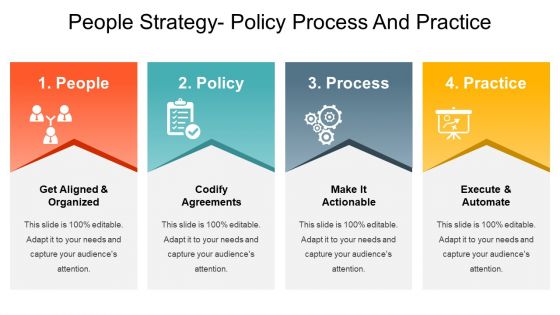
People strategy policy process and practice





Try Before you Buy Download Free Sample Product
 Impress Your
 Audience
 100%
100% Editable
 Save Hours
 of Time


Our People Strategy Policy Process And Practice aid digestion. Your advice will go down easier.
People who downloaded this PowerPoint presentation also viewed the following :
People strategy policy process and practice with all 5 slides:
Cut across differences with our People Strategy Policy Process And Practice. Create a basis for consensus to emerge.



FAQs for People strategy policy
You need four main things: talent acquisition/retention, performance management, learning and development, and succession planning. Most companies screw this up by keeping everything separate instead of connecting the pieces. Performance stuff is huge - do regular feedback, not just those awkward yearly reviews everyone hates. Also get clear career paths, solid compensation, and culture strategy sorted. Here's what I'd do: audit where you are now, find your biggest gaps first. Don't try fixing everything at once or you'll burn out your team. Pick one area and nail it, then move to the next. Way more realistic that way.
Honestly, skip the fancy mission statement BS and figure out what you're actually trying to accomplish. Get specific about your real goals first. Then hire for that. Want innovation? Find curious people who aren't afraid to mess up. Going for efficiency? Get the process nerds who love clear metrics. Every single thing you do with people should connect back to winning - otherwise you're just checking boxes. I see so many companies treat this like some separate HR thing when it should BE the business strategy. Make sense?
Dude, engagement is literally the make-or-break thing for your whole team strategy. Engaged people work harder, stay longer, and actually give a damn about results. They'll even recruit for you - which honestly saves you so much headache. But don't just do those annual surveys and think you're good. That's useless. You gotta check in regularly, listen to what's bugging them, and create real growth opportunities. I'd start with casual one-on-ones to see how people are really doing. Once everything clicks, the difference is night and day.
Dude, you're probably sitting on tons of employee data and not even realizing it. Start tracking stuff like engagement scores, which departments have people quitting, performance numbers - that kind of thing. The magic happens when you connect the dots between different metrics. Like maybe you'll discover that Sarah's team has way better retention than everyone else's, or that remote work actually makes your developers more productive (who would've thought, right?). Don't try to boil the ocean though. Pick one thing you actually care about and go from there.
Start with an audit of what you're doing now - pick one thing to fix this quarter. Post jobs on diverse boards and get diverse people on your interview panels. Employee resource groups are honestly where the magic happens for making people feel like they belong. Your leadership needs to set actual goals and track them, not just talk about diversity. Skip the one-off bias training - it needs to be ongoing or it's pretty useless. Oh, and this sounds obvious but actually listen when people tell you what's not working. I know someone who ignored employee feedback for months and then acted shocked when talented people left.
Look, your leadership style is basically everything when it comes to your people strategy. All those policies you roll out? They mean nothing if you're micromanaging while talking about trust. I've seen it backfire so many times. Transformational and servant leadership usually work best - people actually feel supported instead of managed. But here's the thing: just be consistent with whatever feels authentic to you. Don't try to be someone else. Start simple though. Ask your team how they're experiencing your current approach. Their feedback will tell you everything.
Honestly, you want a mix of hard numbers and the softer stuff that's harder to pin down. Track engagement scores, retention rates, and how many people you're promoting internally. Exit interviews are where you'll find the real tea about what's going wrong. Also look at development program participation and 360 feedback scores - oh, and diversity metrics if that's a priority. The trick is picking maybe 5-7 things that actually matter to your goals instead of drowning in data. I'd set up quarterly check-ins so you can pivot when something's not working.
Honestly, make it feel like a real conversation instead of just throwing info at them. Send welcome stuff before they even start - gets them excited and ready to go. Pair them with a buddy who can handle the random questions (seriously, knowing where the good coffee is matters). Don't just check in during week one and disappear - do it at 30, 60, 90 days too. Make sure they know exactly what's expected and introduce them to people outside their immediate team. Oh, and ask what they think about your whole process afterward. You'll probably learn something useful.
Look, continuous learning really is the foundation of good people management. Skills expire so damn fast these days - what worked five years ago probably doesn't cut it anymore. When you actually invest in your team's development, retention becomes way less of a headache because people stick around when they're growing. I'd start by just asking what skills they want to build. Then map that against where the business is going. Could be formal training, mentoring, or throwing them into stretch projects. The key is matching individual goals with company direction - otherwise you're just wasting everyone's time.
Honestly, start by figuring out what skills you're actually missing - like do a proper assessment first. Then focus on training your current people instead of hiring new ones (way cheaper and they already know your company). I'd also change how you recruit - look for people with potential rather than perfect candidates who tick every box. Cross-training helps too since knowledge gets spread around naturally. Oh, and don't wait until you're desperate. Try mapping out what skills you'll need in six months so you're not scrambling later when everything's on fire.
Honestly, tech can make work way less painful for your team. Start with the stuff that's driving everyone crazy - like onboarding or time-off requests. HR platforms automate all that paperwork nobody wants to deal with. Slack or Teams keeps communication flowing without endless email chains (which, let's be real, people hate). Learning systems let employees pick up new skills when they actually want to. The cool part? Analytics can flag engagement problems before people start jumping ship. Don't try to fix everything at once though. Pick your biggest headache and go from there.
Stop treating feedback like some optional bonus feature. Honestly, most companies are terrible at this - they do one awkward annual review and call it good. Instead, weave it into everything: performance cycles, manager evaluations, daily interactions. Train your leaders to actually give useful feedback (not just "good job!"). Multiple channels work better than formal sit-downs. Make psychological safety a real thing, not just a buzzword. Oh, and reward managers who create environments where people can be honest without getting their heads bitten off. Pick one process this quarter and start there.
Honestly, the hardest part is convincing leadership this stuff matters - they want hard numbers but people metrics are messy. Your managers will push back too because change is scary, even good change. Budget's always tight since HR initiatives feel "fluffy" next to other priorities. You've got to connect everything back to business results or executives won't care. Start with small pilot programs and track whatever you can - engagement surveys, turnover rates, productivity numbers. That data becomes gold when you need more money later. Oh, and retention metrics are usually your strongest argument since hiring costs are brutal right now.
Start with flexible frameworks instead of those rigid yearly plans that become useless in like 3 months. Do pulse surveys and stay interviews regularly - I swear most companies wait until people are already walking out the door. Build transferable skills in your team and keep those external networks warm for when you need them. Oh, and treat your people strategy like it actually matters - review it every quarter, not once and done. The modular approach is clutch because you can pivot when business needs shift. Most orgs think annual planning is enough but honestly? That's not realistic anymore.
Honestly, going remote flips everything upside down - you're managing results instead of butts in seats now. Your onboarding, culture stuff, performance reviews? All needs reworking. Communication has to be super intentional since you can't just bump into people by the coffee machine anymore (which I kinda miss, not gonna lie). The upside is you can hire talent from anywhere, but keeping people engaged when they're isolated is tough. You have to create those connection moments on purpose instead of them happening naturally. I'd start by looking at what you currently do and asking "does this really need to be in-person or are we just doing it because that's how we've always done it?"
-
Great quality product.
-
Excellent template with unique design.