

Key elements of people process product example of ppt




Try Before you Buy Download Free Sample Product
 Impress Your
 Audience
 100%
100% Editable
 Save Hours
 of Time


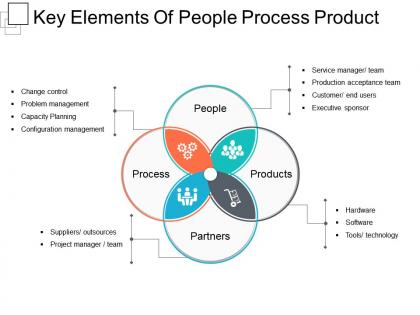
We assure you 100% success rate in your given task by using our key elements of people process product example of PPT. This flower shaped business slides have been designed by our business experts for business professionals like you who do not have time to sit and make the slides themselves. The use of high resolution and premium quality slides in making this 3 Ps PowerPoint presentation will raise the standard of your work. It is thereby assured that the use of this key elements of people, process and product PPT template will let you discuss business related processes like change control, problem management, capacity planning, configuration management, suppliers/ outsource, project manager, service manager, team, production acceptance team, customer, end users, executive sponsors, hardware, software, technology, etc. So if you are ready to take advantage of this beautifully designed deck of slides simply hit the download button, edit and present our key elements PPT presentation. Empower them to decide with our Key Elements Of People Process Product Example Of Ppt. They enable effective delegation.
People who downloaded this PowerPoint presentation also viewed the following :
Content of this Powerpoint Presentation
Description:
The image shows a Venn diagram that highlights the 'Key Elements of People Process Product', which are central to many business and project management methodologies. The diagram divides these elements into four main categories:
1. People:
Emphasizes the human element of business operations by listing factors such as Change control, Problem management, Capacity Planning, and Configuration management. These points suggest the importance of managing people with regards to change, addressing issues, ensuring resources are available to meet demands, and managing the systemic settings within which they work.
2. Process:
Includes elements such as Service manager/team, Production acceptance team, Customer/end users, and Executive sponsor. This area focuses on the workflow and the importance of having a team and leadership structure that can properly integrate production with customer demands, and have executives who sponsor and support the processes.
3. Products:
Considers the tangible and intangible output of business operations such as Hardware, Software, and Tools/technology. This highlights the need for quality, relevant, and up-to-date products, which are crucial to meeting customer requirements and staying competitive in the market.
4. Partners:
Focuses on individuals or groups outside the organization that have a stake in the business outcomes, incorporating Suppliers/outsources, and Project manager/team. This aspect stresses the significance of managing vendor relationships and the role of project managers who oversee the delivery of the business project components.
Use Cases:
Given the broad applicability of these elements, this slide can be used across various industries:
1. Information Technology:
Use: Explaining project and product lifecycle management
Presenter: IT Project Manager
Audience: Project Team Members
2. Manufacturing:
Use: Employee and process training seminars
Presenter: Operations Manager
Audience: Factory Employees and Supervisors
3. Healthcare:
Use: Discussing organizational changes or new system implementations
Presenter: Healthcare Administrator
Audience: Medical Staff and Department Heads
4. Education:
Use: Faculty development concerning curriculum and educational technology integration
Presenter: Dean or Academic Director
Audience: Teachers and Educational Staff
5. Retail:
Use: Strategy meetings for improving customer satisfaction and operational efficiency
Presenter: Retail Operations Director
Audience: Store Managers and Team Leaders
6. Consulting:
Use: Advising clients on business optimization and process improvement
Presenter: Senior Consultant
Audience: Client Management Team
7. Construction:
Use: Overseeing project delivery and supply chain management
Presenter: Construction Project Manager
Audience: Contractors, Engineers, and Architect Partners
Key elements of people process product example of ppt with all 5 slides:
Our Key Elements Of People Process Product Example Of Ppt exemplify unity in diversity. They provide many options to reach the same goal.
FAQs for Key elements of people process product
Honestly? Your team makes or breaks everything. I've watched brilliant products completely tank because the people building them had zero chemistry or just ignored what users actually wanted. Skills matter, but so does listening to feedback. Users decide if you're solving real problems or just building something cool that nobody needs. Even the smartest features won't save you if your team dynamics suck - learned that one the hard way at my last job. Hire people who get it and stay super close to your customers. That's literally it.
Honestly, good processes are like having everyone on the same page without needing to constantly check in. Your team stops wasting time in those "wait, what's happening?" meetings when they actually know who decides what and how work flows between people. I've watched entire sprints get blown because nobody understood the approval chain - it's painful to see. When workflows are clear, devs and designers can work at the same time instead of bumping into each other. Map out where your handoffs and decisions happen right now. I bet you'll immediately spot what's creating bottlenecks.
Competency matrices are honestly your best bet - super easy to see what skills people have vs what they need. 360 feedback is solid too since you get the full picture from everyone they work with. Performance reviews... eh, depends if your managers actually pay attention to what people do daily. For technical stuff, definitely do skills tests or ask for portfolios - way better than just talking about it. Oh and combine like 2-3 methods instead of picking just one. Makes the whole thing way more accurate. Just stay consistent across your team so you can actually spot where the gaps are.
Dude, feedback is literally how you figure out what users actually want vs what's just in your head. I've seen companies completely pivot from one angry email that exposed something they totally missed. Set up surveys, user interviews, support ticket reviews - the usual stuff. But here's the thing: don't let it just sit there collecting dust. You need a system to sort through it and actually do something with the insights. Otherwise you're just hoarding complaints lol. Use it to kill bad ideas early and prioritize the features people are screaming for.
Honestly? Culture and team dynamics will make or break your product - I've seen it happen so many times. When people feel safe to speak up and communicate clearly, you ship faster and build way better stuff. Everyone actually works together instead of hiding in their own little corners. But dysfunction and office politics? That's where everything falls apart. Features get delayed, quality tanks, and you end up with products nobody gives a damn about. How your team handles disagreements and feedback - that's your crystal ball for product success. Good culture means decisions happen quickly and feedback flows. Bad culture means... well, you're probably already feeling that pain.
Honestly, start with your people - figure out their actual skills and daily headaches first. Don't design processes that force them into weird boxes. I've watched so many teams do this backwards and then act shocked when nobody uses their stuff! Build features that fix the workflow problems you find. Check in with users regularly to see what's not clicking. When one thing changes, tweak the others too - everything's connected. Oh and definitely pilot with small groups before going big. Way less painful that way.
Honestly, investing in your team's leaders is a game changer. They'll spot problems early instead of letting them blow up later. People actually start speaking up about bugs when there's real psychological safety - which is huge because nobody wants to be the bearer of bad news, right? Your informal leaders get way sharper at prioritizing user needs over flashy features that don't matter. Decision-making improves across the board. Start with whoever people naturally turn to for advice and train them on giving feedback and making tough calls. The whole team dynamic shifts when leadership is distributed properly.
Oh man, there's so much stuff out there! ProductPlan and Roadmunk are solid for roadmaps, though honestly I just use Notion half the time. Jira's the classic for dev tracking - Linear's nicer but costs more. Figma's basically mandatory now for design handoffs. You'll want analytics too - Mixpanel or Amplitude will show you what users actually do vs what you think they do. Slack integrations save your sanity by cutting down on meetings. Don't go crazy though. Pick like 3-4 that work together instead of tool-hopping every month.
Honestly, first thing is figuring out what skills your team actually has versus what you need for this product vision. I've watched so many startups get pumped about these huge roadmaps then realize nobody can actually build the thing. Pretty painful to watch, tbh. Map out those gaps early - like really early. Then you've got three options: train your current people, hire specifically for what's missing, or maybe scale back the vision to match reality. The brutal honesty part sucks but it beats being stuck halfway through development wondering why nothing's working.
Track your velocity and cycle time for delivery stuff, plus team satisfaction and retention rates. Burnout sneaks up fast and absolutely destroys productivity. For processes, I'd measure lead time, defect rates, and sprint goal completion. People-wise - psychological safety scores, skill development, cross-team collaboration frequency. Honestly, fast delivery is worthless if everyone's miserable and quits. The trick is balancing output with team health indicators. Oh, and don't go crazy with metrics right away - start with 2-3 per area and expand from there.
Start with psychological safety - nobody's gonna innovate if they're terrified of messing up. Celebrate smart failures just as much as wins. Give people actual time to experiment (Google's 20% thing isn't just corporate fluff). Listen to ideas from everyone, not just the C-suite crowd. Cross-functional brainstorming helps too. Honestly, I've watched so many "innovation programs" crash and burn because leadership only backed safe bets. The trick? Make innovation feel like part of everyone's daily job instead of some special quarterly workshop thing. Otherwise you'll just get fancy PowerPoints and zero real change.
Ugh, this is such a real problem. Basically you're stuck between making things run smoothly and not treating people like robots. Your team will push back if processes feel too rigid - nobody wants to be micromanaged. Meanwhile leadership wants consistency and data they can actually measure. What's worked for me is building in those human touches within the streamlined stuff. Regular check-ins, feedback loops, explaining *why* certain steps matter instead of just demanding compliance. Honestly? Start by asking your team where they're most frustrated with current processes. Then redesign from there rather than forcing some top-down solution.
Honestly, cross-functional teams are a game changer for product development. You stop having that stupid back-and-forth between engineering, design, and marketing where everything gets lost in translation. When everyone's actually working together from the start, you catch problems way earlier instead of at the very end when it's expensive to fix. The best part? Your products end up solving real customer issues because you've got different perspectives baked in from day one. I'd just grab one person from each department for your next project and see what happens. Trust me, the difference is pretty obvious once you try it.
Honestly, if your design teams aren't training regularly, they're gonna fall behind fast. User needs change constantly, new tools drop all the time - I've watched whole teams become irrelevant because they stuck with old methods. Plus when everyone's learning the same new stuff, collaboration gets way smoother. The confidence boost alone is worth it. Maybe start with monthly skill sessions? Or bring in someone from outside to shake things up. Oh, and don't make it feel like homework - that's where most companies mess up.
Ugh, you know those awful moments where everyone's like "wait, I thought YOU were doing that"? Good communication kills those instantly. Daily standups help catch problems early instead of at crunch time. Your team actually aligns on what matters and stops building random features nobody wants. Changes happen constantly (honestly more than anyone admits), so keeping everyone updated prevents chaos. Short iterations, fewer bugs, products that solve real problems. Oh and make sure people feel safe calling out weird stuff - that's huge. Trust me, it's worth the extra meetings.
-
Unique design & color.
-
Wonderful templates design to use in business meetings.