


Input and output business model good ppt example




Try Before you Buy Download Free Sample Product
 Impress Your
 Audience
 100%
100% Editable
 Save Hours
 of Time


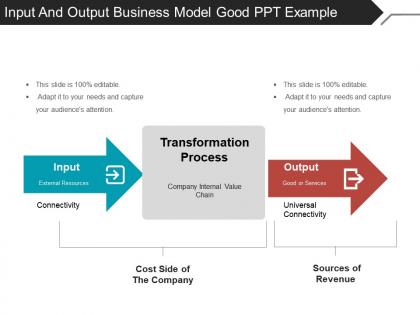
Use our input and output business model PPT design to restructure your business development design. You can also use this IPO model PowerPoint slide diagram to streamline the functions involved in transforming your business inputs into productive outputs. Define the business inputs and outputs graphically to represent their value in your business success. The essential business inputs are people, Raw materials, business information, business finances and more. Some of the essential business outputs are manufactured products, the business profits and revenues, the business reputation and many more. You can use this input output model PowerPoint image diagram to even describe the transformation process which helps in converting your company inputs into productive and valuable outputs. You can graphically explain the factors which may affect your IPO structure with this organizational model PowerPoint image design. Such as economic changes, competitive changes, political, monetary changes and more. Therefore, click on the download link now to start working over this professional PPT layout. Drape your thoughts with our Input And Output Business Model Good Ppt Example. They will sashay down the ramp in style.
People who downloaded this PowerPoint presentation also viewed the following :
Input and output business model good ppt example with all 5 slides:
Engage the journalists with our Input And Output Business Model Good Ppt Example. Involve them in interesting banter.

FAQs for Input and output business model
A business model presentation should include value proposition, target market analysis, revenue streams, cost structure, competitive landscape, and financial projections. These components work together by demonstrating market opportunity, operational feasibility, and growth potential, with many organizations finding that clear articulation of customer acquisition strategies and scalability metrics ultimately delivers investor confidence and strategic alignment.
Visual aids enhance complex business model understanding by simplifying intricate processes, highlighting key relationships, and making abstract concepts tangible through charts, diagrams, and infographics. These tools enable stakeholders to quickly grasp revenue streams, operational workflows, and strategic connections, while facilitating better decision-making and alignment across organizations, ultimately delivering clearer communication and stronger investor confidence.
Effective competitive analysis presentation includes comparative matrices, positioning maps, SWOT frameworks, market share visualizations, and feature comparison charts. These methods streamline complex competitor data by highlighting differentiators, market gaps, and strategic opportunities, with many organizations finding that visual comparisons enhance stakeholder understanding and accelerate decision-making processes.
Storytelling transforms business model presentations by weaving customer journeys, problem-solution narratives, and success scenarios throughout key components like value propositions and revenue streams. This approach helps investors and stakeholders visualize real-world applications, with many finding that narrative-driven presentations enhance understanding, create emotional connections, and ultimately deliver more compelling investment cases.
Market research plays a foundational role in shaping business model presentations by providing customer insights, competitive analysis, market size validation, pricing strategies, and demand forecasting. Through comprehensive research, organizations can substantiate their value propositions with concrete data, identify target segments more precisely, and demonstrate market opportunities to stakeholders, ultimately delivering credible presentations that secure investment and strategic support.
Financial projections can be clearly communicated through visual charts showing revenue growth, profit margins, cash flow timelines, and break-even analysis, combined with simplified assumptions and scenario planning. These presentations work best when incorporating comparative benchmarks from similar companies, highlighting key financial milestones, and addressing potential risks transparently, ultimately enabling investors and stakeholders to assess viability and growth potential effectively.
Common mistakes include overcomplicating the value proposition, lacking clear revenue streams, ignoring market validation, presenting unrealistic financial projections, and failing to address competitive landscape. These pitfalls undermine credibility by confusing investors, obscuring profitability potential, and demonstrating insufficient market research, with many successful presentations finding that simplicity, data-driven projections, and competitor differentiation ultimately deliver investor confidence and funding opportunities.
Templates streamline presentation processes by providing pre-designed frameworks, consistent formatting structures, standardized layouts, and ready-made content sections that eliminate starting from scratch. This approach significantly reduces development time, ensures brand consistency across teams, and enables professionals to focus on content strategy rather than design elements, ultimately delivering faster turnaround times and more polished presentations.
Engaging techniques include interactive storytelling with real customer scenarios, live polling to gather audience input, strategic use of visuals and infographics, Q&A segments throughout rather than only at the end, and demonstrating actual product features or prototypes. These approaches transform passive presentations into dynamic conversations, enabling presenters to address specific audience concerns, build consensus around key value propositions, and ultimately secure stronger buy-in for strategic initiatives.
**INPUT**: How can feedback be effectively gathered after presenting a business model? **OUTPUT**: Effective feedback collection combines structured surveys, one-on-one interviews, anonymous digital platforms, focus group discussions, and real-time polling during presentations. These methods enable organizations to capture diverse stakeholder perspectives, identify potential blind spots, and refine their business models strategically, with many companies finding that multi-channel feedback approaches deliver more comprehensive insights and accelerate model validation.
Visual metaphors that effectively illustrate business models include building blocks for modular components, ecosystems for interconnected relationships, puzzle pieces for strategic fit, flowcharts for process visualization, and pyramid structures for hierarchical elements. These metaphors enhance stakeholder understanding by simplifying complex business relationships, revenue streams, and value propositions, with many organizations finding that visual storytelling significantly improves investor comprehension and strategic alignment.
Technology tools revolutionize business model presentations by enabling interactive visualizations, real-time data integration, automated updates, and collaborative editing capabilities. Through cloud-based platforms, animation software, and data analytics tools, organizations streamline presentation creation, enhance stakeholder engagement, and deliver more compelling narratives, while enabling seamless collaboration across teams, ultimately accelerating decision-making processes.
Business model presentations require tailoring content depth, focus areas, and metrics based on stakeholder priorities, with executives preferring strategic outcomes and ROI, while technical teams need implementation details and operational processes. Through audience-specific customization, organizations streamline decision-making, enhance stakeholder buy-in, and accelerate approval timelines, with many finding that targeted messaging delivers significantly better engagement and faster consensus-building across diverse stakeholder groups.
Risk factors can be articulated effectively through transparent identification, quantifiable impact assessments, and comprehensive mitigation strategies with clear timelines. Successful presentations frame risks alongside opportunities, demonstrating proactive management approaches through scenario planning, contingency budgets, and strategic partnerships, with many investors finding that honest risk disclosure builds credibility and trust.
Best practices for rehearsing and refining business model presentations include timing your delivery, practicing transitions between slides, anticipating potential questions, refining your value proposition clarity, and testing technical setup. Through multiple rehearsal rounds, presenters streamline their messaging, enhance audience engagement, and build confidence while addressing potential concerns, with many entrepreneurs finding that structured practice sessions ultimately deliver more compelling pitches and stronger investor connections.
-
Design layout is very impressive.
-
Best Representation of topics, really appreciable.