


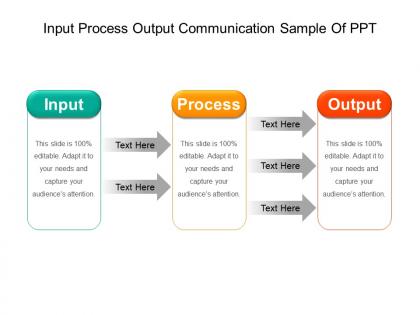
Input process output communication sample of ppt




Try Before you Buy Download Free Sample Product
 Impress Your
 Audience
 100%
100% Editable
 Save Hours
 of Time


Handle attempts to instigate dissent with our Input Process Output Communication Sample Of Ppt. Counter any irksome interference.
People who downloaded this PowerPoint presentation also viewed the following :
Input process output communication sample of ppt with all 5 slides:
Ensure the equation becomes easy to fathom with our Input Process Output Communication Sample Of Ppt. It helps explain complex formulas.

FAQs for Input process output communication
So there are like 5 main parts to communication - sender, message, channel, receiver, and feedback. Basically you encode your thoughts into words, send them through whatever method (text, call, in person), then they decode what you meant. Hopefully they give you some feedback so you know they got it. Oh and there's always noise screwing things up - actual sounds, distractions, or just your own assumptions getting in the way. Honestly, when conversations go sideways I just think through each step to figure out where it broke down. Usually helps me spot the problem.
So basically, the sender starts the whole thing - they're turning their ideas into actual words or signals that can get sent somewhere. The receiver does the opposite, taking those signals and figuring out what they mean. Pretty simple concept, but honestly it's more helpful than you'd think. Since it breaks communication into these clear steps, you can actually pinpoint where things go wrong. Like if someone's not getting your point, maybe you explained it weird, or the message got garbled somehow, or they're just not interpreting it right. It's like having a roadmap for when conversations fall apart.
So feedback and noise are huge for communication. You need feedback to know if people actually get what you're saying - or if they're just nodding along confused. It's like texting someone and never getting a response, super frustrating. Noise is all the stuff that messes up your message. Could be actual noise, bad timing, or someone's having a terrible day and can't focus. I always try to check if people understood me, especially with important stuff. Oh and figuring out what's getting in the way helps too - then you can work around it.
Context is huge for communication tbh. Your environment, who you're talking to, cultural stuff - all of it changes how people receive your message. You wouldn't text your boss the same way you'd text me, obviously. Different situations need different approaches and channels. Plus timing matters way more than people think. Physical space, relationship dynamics, even what kind of day someone's having can create "noise" that messes with your message. I always try to think through these factors before important conversations. Saves me from those cringey moments where something lands totally wrong, you know?
So basically linear models are like old TV broadcasts - just one direction from sender to receiver. Interactive models actually include feedback though, which makes way more sense tbh. Like, linear communication is you sending a message and crossing your fingers it worked. Interactive recognizes people respond back, creating this whole cycle of back-and-forth. Way messier but honestly more realistic. Most workplace stuff involves responses anyway. Build in time for questions instead of just info-dumping on people. Communication's cyclical, not some neat little sequence.
So basically, encoding is when you turn your thoughts into words or gestures or whatever. Then the other person decodes it - they interpret what you meant based on their own experiences. Problem is, what you encode and what they decode can be totally different things. That's literally how most fights start, honestly. Your brain thinks you're being clear but theirs is processing something completely different. So yeah, always double-check that they actually got what you meant. Don't just assume they're on the same page.
Oh man, cultural stuff totally changes how people communicate. Like in Japan, they pick up on tons of nonverbal cues and assume you share their context. Germans? They'll just tell you straight up what they mean. I found out the hard way on my first international project that some cultures won't give you direct feedback - everything goes through the hierarchy first. Even when someone says the exact same words, people decode it differently based on their background. You've got to read the room and adjust your style instead of assuming everyone thinks like you do.
Hey! So Berlo's SMCR model is actually super helpful for presentations. First, build up your credibility as the Source - know your stuff inside and out. Your Message should match your audience's level (skip the technical jargon with regular folks). Pick the right Channel too - sometimes a simple handout beats fancy slides. But honestly? The Receiver part is where most people totally mess up. I can't tell you how many boring presentations I've sat through because someone didn't bother figuring out what their audience actually cared about. Map out each piece beforehand and you'll catch problems early.
Okay so basically, when you understand how communication actually works, you can figure out where things go wrong with your team. Like when messages get completely twisted or lost? Usually it's because there's "noise" in the system, or people aren't giving feedback, or everyone's assuming they're on the same page (spoiler: they're not). Once you know about the whole sender-receiver-feedback thing, you'll start being more careful about how you word stuff and actually check if people got what you meant. Also watch for when someone's just too swamped to process what you're saying. Honestly, just asking "does this make sense?" way more often will cut down on so much confusion.
You want the transactional model for stuff that's genuinely back-and-forth - like face-to-face chats, video calls, or those chaotic Slack threads where everyone's jumping in. Perfect for negotiations, brainstorming, customer service calls. Basically anywhere you need real-time feedback and can't just blast out info one-way. It captures how people actually communicate at work (which is messier than textbooks suggest). Unlike linear models where someone just talks at you, this one shows the constant give-and-take. Use it when you're dealing with genuine dialogue situations.
Honestly, half the battle is just picking the right way to talk to someone - like don't text complicated stuff when you could just call, you know? Keep things simple and ditch the jargon unless you're sure they'll get it. Timing's everything too. Nobody processes important info well when they're already overwhelmed. I always ask "make sense?" or have people repeat back what they heard - saves so much confusion later. Oh, and obvious stuff like finding quiet spots and making sure your tech actually works. Really though, just double-check your message actually got through the way you meant it.
So basically, digital platforms completely change how we communicate - nobody's just sending OR receiving anymore. Everyone's doing both at the same time, which gets chaotic fast. You know how Slack threads turn into like three different conversations? That's exactly what I mean. Plus people can respond instantly or wait hours, and there's all this extra context with emojis and GIFs that didn't exist before. Oh, and threading makes everything even messier. The trick is writing messages that'll actually work in a back-and-forth conversation instead of just broadcasting into the void.
Honestly, your body language and tone matter WAY more than the actual words coming out of your mouth. Like when someone says "great job" but rolls their eyes? Yeah, you're getting the eye roll message, not the praise. Your facial expressions, how you stand, even awkward pauses - people read all of that stuff first. It's wild how much weight non-verbal cues carry. If your body language doesn't match what you're saying, people will believe what they see over what they hear every single time. That's just how our brains work.
Dude, crisis communication is basically like that telephone game but everything's on fire. You've gotta get that sender-receiver thing working FAST - clarity is everything because people are already freaking out. There's so much noise during a crisis - emotions running high, social media going nuts, everyone's got an opinion. Multiple channels help cut through the chaos. Set up those feedback loops immediately so you actually know if people get what you're saying. I learned this the hard way - never assume they understood you. Two-way communication teams are clutch here. Oh, and overcommunicate like crazy because normal rules don't apply when everything's falling apart.
Ugh, switching between different ways of communicating is honestly such a pain. You lose all the tone and body language stuff in emails. Video calls are great until someone's wifi decides to crap out mid-sentence. Text messages make you cut everything down so much that you end up sounding weirdly blunt sometimes. Phone calls work but you can't see if someone's confused or whatever. Then there's in-person meetings - some people just freeze up when they have to speak on the spot instead of writing their thoughts out. Oh, and don't get me started on response times. People blow up your phone if you don't text back immediately but totally ghost emails for weeks. Just match whatever you're saying to how complex it is and how that person likes to communicate.
-
Excellent design and quick turnaround.
-
Very well designed and informative templates.