

Information processing cycle input process output computer example of ppt





Try Before you Buy Download Free Sample Product
 Impress Your
Audience
 100%
Editable
 Save Hours
of Time


Be an entertaining joker with our Information Processing Cycle Input Process Output Computer Example Of Ppt. Allow folks to have fun at your expense.
People who downloaded this PowerPoint presentation also viewed the following :
Information processing cycle input process output computer example of ppt with all 5 slides:
Feel empowered to handle difficulties with our Information Processing Cycle Input Process Output Computer Example Of Ppt. They enable you to tackle hazards.
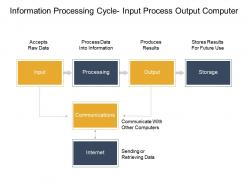


FAQs for Information processing cycle input process output computer
The information processing cycle includes input, processing, storage, output, and feedback stages. These stages streamline organizational decision-making by collecting raw data, transforming it into actionable insights, storing it for future reference, delivering results to stakeholders, and incorporating user responses, with many businesses finding that this systematic approach enhances operational efficiency and competitive advantage.
Data input involves collecting raw, unprocessed facts like customer transactions, sensor readings, or survey responses, while information output delivers processed, meaningful insights such as sales reports, trend analyses, or performance dashboards. Through systematic processing and analysis, organizations transform scattered data into actionable intelligence that enables strategic decision-making, operational improvements, and competitive advantage.
Storage serves as the critical foundation of the information processing cycle, enabling data persistence, accessibility, and continuity across business operations, systems, and time periods. Through strategic storage solutions, organizations streamline data retrieval, enhance operational efficiency, and maintain competitive advantage, with many financial services and healthcare institutions finding that robust storage capabilities ultimately deliver faster decision-making and improved customer experiences.
Feedback serves as a critical quality control mechanism that validates output accuracy, identifies processing errors, and enables continuous system improvement throughout the information processing cycle. Through real-time monitoring and analysis, organizations in sectors like banking and healthcare can refine their data processing workflows, enhance decision-making accuracy, and ultimately deliver more reliable services while maintaining competitive advantage.
Modern technologies enhance the information processing cycle by automating data collection through IoT sensors, accelerating processing with AI and machine learning algorithms, and enabling real-time analytics for faster decision-making. Through cloud computing and advanced databases, organizations streamline storage and retrieval while improving accuracy, with many financial institutions and healthcare systems finding these enhancements deliver significantly faster services and competitive advantages.
Errors during processing can significantly compromise data accuracy, leading to flawed analysis, incorrect business decisions, and reduced system reliability across operations. These disruptions cascade through organizations, affecting everything from financial reporting to customer service delivery, with many companies finding that processing errors ultimately undermine competitive advantage and operational efficiency.
Data validation occurs through multiple checkpoints including input verification, format consistency checks, range and logic validations, and cross-reference matching against established parameters. These systematic verification processes streamline accuracy by detecting errors early, ensuring data integrity throughout processing, and maintaining reliable outputs, with organizations across sectors like banking and healthcare finding that robust validation protocols significantly reduce processing errors while enhancing operational efficiency.
Common data collection methods in the information processing cycle include surveys, interviews, observations, sensors, web scraping, database queries, and transaction logs. These approaches enable organizations to gather structured and unstructured information from multiple sources, with many companies finding that combining automated collection with human insights delivers more comprehensive datasets for strategic decision-making.
The information processing cycle in AI involves data input through sensors or databases, processing via algorithms and machine learning models, storage in neural networks or memory systems, and output generation through predictions or decisions. AI systems like autonomous vehicles and fraud detection platforms leverage this cycle to continuously learn from new data, refine their algorithms, and deliver increasingly accurate results, ultimately enhancing operational efficiency and competitive advantage.
Real-time data processing transforms decision-making by enabling immediate responses to changing conditions, reducing delays in critical business operations, and providing instant visibility into performance metrics across organizations. This immediacy allows companies in sectors like financial trading, healthcare monitoring, and supply chain management to make informed decisions within seconds rather than hours, ultimately delivering competitive advantages and minimizing costly delays in increasingly fast-paced markets.
Different industries utilize the information processing cycle by adapting input, processing, output, and feedback stages to their specific operational needs, with healthcare processing patient data for diagnoses, manufacturing optimizing production workflows, and financial services analyzing transaction patterns. These sector-specific applications streamline decision-making, enhance operational efficiency, and deliver faster customer services, ultimately providing competitive advantages in increasingly data-driven business environments.
Essential security measures during the information processing cycle include data encryption, access controls, authentication protocols, backup systems, and audit trails. These safeguards protect information through input validation, secure processing environments, and controlled output distribution, with many organizations finding that layered security approaches significantly reduce cyber risks while maintaining operational efficiency and regulatory compliance.
Consider a bank's loan approval system: **input** involves collecting customer data through applications, **processing** includes credit score analysis and risk assessment algorithms, **storage** saves application details in secure databases, and **output** delivers approval decisions to customers. This cycle enables banks to streamline decision-making, reduce processing time from days to hours, and enhance customer experiences while maintaining regulatory compliance and operational efficiency.
The information processing cycle directly enables data analytics by providing the systematic framework of input, processing, storage, and output that transforms raw data into actionable insights. Through automated collection, advanced algorithms, and strategic analysis, organizations in finance, healthcare, and retail streamline decision-making processes, enhance predictive capabilities, and ultimately deliver faster business intelligence and competitive advantage.
Future trends influencing information processing cycle evolution include artificial intelligence integration, edge computing, quantum processing capabilities, real-time analytics, and automated decision-making systems. These technologies streamline data collection, enhance processing speeds, and deliver faster insights, with many organizations finding that strategic combinations ultimately enable competitive advantages through accelerated business intelligence and operational efficiency.
-
Design layout is very impressive.
-
Use of icon with content is very relateable, informative and appealing.