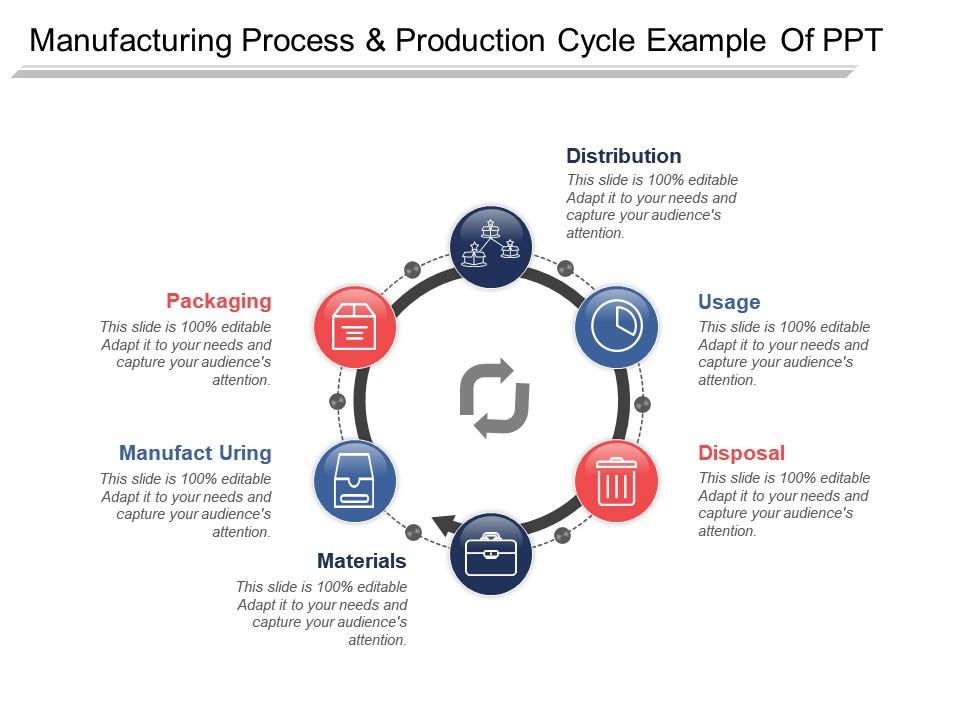
Manufacturing process and production cycle example of ppt

Rating:
100%
Manufacturing process and production cycle example of ppt
Slide 1 of 5

or

Favourites Favourites

Try Before you Buy Download Free Sample Product

Audience Impress Your
Audience
Editable 100%
Editable
Time Save Hours
of Time
The Biggest Sale is ending soon in
0
0
:
0
0
:
0
0
Rating:
100%
Presenting manufacturing process with producing extraction expansion printing and packaging production cycle presentation. The slide consists of high-definition graphics and icons. The slides are entirely editable and can easily be customized. As per your need, you can clip out any slide content of your choice and include it in another document as well. The template is compatible with PowerPoint, multiple software, and Google Slides. PPT is available in different aspect ratios as well. Alter the overall appearance of the presentation and save your time and efforts while drafting a visually stunning PPT.

FAQs for Manufacturing process and production cycle

So basically you've got five main steps: design/planning, getting your raw materials, actually making the stuff, checking quality, then shipping it out. Design phase is crucial - trust me, changing things later gets stupid expensive. Manufacturing floor is where everything comes together, obviously the most important part. After that, quality control saves your butt by catching problems before customers do. Then it's just packaging and getting orders out. Honestly though, you should sketch out your specific process first since every operation is different depending on what you're actually producing.

Honestly, automation is a game changer for manufacturing. Machines run all day without coffee breaks or sick days - which is pretty sweet for keeping things moving. You get way faster production and fewer mistakes since there's no human error involved. The quality stays consistent too, which customers love. Labor costs drop per unit, and you can ramp production up or down when demand changes. My advice? Look at whatever tasks eat up the most time and are super repetitive. Those are perfect spots to start automating.

So quality control is basically your safety net - catches problems before they blow up into expensive disasters. Set up checkpoints throughout production where you're testing materials and watching key metrics. Honestly, it feels like busy work until you avoid your first major recall. Build it right into your process from the start though, don't just tack it on later. Train your people to catch issues fast. I mean, the finished product inspections are obvious, but the real magic happens when you're monitoring stuff during production. Way cheaper to fix things early than deal with angry customers later.

So lean manufacturing is all about cutting out the "8 wastes" - overproduction, waiting around, too much inventory, pointless movement, that kind of stuff. Honestly, once you start looking for it, you'll see waste everywhere (kind of annoying actually). Map out one of your processes first and mark anything that feels stupid or redundant. The big question is always "does this actually help the customer?" If not, ditch it. Techniques like value stream mapping help you spot the problems. You'll notice better flow and quality pretty fast once you get going.

So batch production is like making cookies - you do one tray, then switch to maybe muffins for the next batch. Pretty flexible that way. Continuous production never stops though, like those oil refineries that just keep pumping out gas 24/7. Main thing is batch lets you change what you're making easily, but continuous is way more efficient if you're cranking out massive volumes. Once continuous gets going, it basically runs itself with way less people needed. Batch needs more babysitting honestly. Go batch for variety and smaller amounts, continuous if you're doing huge quantities of the same stuff.

Look, your supply chain basically makes or breaks your whole manufacturing game. Good supplier relationships mean your production lines actually run without constant headaches - no surprise stockouts or expensive rush orders screwing up your schedule. Bad supply chain? You're constantly putting out fires and bleeding money. Here's the thing though - it's not just about keeping stuff in stock. If your suppliers can't flex with demand changes, you're stuck too. Can't scale up when orders spike, can't dial back when things slow down. Honestly, I'd focus on nailing down solid supplier partnerships first, then work on decent demand forecasting. Makes everything way smoother.

Dude, manufacturing is getting crazy these days. IoT sensors are everywhere now, tracking everything in real-time. AI handles scheduling and actually predicts when machines will break down - pretty neat stuff. 3D printing can make almost anything (seriously, I saw them print a working engine part last week). Robots are doing way more complex jobs than before. Oh, and digital twins let companies test changes virtually first. The coolest part? You can catch problems before they mess up your whole production line. Way better than scrambling to fix things after they break.

Honestly, just pick one thing and start there - don't try to do everything at once. Energy stuff is usually the easiest win since you'll actually save money. Switch some lights to LED, maybe look into solar if that's realistic for you. Waste reduction is huge too - like, you'd be shocked how much companies throw away without thinking about it. Try to find suppliers who use recycled materials when you can. Oh, and if you use water in your process, see if you can recycle it somehow. The cost savings from energy alone usually pays for itself pretty quick, which makes the whole sustainability pitch way easier to sell internally.

Track OEE first - it rolls availability, performance, and quality into one metric so you're not juggling a million numbers. Cycle time and defect rates are obvious ones too. Throughput matters, obviously. First-pass yield tells you if you're getting it right the first time or constantly fixing stuff. I'd also watch downtime by category and cost per unit since that's where you'll actually see money walking out the door. Setup times too if you're switching between products a lot. Start simple with these basics before you get all fancy with dashboards and whatnot.

Look, good training seriously boosts your production quality and efficiency. Your workers make way fewer mistakes when they actually know what they're doing. Less downtime, fewer defects, better throughput - all that good stuff. Honestly, I can't stress enough how much trained employees are less likely to break your expensive equipment (trust me on this one). The money you spend upskilling pays off big time through less waste and faster cycle times. Oh, and your first-pass yields get way better too. Start with your biggest skill gaps first - that's where you'll see the most impact.

Oof, the money thing hits hardest - you're dropping serious cash on new gear and software. Plus your team will need training since most folks don't know IoT from a toaster. Honestly, the cybersecurity stuff keeps me up at night too. Once you connect everything, hackers have way more entry points than before. Oh, and good luck getting your ancient equipment to talk to modern systems - that's always fun. My advice? Pick one small area and test it out first. Don't go crazy trying to digitize everything at once.

Dude, don't skip prototyping - seriously. It catches all the dumb mistakes before you blow money on tooling. I've watched teams rush past this step and then hate their lives later when they find major flaws. You'll test if stuff actually works, figure out manufacturing headaches, and get real feedback while fixes are still cheap. Manufacturing is weird like that - problems always cost 10x more to solve later. Budget way more time for prototypes than feels right. Trust me, every hour you spend here saves you days of panic down the road.

Yeah, traditional manufacturing is pretty rough on the environment - crazy high energy use, toxic waste everywhere, and it just burns through resources way too fast. Factories are constantly pumping out CO2 and creating nasty byproducts that need special disposal. The whole "take-make-waste" thing is honestly broken at this point. Transportation emissions don't help either, moving all that stuff around. But there's hope! You can push for cleaner alternatives in your operations. Lean manufacturing works great. So does switching to renewable energy and better waste management. Oh, and circular economy principles - those are game changers.

Look, first thing - figure out your actual sales patterns and seasonal stuff so you're not just guessing. Set up automatic reorder points because who has time to babysit every product? ABC analysis is clutch here - focus way more attention on your expensive inventory items. Just-in-time ordering used to be the move, but honestly it's been a mess with all the supply chain weirdness lately. Get some decent inventory software that shows real-time numbers. Oh, and definitely start by checking what's already sitting in your warehouse doing nothing - you'd be surprised how much dead stock people forget about.

First thing - audit what you're doing now and figure out which machines would totally screw you if they went down. Set up a maintenance schedule based on manufacturer specs, but honestly, your actual usage matters more than their generic timelines. Train your operators to catch weird noises or vibrations early. Yeah, keeping detailed logs is boring as hell, but trust me when something breaks you'll be glad you did it. Stock spare parts for your critical stuff. Oh, and don't skip the basic cleaning and lubrication intervals - that's where most people mess up.

Ratings and Reviews

100% of 100
Review Form
Write a review
Most Relevant Reviews
  1. 100%

    by Cortez Graham

    Informative design.
  2. 100%

    by Harry Williams

    Great designs, really helpful.
  3. 100%

    by Douglas Lane

    Illustrative design with editable content. Exceptional value for money. Highly pleased with the product.
  4. 100%

    by Daniel Robinson

    Designs have enough space to add content.

4 Item(s)

per page: