

Manufacturing process model powerpoint template




Try Before you Buy Download Free Sample Product
 Impress Your
Audience
 100%
Editable
 Save Hours
of Time


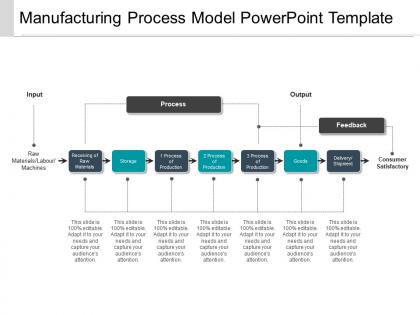
Modify presentation related to business processes with this manufacturing process template for PowerPoint. A user can display different types of processes, while still maintaining a cool retro appearance and feel of the manufacturing process model presentation slide. With the help of our professionally designed manufacturing process PPT slide, you can show the production process in a colorful as well as interactive way. The product manufacturing process template for PowerPoint incorporates five main processes such as conception, research, analysis, development, and launch and usually this is the common process concerned in production. A user can elaborate each process by using the product manufacturing model PPT slide design. The manufacturing process modelling PowerPoint template feature each phase by using differently colored flat vector box. Each box contains a text placeholder to give a name to the specific stage that occurs while implementation of process. This color coding helps the viewers to easily identify the processes as well as quickly understand the concept the user wishes to convey to them. Our professionals crafted this PowerPoint presentation template to make sure that the user can use the slides to its maximum potential. Go from concept to application with our Manufacturing Process Model Powerpoint Template. Dreams evolve into actual achievements.
People who downloaded this PowerPoint presentation also viewed the following :
Manufacturing process model powerpoint template with all 5 slides:
Get fit for inspection with our Manufacturing Process Model Powerpoint Template. Earn the appreciation of your bosses.


FAQs for Manufacturing process
So basically you've got five main stages to think about. First is design and planning - figure out what you're actually making and how. Then sourcing and procurement where you line up materials and suppliers. Production is where everything actually happens on the manufacturing floor (obviously the fun part). Quality control runs through everything but gets intense after production to catch problems. Distribution wraps it up by getting products to customers. Honestly, the real trick isn't nailing each stage perfectly - it's making sure they don't work in silos. You'll want to map out how info and materials flow between stages so everything connects smoothly.
Look, it really comes down to what you're making and how much. Batch processing is great when you need flexibility - like pharma companies switching between different drugs - but you'll get downtime between runs. Oil refineries go continuous because they're pumping out massive volumes of the same stuff 24/7. That's where continuous shines. Discrete manufacturing works for complex things like cars where each unit hits different stations. Honestly, the biggest mistake I see is trying to force the wrong model - like cramming a batch process into continuous mode. Just match your approach to your actual volume and variety needs.
Honestly, tech runs the whole show in manufacturing these days. IoT sensors grab data in real-time while AI figures out the best production schedules. Automation handles all the boring repetitive stuff - which is great because who wants to do that anyway? Digital twins are wild though, you can test changes virtually before touching anything. Cloud platforms tie it all together so your teams don't have to be in the same building to work together. Just don't get caught up in shiny new tech that doesn't actually fix your real problems.
Simulation tools are perfect for this - you can test different scenarios without touching your actual production line. Map out your current process first, then play around with variables like machine speeds, staffing, or even layout changes. It's honestly pretty cool how you can spot bottlenecks and waste patterns digitally before they bite you in real life. I'd definitely run simulations on any improvements you're considering to check the ROI. Way better than making expensive changes and hoping for the best. You'll save yourself headaches and money by catching problems early.
Honestly, your team's gonna push back hard on any changes - that's like 90% guaranteed. Integration with whatever systems you already have running will be a nightmare too. Budget way more time than you think, seriously. I learned this the hard way last year. Training takes forever because people need their hand held through everything. Quality dips while everyone's figuring things out, and your normal workflow gets completely messed up. Do a small test run first before you unleash it on everyone. Also, add at least 30% to whatever timeline you're thinking. Trust me on that one.
Honestly, lean principles are like decluttering your entire process - you keep only what actually adds value to customers. Map out your current workflow first, then spot all the waste (overproduction, waiting around, unnecessary transport, that kind of stuff). Your new model should focus on pull systems instead of batch processing. Build in quality checks as you go rather than catching problems later. The whole point is continuous flow - think assembly line but smarter. Oh, and definitely standardize the work steps that actually matter. It's way more effective than trying to fix a messy process afterward.
Pick 3 buckets: quality stuff (defect rates, first-pass yield), efficiency (cycle time, throughput), and costs (per-unit, waste). Most teams go crazy tracking like 20 metrics that look impressive but don't actually help. Stick to 5-7 max that connect to real business results. You'll want both leading indicators (setup time) and lagging ones (customer complaints). Honestly, I'd just grab one from each bucket that your team can control first. My old manager used to say dashboards are where good intentions go to die - he wasn't wrong. Build the habit, then add more.
Honestly, your supply chain is gonna mess with your manufacturing model constantly. Unreliable suppliers? You'll need buffer times built in. Material delays mean tweaking your production schedules and finding backup sources. Raw material prices are all over the place lately - totally screws up cost projections but what can you do. Different suppliers in different regions each have their own lead times and bottlenecks to worry about. The key is updating your process model based on what's actually happening, not some perfect-world scenario that doesn't exist.
Honestly, flowcharts are a lifesaver for this stuff - map out every input, process, and output visually. Document literally everything: raw materials, timing, equipment specs, quality checks, decision points. I can't tell you how many times I've seen processes crash because someone assumed a step was "obvious." Include what happens when things go wrong too. Oh, and version control is clutch so everyone stays on the same page. Here's the real test though - hand your documentation to someone who's never seen the process before. They'll spot the gaps you totally missed.
Dude, automation totally flips manufacturing on its head. You can't just think "step A, B, C" anymore - now everything's connected with feedback loops and machines making their own calls. Process maps become these living things that pull in sensor data and adjust routes based on what's actually happening. Honestly, the complexity jump is insane! Your models need to handle when stuff goes wrong and fix themselves. Instead of those old sequential chains, picture everything as one big interconnected web. That's where the magic happens.
Honestly, you can build sustainability into pretty much every step. Design phase? Pick recyclable materials and make stuff easy to take apart later. Production's where you'll see big wins - cut energy use, reduce waste (this part seriously saves money), conserve water. Supply chain matters too, though people forget about it. Source locally when you can and find suppliers who actually care about this stuff. Oh, and track your environmental impact with real metrics throughout. My advice? Don't try everything at once. Pick one area, see what happens, then expand. Way less overwhelming that way.
So basically, Industry 4.0 flips your whole manufacturing setup from these rigid, separate processes into one big connected system. IoT sensors and AI give you real-time monitoring everywhere - honestly, the visibility is crazy compared to what we had before. You can do predictive maintenance now, mass customization, all that stuff. Your process models have to handle continuous feedback loops and production lines that actually adapt on the spot when demand shifts. It's wild how autonomous some of this decision-making gets. I'd start by figuring out which processes would benefit most from getting real-time data flowing through them first.
Honestly, cross-functional teams are game-changers because everyone sees problems differently. Manufacturing spots bottlenecks that engineering misses. Quality catches stuff operations overlooks. You know how sometimes someone has a "brilliant" idea that totally screws over another department? That stops happening when everyone's actually talking to each other. The trick is giving these teams real power to fix things, not just write reports nobody reads. I'd start small though - pick your worst process headache and build a team specifically around that. Once people see it works, you can expand from there.
Training your team is huge - seriously can't stress this enough. The best process design means nothing if people don't know how to actually do it right. Your employees need to understand their roles and spot problems before they blow up. I'd honestly focus on hands-on sessions over boring PowerPoints any day. Quick reference guides help too, something they can grab when they're confused on the floor. Well-trained people will actually want the changes to work instead of fighting you every step. It's really the difference between success and watching everything fall apart.
Honestly, statistical process control is your best friend here - set up control charts to catch problems before they blow up. Your operators will spot issues way before the data does, so create good feedback loops with them. Kaizen events are surprisingly effective (and way less boring than they sound). When stuff breaks, have solid root cause analysis ready to go. Oh, and definitely integrate predictive maintenance if you can swing it. The trick is building improvement into your daily routine instead of just scrambling when everything's on fire. Makes life so much easier.
-
Perfect template with attractive color combination.
-
Professional and unique presentations.
-
Design layout is very impressive.
-
Graphics are very appealing to eyes.