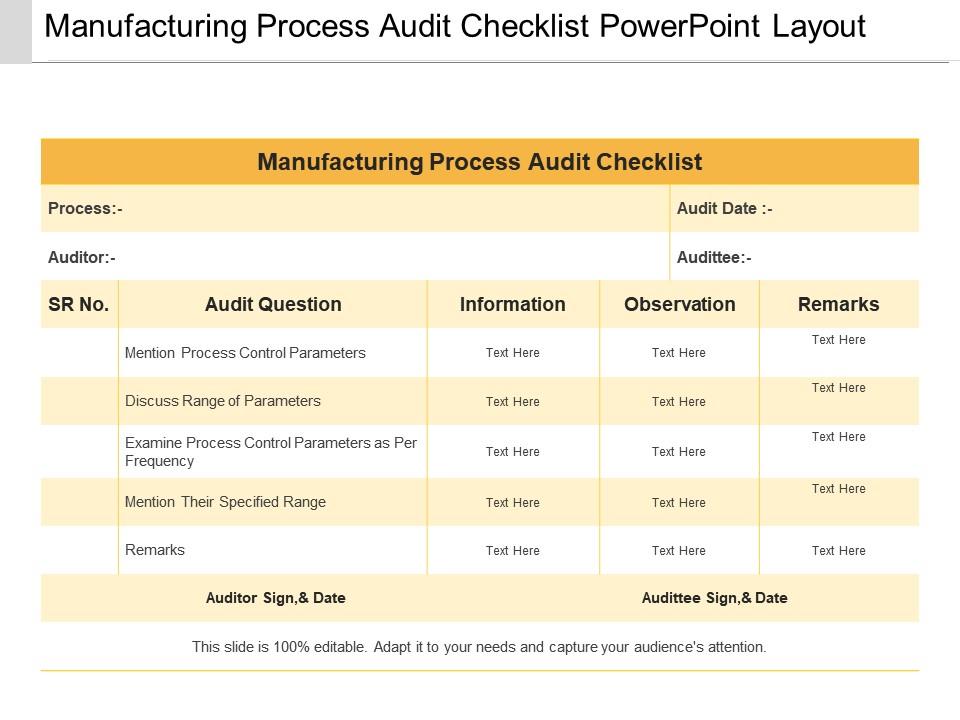
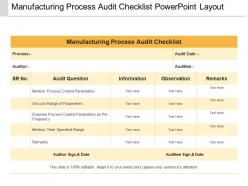
Manufacturing process audit checklist powerpoint layout

Rating:
95%
Manufacturing process audit checklist powerpoint layout
Slide 1 of 5
Favourites Favourites

Try Before you Buy Download Free Sample Product

Audience Impress Your
Audience
Editable 100%
Editable
Time Save Hours
of Time
The Biggest Sale is ending soon in
0
0
:
0
0
:
0
0
AI-Ready
Upload this template to AI and ask it to make any changes to content or color
100% editable Powerpoint Template for AI-assisted presentations. Finish your work in less time. ​
Works with
Microsoft PowerPoint
Microsoft 365
Claude for PowerPoint
ChatGPT
Google Slides
Microsoft Copilot
Rating:
95%
Presenting the manufacturing process audit checklist PowerPoint layout. Design allows full editing. Include business name, logo, and trademarks make the design more personalized and authentic. Easy and quick downloading available. Design is fully compatible with Google Slides and other online and offline software. Download and convert the design into JPEG and PDF formats. PPT fully supports both standard and widescreen views.

FAQs for Manufacturing process audit

Start by figuring out what you're actually auditing and why. Look through all their documentation first, then go watch what's really happening on the floor - that's honestly where you'll find the most interesting stuff. The gap between what's written down and reality is usually pretty wild. Talk to the operators and their supervisors about what bugs them daily. Check if they're hitting regulatory requirements and quality standards. Write down everything (good and bad), figure out why problems are happening, then make a priority list of fixes. Oh, and definitely do a wrap-up meeting with the team before you finish your report. They hate surprises.

So first figure out what you're actually trying to achieve - quality, efficiency, costs, delivery times, whatever matters most to your operation. Pick the metrics that directly impact those goals. Defect rates for quality, OEE for efficiency, stuff like that. Honestly, don't go overboard here - I've seen people track like 20 different things and then wonder why nothing improves. Stick to maybe 5-7 KPIs you can actually do something about. Each one needs a starting point, a target, and someone responsible for it. Then your audit just checks if you're consistently measuring this stuff and taking action when things go sideways.

Grab your SOPs and quality control records first - those are non-negotiable. Production logs and batch records matter too since they show what really went down vs what was supposed to happen. Equipment calibration certs, employee training docs, and safety stuff should be easy wins with auditors. Oh, and definitely pull your corrective action reports and supplier qualification paperwork. Change control records are smart to include because any process tweaks always raise eyebrows. Honestly, start collecting this stuff now instead of panicking later when they give you the actual date.

Dude, you've gotta try digital checklists on tablets - no more messy handwriting or lost paperwork. IoT sensors are where it gets really cool though, they just automatically track everything without you babysitting each measurement. My buddy's plant started with their longest audit checklist first and it cut their time in half. AI can spot problems brewing before they blow up too. Honestly the setup's annoying at first but once it's running? Total game changer. Real-time data beats scrambling around with clipboards any day.

Dude, start by comparing what's actually happening to what's written down - that's where most problems jump out. Missing signatures and outdated procedures are everywhere. Then check if people are actually following safety rules (spoiler: they're not, especially with PPE). Look for quality control stuff getting skipped, like inspections or equipment that hasn't been calibrated. Training records are gold for finding gaps too. Oh, and watch for materials just sitting around when they shouldn't be - that workflow thing gets messy fast. Honestly, just walk through and see what doesn't match the documentation.

Map your checklist straight to the standards you're dealing with - ISO 9001, AS9100 if you're in aerospace, whatever fits your industry. Each audit point needs to connect to a specific clause number. I always keep a standards matrix because who can remember all those numbers? Document with timestamps and photos for evidence. Your audit team should know the latest updates before they start - have those standard docs right there during audits. Oh, and don't just tick boxes. Actually verify you're measuring what the standard wants, not what's easiest to check.

Dude, employee interviews are where you get the real story during manufacturing audits. Documentation shows you one thing, but workers tell you what's actually going down on the floor. Talk to operators, supervisors, quality people - they'll spill about workarounds and problems that've been bugging them forever. Some of my best audit catches came straight from these chats, not from paperwork. Hit up different shifts too because day crew might have totally different issues than night shift. People love venting about broken processes once they trust you're not there to get them in trouble.

Check your defect rates, customer complaints, and rework costs first - see how they stack up against benchmarks or past performance. But honestly? The spreadsheets only tell half the story. Walk around and actually watch how people do quality checks versus what the manual says they should do. Are your inspection points catching problems early enough? Talk to both your quality team and production folks about what's driving them crazy. I always find the best intel comes from combining those hard numbers with what you see happening on the floor. That's where you'll spot the real gaps between theory and practice.

Hey! So for audit docs, be super specific about what you saw and exactly where/when. Skip the wishy-washy words like "sometimes." Photos are your best friend - they'll save you from so many headaches later when people try to argue. Don't just write down problems though. Good stuff matters too. I always use the same format so my team can actually find things quickly. Oh, and tie everything back to your actual standards or criteria. Makes your recs way more solid when you're presenting. Trust me on that one.

Honestly, I'd start with anything that's a safety risk or could cause major quality issues - that stuff has to be at the top. After that, look at your cost-benefit situation because quick wins that don't cost a fortune are your best friend. I like making a simple chart plotting how bad something is versus how easy it is to fix. The easy stuff with high impact? That's pure gold. Oh, and don't ignore regulatory requirements - those aren't negotiable anyway. Just make sure you've got the people and time to actually tackle your priorities, then assign clear owners with real deadlines.

So lean manufacturing actually makes audits way more focused - you're looking at stuff that creates real value instead of just ticking boxes. Instead of drowning in paperwork, you're checking for continuous improvement evidence and standardized work. 5S is clutch because problems jump out at you immediately. Your checklist should hit waste identification and value stream mapping - honestly, it's so much better than traditional audits. You'll be tracking flow and cycle times, doing actual root cause analysis. Way more effective at catching operational issues that matter. Oh, and visual management systems become a big part of what you're evaluating too.

Quarterly's probably your safest bet to start with. But honestly? It really comes down to how risky your stuff is and what regs you're dealing with. If you've got high-risk processes or just had quality problems, maybe go monthly. Stable operations can probably stretch to twice a year. I'd be careful going longer than that though - I've watched companies regret it. Medical device folks dealing with FDA obviously need way more frequent checks. Just pick quarterly for now and tweak it based on what comes up. Oh, and set those calendar reminders before you forget!

Honestly, you're gonna need both the technical side and audit skills. Get familiar with whatever processes you'll be checking - quality control, equipment stuff, safety rules. Then learn the audit basics like documentation and interviewing without being annoying about every little thing. Shadow some experienced auditors first though - that's where you really learn how to handle tricky situations. Most companies have internal programs, or you could go for something like the ASQ quality auditor cert. People skills matter just as much as knowing the technical stuff since you'll be working with production teams all day. Oh, and don't underestimate how much relationship-building affects your success.

Group your findings by how bad they are, then assign someone to fix each one with actual deadlines. Here's the thing though - look for patterns across different audits. That's where you'll catch the real problems instead of just random stuff going wrong. I've watched teams waste so much time fixing individual issues without stepping back to see what's really broken. Your data should tell you which processes are the biggest mess. Track if things actually improve over time. Regular check-ins help too, but honestly don't overthink it - just focus on what's actually making a difference.

Set up your follow-up system right when the audit ends - don't wait around. Monthly check-ins with department heads work pretty well for tracking corrective actions. I'd create a simple spreadsheet to see what's done versus what's still hanging out there. Here's the thing though - people always get distracted by their regular work afterward, so momentum dies fast. Give each action item a clear owner with actual deadlines that make sense. Oh, and don't just tick boxes when they say stuff's fixed. Do some quick spot checks or mini-audits to make sure things actually work.

Ratings and Reviews

95% of 100
Review Form
Write a review
Most Relevant Reviews
  1. 80%

    by Deon Warren

    Illustrative design with editable content. Exceptional value for money. Highly pleased with the product.
  2. 100%

    by Craig Moreno

    Great designs, really helpful.
  3. 100%

    by James Lee

    Use of different colors is good. It's simple and attractive.
  4. 100%

    by William Harris

    The Designed Graphic are very professional and classic.

4 Item(s)

per page: