


Manufacturing process development powerpoint template




Try Before you Buy Download Free Sample Product
 Impress Your
 Audience
 100%
100% Editable
 Save Hours
 of Time


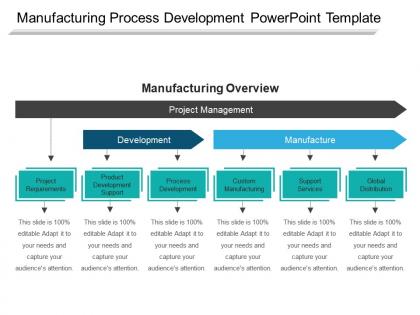
Use our Manufacturing Process Development PowerPoint Template as a guide for discussing the manufacturing process development in stages. Manufacturing process is a cycle by means of which an innovative firm routinely converts ideas into commercially viable goods or services. Therefore, we bring you this PPT which covers the manufacturing development stages. They are further subdivided in different stages like project requirements, development support, process development, customer manufacturing, support system etc. The PPT template helps to identify the processes quickly. The PowerPoint template ensures that the user can use the slides to their maximum potential. The presentation is ideally suited for manufacturing and production processes where the entire team on assembly line need to understand the manufacturing process in detail. The user may edit and revise the template and its PowerPoint objects to fit specific requirements. So, quickly download our powerful PowerPoint presentation to ease your burden. Build a foundation for harmonious co-existence with our Manufacturing Process Development Powerpoint Template. It helps fight intolerance.
People who downloaded this PowerPoint presentation also viewed the following :
Manufacturing process development powerpoint template with all 5 slides:
Our Manufacturing Process Development Powerpoint Template enable face to face engagement. Feel the effect your ideas are having.

FAQs for Manufacturing process
So basically you've got five main stages: concept development, process design, pilot testing, scale-up, then full implementation. Start by nailing down your product requirements and figuring out how you'll actually make the thing. Process design is next - honestly this is where most people screw up because they rush through the details. Pilot testing validates everything works small-scale. Scale-up optimizes for real production volumes. Then you implement and keep an eye on things. Quick tip though - seriously spend extra time in pilot testing. Way cheaper to find problems there than when you're already in full production mode.
Honestly, start with value stream mapping right from the beginning - don't wait until later. Figure out what actually matters to your customer first, then build everything around just those steps. When you map out each activity, you'll probably find tons of pointless stuff that somehow snuck in (happens every time). Instead of those marathon planning sessions, go with quick prototypes and fast feedback loops. Design everything with standardization in mind from the start. The trick is treating waste elimination like a core design rule, not something you fix after production kicks off. Makes such a difference.
So automation cuts out bottlenecks and those annoying human errors that slow everything down. Your cycle times get way faster, quality stays consistent, and you're not dealing with as much waste - machines don't have off days like we do, you know? Workers can actually do interesting stuff instead of mind-numbing repetitive tasks. Honestly, the trick is figuring out which processes give you the best bang for your buck. I'd start with whatever's eating up the most time or where mistakes happen constantly, then build from there.
So digital twins are pretty cool - you basically make a virtual copy of your production line that updates in real time with actual data. Run different scenarios without messing with your real equipment. Test changes, spot bottlenecks, optimize settings. No downtime or wasted materials while you figure stuff out. Plus you can catch equipment issues before they break (maintenance teams love this). Honestly, the predictive stuff is where it gets really useful. Start with just one machine or process first though. Once you see how much time it saves, scaling up becomes a no-brainer.
Honestly, the worst part is when everything works great in testing but completely bombs during scale-up. Happens way more than you'd think. Equipment suddenly can't handle the volume, quality gets all over the place, and sourcing materials becomes this whole nightmare you didn't see coming. Plus there's always some regulatory thing that pops up out of nowhere. Cost pressures hit different too once you're actually producing. Oh, and definitely loop your quality people in early - don't just dump everything on them at the end. Build in tons of extra time for testing iterations because you'll need it.
Your material choice is gonna dictate literally everything else in manufacturing. Different materials need different equipment, temps, and production speeds. Some are just a pain to work with honestly! Once you pick your material, that determines your tooling, quality checks, facility setup - the whole nine yards. Choose something with tight tolerances? You're stuck with completely different process settings. I learned this the hard way once. Definitely test with a pilot run first before you commit to full production though.
Look, start with defect rates and first-pass yield for quality stuff. Then track cycle time and throughput for efficiency. Cost-wise, watch your per-unit costs and waste. Don't forget safety - incident rates and near-misses matter. Honestly? Most people go crazy tracking like 20 different things that sound impressive but tell you nothing useful. Pick 2-3 that actually affect your customers and profits. Get your baseline numbers first, then set targets you can actually hit. I learned this the hard way - trying to measure everything just makes you spin your wheels.
Honestly, prototyping saves your ass in manufacturing. You're basically doing a trial run before committing to the real deal. Catch all those annoying bottlenecks and material waste issues when fixing them won't break the bank. Way better than discovering problems during full production - that's when things get expensive fast. I'd build several prototypes at different scales so you can see how everything behaves as you ramp up. Play around with different tooling and sequences too. It's like... you wouldn't perform without rehearsing first, right? Same concept here.
So the stuff that's really shaking things up right now - digital twins, AI optimization, and mixing 3D printing with traditional manufacturing. Digital twins let you test everything virtually first, which honestly saves you from so many headaches later. Machine learning is getting crazy accurate at spotting bottlenecks you'd totally miss otherwise. 3D printing combined with regular methods? Opens up designs that were impossible before. My buddy's company started with just one digital twin pilot and it blew their minds. I'd say pick one process you already know well and try it there first.
So basically, supply chain integration makes your manufacturing way smoother. You get better visibility into what's coming and can actually plan around real demand instead of just winging it. Lead times shrink too. Real-time data helps you spot problems before they blow up - honestly game-changing when you're trying to hit deadlines. The cool part is adjusting your process based on material quality changes or if downstream capacity shifts. Oh, and better demand forecasting obviously. I'd start small though - pick your top 3 suppliers and get shared data platforms going with them first.
Map out everything that could go wrong first - equipment failures, wonky materials, human error, weather, you name it. Rank them by how likely they are and how badly they'd mess things up. A simple risk matrix works great for visualizing this stuff. Write down your backup plans as you go. Honestly, talk to your operators and maintenance crew too - they catch things we engineers totally miss. Keep updating it regularly since processes change. The worst thing is creating some document that just sits there doing nothing while your actual risks evolve.
So basically you want to hit three main things: energy efficiency, cutting waste, and picking better materials. Map out where you're burning through energy first - stuff like switching to LEDs or variable speed drives. Waste streams are huge too - design processes that create less junk or actually use byproducts somewhere else in the system. Material-wise, go renewable when you can and design things so they come apart easily later. Trust me, doing this upfront beats trying to fix everything after the fact. Oh and definitely start with an energy audit of what you've got now - that'll show you the biggest wins right away.
Honestly, you'll want a good mix of technical stuff and people skills. Get folks who know lean manufacturing and statistical process control - plus whatever tech your industry runs on. Automation, quality systems, that kind of thing. Problem-solving is probably the biggest one though, since half the time you're just troubleshooting weird issues that make no sense. Communication matters too because your engineers have to explain complex processes to operators who just want things to work. Oh, and cross-training helps so people actually understand how their changes affect other teams. I'd start by looking at what skills you already have and figure out the worst gaps first.
Start with basic manual checks and small batch testing - nothing fancy. You'll catch the obvious problems this way. Document every failure because that's how you build better systems later. Once things stabilize, add automated monitoring and statistical controls gradually. Honestly, it's pretty messy in the beginning but that's just how it goes. Real-time data collection comes next. By production time you want solid in-line inspection and clear acceptance criteria. The feedback loops are crucial too - learned that one the hard way! Build complexity slowly as your process gets more reliable.
Look, customer feedback is basically your reality check - tells you if your manufacturing process actually works once it hits the real world. You might think everything's perfect coming off the line, but customers will spot quality issues, packaging problems, or performance gaps you totally missed. Their complaints usually point straight to specific process steps that need fixing. Like if everyone's complaining about chipping coating, you know something's up with your surface prep or curing temps. Way cheaper than trying to catch everything through internal testing alone - trust me on that. Just set up regular feedback loops and track which complaints connect to which process stages.
-
Commendable slides with attractive designs. Extremely pleased with the fact that they are easy to modify. Great work!
-
Helpful product design for delivering presentation.
-
Great quality product.
-
Use of icon with content is very relateable, informative and appealing.