Production Process Line Flowchart Diagram Of Car Manufacturing

Rating:
80%
Production Process Line Flowchart Diagram Of Car Manufacturing
Slide 1 of 6

or

Favourites Favourites

Try Before you Buy Download Free Sample Product

Audience Impress Your
Audience
Editable 100%
Editable
Time Save Hours
of Time
The Biggest Sale is ending soon in
0
0
:
0
0
:
0
0
Rating:
80%
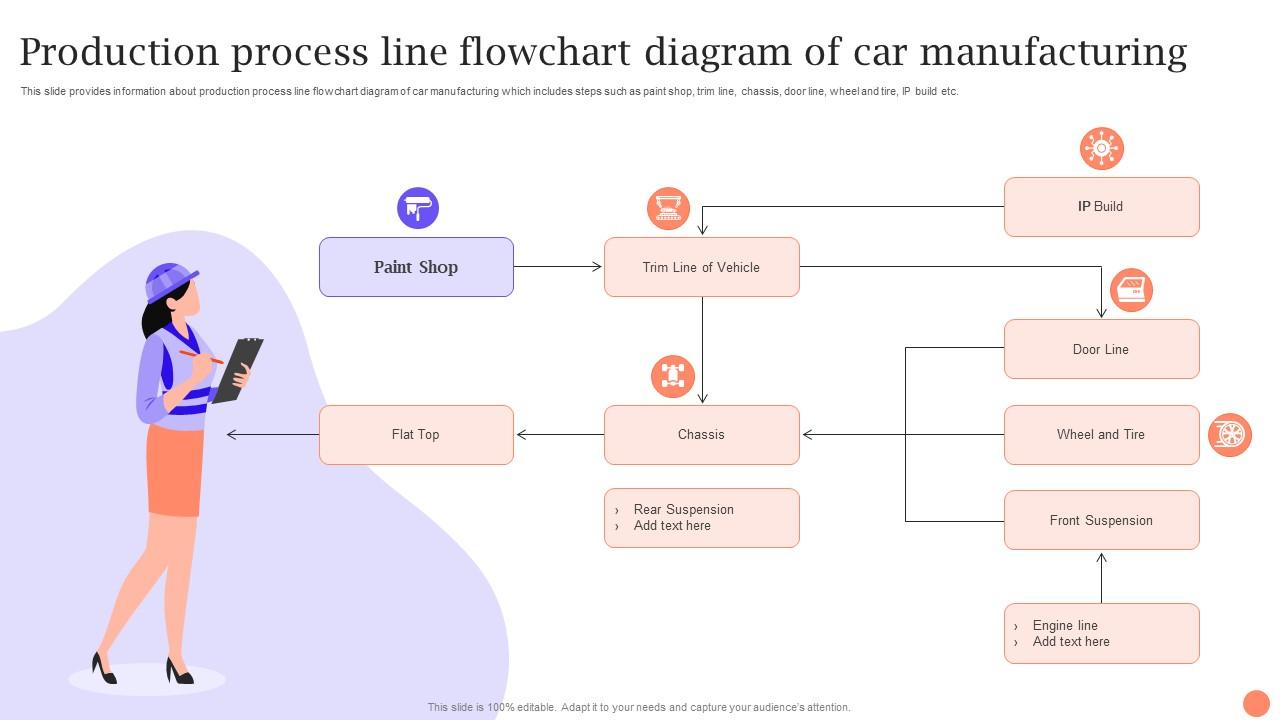
This slide provides information about production process line flowchart diagram of car manufacturing which includes steps such as paint shop, trim line, chassis, door line, wheel and tire, IP build etc. Introducing our Production Process Line Flowchart Diagram Of Car Manufacturing set of slides. The topics discussed in these slides are Production Process Line, Flowchart Diagram, Car Manufacturing. This is an immediately available PowerPoint presentation that can be conveniently customized. Download it and convince your audience.

People who downloaded this PowerPoint presentation also viewed the following :

FAQs for Production Process Line Flowchart Diagram

So car manufacturing breaks down into four main chunks: stamping, welding, painting, and final assembly. Stamping comes first - they press body panels out of steel sheets. Then welding puts all those pieces together into the actual frame and body structure. Painting is next, and man, that process drags on forever with all the primer layers and drying time. Assembly's where it gets crazy though - engine, seats, electronics, everything gets installed. If you're thinking about diving into this stuff for your project, I'd definitely look at the assembly part first. That's where all the real headaches live.

Dude, automation is a game-changer for car manufacturing. Robots can weld and paint parts way faster than humans, plus they don't need coffee breaks - literally running 24/7. The precision is insane too, so you get way less waste and better quality control. Yeah, the initial investment will hurt your wallet pretty bad. But once it's up and running? Your costs per car drop like crazy. You can also ramp production up or down depending on what the market wants. Honestly, I'd start by automating whatever your biggest pain point is first.

Dude, car manufacturing is wild when you think about the logistics. Like 30,000 parts from suppliers all over the world have to show up at the factory at exactly the right moment. One tiny delay and suddenly you're building cars without steering wheels or whatever. The supply chain people basically play this massive coordination game - they can't let you run out of engines while you've got a mountain of floor mats sitting there. Just-in-time delivery is probably the key concept to wrap your head around first. It's honestly impressive it works at all.

So basically car companies check everything at every step - incoming parts, assembly, final testing, all of it. They've got robots scanning for defects plus actual people eyeballing the important stuff. Then there's the wild testing - vibration torture, water leak tests, honestly looks brutal. The smart move is catching issues early before they snowball. Oh, and definitely look into "poka-yoke" systems for your project - they're designed so workers literally can't mess up even if they try. Statistical sampling happens throughout too, keeps things consistent.

Yeah, car manufacturing is honestly pretty rough on the environment. Steel production alone pumps out tons of CO2, and don't even get me started on how much water they use for cooling and cleaning everything. The mining part is what really gets me though - they're literally strip-mining for lithium and rare metals, just destroying entire ecosystems. Paint and coating processes create nasty chemical waste that has to be disposed of carefully. Most companies are switching to renewable energy in their factories now, which is good. If you're looking at suppliers, definitely ask about their sustainability certs and metrics.

So Toyota basically cracked the code on this - lean manufacturing cuts out all the wasteful stuff. Just-in-time delivery means parts show up right when you need them instead of hoarding everything in warehouses. Pretty smart actually. The main things are keeping inventory low, getting workers involved in quality improvements, and making production flow smoother. Modern car plants can pump out vehicles way faster with fewer mistakes than the old days. Honestly it's everywhere now. If you're trying to improve any process, just figure out what actually adds value versus what's just... there.

So you've got AI quality control that's crazy fast at catching defects - way better than people honestly. 3D printing is big for prototypes and some actual parts too. Cobots are really taking off because they don't replace workers, just help them out. Digital twins let companies test entire production lines virtually first, which saves a ton of cash on mistakes. Tesla and BMW are crushing it with their smart factories if you want examples. Oh, and everyone's pushing sustainable manufacturing now. That's pretty much the main stuff happening right now.

So basically they build safety stuff right into the process, not just tack it on later. The frame gets welded with crumple zones already designed in. Airbags and sensors go in during regular assembly - honestly it's pretty satisfying to watch if you're into that kind of thing. They're testing safety constantly too, not waiting until the end. I think the biggest difference from older cars is that everything starts with safety in mind now, so the whole production line has to be set up that way from the beginning.

Dude, steel's still king for most car stuff - frames, body panels, engine parts. It's strong and doesn't break the bank. Aluminum's everywhere now too, especially hoods and doors since it shaves off weight. Your interior? That's mostly plastics and composites, plus bumpers. Carbon fiber looks cool but honestly it's way too pricey unless you're buying a Lambo or something. Manufacturing-wise, steel and aluminum are gonna eat up most of your budget, so I'd start there if you're sourcing materials.

Dude, design choices literally control everything that happens after. Pick complex curves or super tight tolerances? You're stuck with expensive machining and fancy equipment. Material selection, assembly order, tooling needs - they all stem from those early design calls. Here's what I learned the hard way: good designers actually start with manufacturing limits and work backwards. Saves so much drama later. Your part shape decides if you can stamp it or need to forge it. Even something like component placement affects how you'll set up the assembly line. Pro tip - get manufacturing engineers in those design reviews early. They'll spot costly screw-ups before production starts.

Honestly, the battery supply chain is your biggest headache - there's like 3 major suppliers and everyone's fighting over capacity. Manufacturing's another beast entirely. You'll need completely different equipment for battery assembly, new safety rules, the whole nine yards. Your workers need retraining on high-voltage stuff which takes forever (learned this the hard way). Oh and retooling production lines? Budget double what you think. Start hunting for battery partnerships now - seriously, yesterday if possible. The certification process alone will eat months you don't have.

So basically, EV lines need way fewer stations since electric motors are super simple compared to gas engines. No complex engine stuff, transmissions, or exhaust systems to deal with. Pretty crazy how streamlined it becomes, honestly. You do need special battery assembly areas though - safety's a big deal there. The wiring gets more complicated too with all the electrical bits. Oh, and testing is totally different - you're checking batteries and charging instead of engine diagnostics. From what I've heard, you'll need like 30-40% fewer stations overall. Makes the whole setup less of a headache.

Oh man, consumer feedback basically runs the whole show in car manufacturing. Companies are obsessed with it - they do focus groups, surveys, test drives, you name it. They even stalk social media now which is kinda creepy but whatever. All that input shapes everything from how the dashboard looks to what safety features they prioritize. Honestly, the smart manufacturers never stop collecting feedback. It's not like they ask once and call it good. They're constantly tweaking designs based on what people actually want, not just what engineers think is cool.

Look, smart manufacturers are basically playing detective with upcoming regulations - tracking what's coming down the pipeline years ahead. They dump money into R&D teams for this exact reason. Plus they lobby hard during rule-making (honestly, pretty clever move). The key thing is building flexible production lines so you can swap components without tearing everything apart. I learned this the hard way at my last job - we got blindsided by new emissions standards. Set up regular meetings with your regulatory people. Seriously. Catch this stuff early or you're scrambling later.

Dude, you definitely need the technical stuff - blueprint reading, machine operation, quality control basics. But honestly? The soft skills are just as important. Problem-solving is huge because when something goes wrong on the line, it goes REALLY wrong fast. You'll be talking to your team constantly so communication matters way more than people think. Oh and get ready to be on your feet all day - it's physically tough work. My buddy who works at Ford swears by learning lean manufacturing principles first, plus some basic mechanical knowledge doesn't hurt either.

Ratings and Reviews

80% of 100
Review Form
Write a review
Most Relevant Reviews
  1. 80%

    by Darrin Porter

    Loved the templates on SlideTeam, I believe I have found the go to place for my presentation needs! 
  2. 80%

    by Smith Flores

    Awesomely designed templates, Easy to understand.

2 Item(s)

per page: