

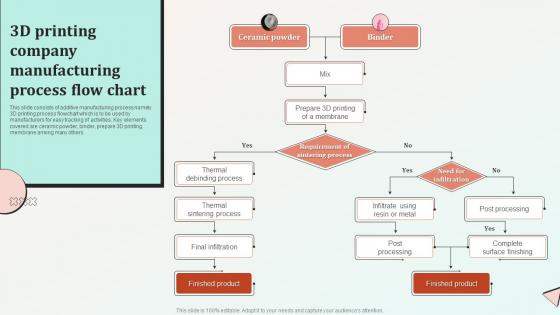
3D Printing Company Manufacturing Process Flow Chart




Try Before you Buy Download Free Sample Product
 Impress Your
Audience
 100%
Editable
 Save Hours
of Time


This slide consists of additive manufacturing process namely 3D printing process flowchart which is to be used by manufacturers for easy tracking of activities. Key elements covered are ceramic powder, binder, prepare 3D printing membrane among many others.
People who downloaded this PowerPoint presentation also viewed the following :
3D Printing Company Manufacturing Process Flow Chart with all 6 slides:
Use our 3D Printing Company Manufacturing Process Flow Chart to effectively help you save your valuable time. They are readymade to fit into any presentation structure.






FAQs for 3D Printing Company Manufacturing
So there's basically three main types. FDM melts plastic filament - that's what you probably picture when thinking about 3D printing. Most affordable option too. SLA uses liquid resin with UV light and gives crazy good detail, which is why dentists use them. Then there's SLS that fuses powder with lasers - pretty cool because the powder supports itself so you don't need support structures. Honestly, I'd just get FDM for your first one unless you're doing jewelry or something that needs super fine details. Way easier to deal with.
Dude, material choice is huge - it literally makes or breaks your print. PLA's super beginner-friendly but snaps if you look at it wrong. Good for prototypes though. PETG and ABS? Way tougher, can actually handle some beating. Carbon fiber stuff is insanely strong but honestly such a headache to dial in sometimes. Oh, and layer adhesion changes completely between materials - that's what determines if your part holds together or falls apart under pressure. Trust me, go PETG or ABS minimum for anything functional. I learned this the hard way when my PLA bracket failed spectacularly.
So 3D printing's pretty much taken over everything these days. Healthcare does custom prosthetics and implants, which is honestly amazing. Car companies use it for prototyping parts and tooling. Aerospace is wild though - they're literally printing rocket components now! Architecture firms make scale models, jewelers create custom pieces. Oh, and manufacturers use it for small production runs when they don't need thousands of something. It really works best when you need weird shapes or personalized stuff that regular manufacturing would struggle with. Worth considering if your project needs custom or complex designs.
Dude, 3D printing has so many annoying rules compared to regular modeling. Overhangs can't go past 45 degrees without supports, which sucks. Wall thickness needs to be 1-2mm minimum or everything gets wobbly. Tiny details? Forget about it - they just turn into blobs anyway. Oh, and orientation matters big time since layer lines make things weak in weird directions. I always run printability checks now because redoing a 12-hour print job makes me want to throw my printer out the window. Trust me on that one.
Yeah, you're gonna need software for sure - it's like the brain behind everything. First, grab some CAD software to actually design your model. Fusion 360 or Tinkercad work great. Then comes the slicer, which is honestly where things get interesting. Cura, PrusaSlicer - they translate your model into actual printer commands. Layer height, supports, infill patterns - all that gets decided here. Bad slicer settings will mess up even the coolest design, trust me on that one. I'd say start with PrusaSlicer though, their beginner presets are pretty solid and won't leave you totally lost.
Dude, post-processing is a game changer - takes your prints from looking kinda rough to actually professional. First thing, obviously get rid of supports and clean up the mess. Then sand down those layer lines if you want it smooth. ABS? Try acetone vapor smoothing, works crazy well. Prime and paint if you're going for that finished look. You can even drill holes or tap threads for threading - honestly the possibilities are endless once you start messing around. I've wasted way too many weekends perfecting prints that probably didn't need it, but whatever. Just start with basic sanding and you'll be shocked at the difference it makes.
Honestly, it's kind of a mixed bag. PLA filament is pretty solid since it biodegrades, but ABS and other plastic ones? Not so much. Energy-wise though, 3D printing beats traditional manufacturing by a lot - you're only using what you actually need instead of wasting a bunch of material. Some printers can get a bit funky with fumes, so crack a window or something. Oh, and if you mess up prints (happens to everyone), look into those filament recycling programs. They'll turn your failures back into usable stuff. Stick with bio-based materials when you can.
Honestly, 3D printing is way slower for mass production - like, embarrassingly slow compared to injection molding which cranks out thousands of parts per hour. I've literally started prints Friday afternoon and they're still running Monday morning lol. But for prototypes? Total game changer. You skip all that tooling nonsense and go straight from design to part in hours instead of waiting weeks. Small batches are perfect too. Traditional manufacturing needs all this setup time first, so if you just need a few custom pieces or you're still tweaking your design, 3D printing destroys the competition. Really depends what you're trying to do.
Honestly, it's mostly about speed and money. Traditional injection molding just crushes 3D printing when you need thousands of parts. Plus every printed piece comes out slightly different, which is annoying for quality control. The economics get brutal at high volumes too - you'll spend forever on post-processing alone. Removing supports from hundreds of parts? No thanks. That said, HP's Multi Jet Fusion tech is actually pretty decent for scaling up. Or you could just use 3D printing for making your tooling instead of the final parts. Way more practical.
Dude, the speed is insane - you'll go from idea to holding something real in like hours, not weeks. I can't even tell you how addictive it gets when you're tweaking designs and printing new versions same day. You catch problems super early before dropping cash on expensive tooling. Complex shapes that'd be impossible with normal manufacturing? No problem. My workflow's usually starting with crappy low-res prints just to see if it works, then bumping up quality once I've got the design right. Honestly changed how I think about prototyping completely.
Dude, 3D printing is totally changing the game for design. You can literally create stuff that would've been impossible before - crazy internal geometries, lattice structures, parts with multiple materials. Traditional manufacturing would've laughed at half this stuff. What's cool is you're not stuck thinking "can a machine cut this?" anymore. Instead you just focus on what the part actually needs to do. Function first, basically. Oh, and definitely mess around with topology optimization tools if you get the chance - they'll blow your mind with what's possible. The creative freedom is honestly insane.
First thing - get some ventilation going because those plastic fumes are nasty to breathe. Don't touch the hot end or bed obviously (I burned myself like an idiot when I first started). Safety glasses help when you're yanking off supports since they love to go flying. Never leave it running overnight or anything - house fires aren't worth it. Oh and clear out space around the printer so you're not constantly bumping into it. The whole setup gets pretty hot and you don't want to accidentally knock something over while it's doing its thing.
Dude, AI stuff for 3D printing is actually pretty sick. It'll catch failures before they wreck your whole print - like spotting warping or clogs early. The software can even tweak settings while it's running, which honestly blows my mind sometimes. Machine learning gets smarter about materials too, learning what worked before to suggest better temps and speeds next time. Support structures get optimized automatically. You'll waste way less filament and get cleaner results overall. Check out AI slicing software first - that's probably your best starting point. Some of the monitoring systems are getting really good too.
So printer costs are all over the place - like $200 for basic ones, but industrial models hit $10k+. Filament runs $20-50 per kg and trust me, that stuff disappears way faster than you'd expect. Then there's the random stuff like replacement nozzles, build plates, cleaning supplies. Oh and some printers need software licenses which is annoying. Maintenance is honestly where people get surprised - lubricants, repairs, all that jazz. I'd grab a decent mid-range printer first and just see how much you actually use it before going crazy with upgrades.
Honestly, 3D printing is way better for waste - you're only using what you actually need instead of cutting away tons of material like old-school manufacturing. The on-demand thing is huge too since you can print stuff locally and skip all that shipping. I love how you can make parts way lighter but just as strong. Quick prototyping without expensive tooling? Game changer. You'll iterate so much faster and won't end up mass-producing something that totally sucks. I'd start by looking at which parts you're already making that might work better printed instead.
-
Definitely recommend SlideTeam to all who need help with PowerPoint presentations. Their design team can create anything you need.
-
World-class PowerPoint designs that are fully customizable!