

Manufacturing process flow diagram pharmaceutical development new medicine ppt tips




Try Before you Buy Download Free Sample Product
 Impress Your
 Audience
 100%
100% Editable
 Save Hours
 of Time


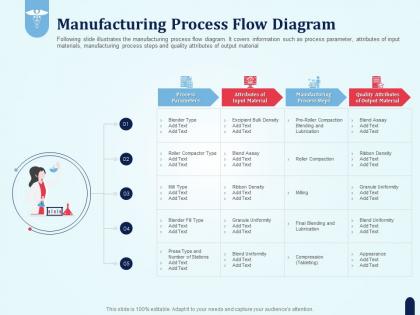
Following slide illustrates the manufacturing process flow diagram. It covers information such as process parameter, attributes of input materials, manufacturing process steps and quality attributes of output material.
People who downloaded this PowerPoint presentation also viewed the following :
Manufacturing process flow diagram pharmaceutical development new medicine ppt tips with all 2 slides:
Use our Manufacturing Process Flow Diagram Pharmaceutical Development New Medicine Ppt Tips to effectively help you save your valuable time. They are readymade to fit into any presentation structure.
FAQs for Manufacturing process flow diagram pharmaceutical development new
So basically you've got raw material receiving and testing first. Then dispensing/weighing, mixing or granulation, compression for tablets or filling for capsules/liquids. Coating comes next if needed. Quality control testing is literally everywhere - I swear they test at every single step. After that it's packaging, labeling, serialization for compliance stuff, and final release testing. Oh and documentation requirements are insane at each stage. Environmental controls too. Honestly though, I'd map out your specific product flow first since tablets vs injectables vs other forms can be pretty different sequences.
So QC runs through your whole manufacturing process, not just at the end. Raw materials get tested when they come in. Then you've got checks during the critical steps. Final testing happens before packaging - honestly, it's kinda like video game checkpoints if you think about it. Each stage has criteria your product has to hit before moving on. Anything fails? The batch gets flagged or tossed right there. Here's the thing though - QC controls everything. Nothing moves without their sign-off, which can be annoying but necessary. Build in extra time for testing because delays happen.
Raw materials are literally the backbone of everything you're making. APIs, excipients, packaging stuff, solvents - all of it has to hit those quality standards before it touches your manufacturing line. Any contamination or weird deviation? It's gonna mess up your entire batch downstream. Honestly, I've seen companies get burned by skipping proper documentation here. Keep those batch records and certificates of analysis organized for every single material. Trust me, when regulators show up, you'll be so glad you did the paperwork right. It's like that saying about garbage in, garbage out, but with way higher stakes.
So you basically build risk assessment into every step of manufacturing - raw materials coming in, all the way to shipping out finished product. Start by mapping out potential problems using FMEA or HACCP (honestly HACCP's easier if you're just getting started). Then figure out how likely each issue is and what damage it could do. Each risk needs its own controls and monitoring steps that go straight into your batch records. The tricky part? Actually keeping those assessments updated when things change. Most people just shove them in a file somewhere and never look again.
Okay so you're gonna need to follow cGMP regulations from the FDA - that covers everything from handling raw materials to releasing your final product. If you're in the EU, they've got similar GMP guidelines too. Your process flow diagrams have to show critical control points and contamination prevention at each step. The documentation is honestly insane - every single deviation and batch record needs tracking. I know the paperwork feels brutal at first, but it's all for patient safety. Map your current processes against cGMP requirements first. That'll show you what gaps need fixing before your next inspection rolls around.
Honestly, automation is a game changer - mixing, filling, packaging all happens way faster than doing it by hand. Digital monitoring catches problems early so you're not tossing whole batches (learned that one the hard way). Real-time data lets you tweak things as you go instead of hoping for the best. Oh, and predictive maintenance is clutch for keeping machines from randomly breaking down. Start by mapping your process flow to spot the worst bottlenecks first. That's where you'll see the biggest impact. Trust me, once you get these systems talking to each other, everything just clicks.
Ok so upstream is all the stuff that happens before you get your actual drug - cell culture, fermentation, growing biologics, basically making the active ingredient. Then downstream comes after that. That's your purification, filtration, formulation, putting it into vials or whatever. I think of it like a river tbh - flows downstream toward the final product. Upstream = raw material creation, downstream = turning it into something patients can use. Trace any process flow from start to finish and you'll spot where one phase hands off to the other. Makes way more sense when you see it visually.
Dude, environmental stuff will absolutely wreck your pharma production if you're not careful. Temperature and humidity swings? Total nightmare for quality control. I watched a whole week's worth of batches get tossed because nobody noticed the humidity creeping up - honestly still makes me cringe thinking about the waste. Your cleanroom has to stay locked in spec or you're dealing with contamination and angry regulators. Real-time monitoring is clutch here. Set up those automated alerts so deviations don't sneak up on you. Trust me, catching problems early beats explaining batch failures to management.
Honestly, it's all about hitting those checkpoints throughout your whole process. Temperature and humidity control is massive - storage, mixing, processing, all of it. I'd say environmental monitoring is probably your biggest friend here. Run regular in-process tests so you catch degradation before it becomes a nightmare. Time limits matter too; some intermediates basically expire if they sit too long. Don't sleep on packaging either - light and moisture will destroy your stability faster than you think. Document everything though, because that stability data becomes your shelf-life proof later on.
So basically you go lab → pilot → commercial scale, adjusting equipment and parameters at each step. The trick is keeping your critical process stuff consistent throughout - that's where most people mess up honestly. Document everything because FDA will want to see it all later. I'd start by figuring out which parameters are gonna be most sensitive when you scale up. It's way more methodical than other industries, which is honestly kind of refreshing? Your regulatory folks will probably want to get involved early too. Just don't rush the validation testing between phases.
Honestly, you need multiple barriers between your product and contaminants - airlocks, positive pressure, proper gowning procedures. Map out your current contamination control points first and spot the gaps. Material flow patterns are crucial to prevent cross-contamination, plus regular environmental monitoring with clear alert limits. People are your biggest risk, no joke - training is everything. Your cleaning procedures need validation, and don't forget HVAC systems with HEPA filtration. Oh, and maintain those pressure gradients religiously. Start with what you've got and build from there.
So you've got three stages to worry about: prospective (before you start), concurrent (during those first runs), and retrospective (once you've got production data). Every critical step needs validation - raw materials all the way to packaging. Document everything as it happens, seriously. Don't try to go back and fill stuff in later because auditors will tear you apart. The trick is figuring out your critical control points upfront and watching them like a hawk with solid acceptance criteria. Yeah, it's a ton of paperwork but honestly? Better safe than sorry with this stuff.
Honestly, automation is a total game-changer for pharma workflows. Manual bottlenecks just disappear - we're talking hours shrinking down to minutes on some processes. Your batch processing speeds up, quality monitoring happens in real-time, and data integrity gets so much better since everything's digital now. Compliance becomes way less of a headache too (goodbye frantic paperwork hunting during audits). The coolest part? Predictive maintenance where equipment basically tells you "hey, I need some TLC" before breaking down. I'd start by figuring out which manual steps cause the most errors and automate those first.
So basically sensors and PLCs grab all the data at control points - temp, pressure, pH, flow rates, all that. Your MES logs everything automatically while operators still do manual batch records (which honestly feels redundant but whatever). Analysis happens in real-time through control algorithms that tweak things as needed. Then QA reviews everything later for batch release. The amount of data is insane! You'll want good trending and exception reports set up though, otherwise you're just drowning in numbers until something breaks.
Dude, check out AI-powered process optimization and digital twins – they're seriously changing pharma manufacturing. Real-time analytics can predict when equipment's about to crap out and auto-adjust everything to keep quality consistent. Continuous manufacturing is finally picking up steam (took forever, right?). The modular facilities thing is pretty cool too since you can actually scale based on what you need. Oh, and advanced robotics obviously. Start digging into digital twin software now because that's where the money is. Batch processes are so last decade.
-
Illustrative design with editable content. Exceptional value for money. Highly pleased with the product.
-
Nice and innovative design.
-
Much better than the original! Thanks for the quick turnaround.
-
Understandable and informative presentation.
-
Illustrative design with editable content. Exceptional value for money. Highly pleased with the product.