


Drug Development Process In Pharmaceutical Industry




Try Before you Buy Download Free Sample Product
 Impress Your
 Audience
 100%
100% Editable
 Save Hours
 of Time


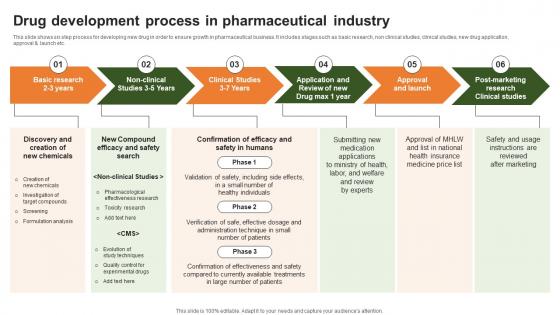
This slide shows six step process for developing new drug in order to ensure growth in pharmaceutical business. It includes stages such as basic research, non clinical studies, clinical studies, new drug application, approval and launch etc.
People who downloaded this PowerPoint presentation also viewed the following :
Drug Development Process In Pharmaceutical Industry with all 9 slides:
Use our Drug Development Process In Pharmaceutical Industry to effectively help you save your valuable time. They are readymade to fit into any presentation structure.









FAQs for Drug Development Process
So there's four phases after they test it in labs. First one's just safety - like 20-100 people to make sure it won't kill you. Then phase II gets a few hundred folks to see if it actually does anything useful and figure out the right dose. Phase III is where things get serious - thousands of people, comparing it to whatever's already out there or giving placebos. Honestly, this is where most drugs fail. After FDA approval, phase IV just tracks long-term effects in regular patients. The whole thing? You're looking at 10-15 years and costs get absolutely insane as you go.
Preclinical studies are where you test your drug in cells and animals before touching humans. Think of it as your last chance to catch major problems without spending millions. Most compounds (like 90%+) actually crash and burn here, which honestly saves everyone a headache later. You're figuring out dosing, side effects, how it behaves in the body - all that crucial stuff. The data becomes your roadmap for clinical trials and what you show regulators to get approval. It's tedious but you really can't skip this step if you want your compound to have any shot.
The FDA controls everything - they review your early data, approve trial protocols, and decide if your drug can actually sell. Follow ICH guidelines, GMP, and GCP rules no matter what. Honestly, the FDA's guidance documents are clutch since they update them constantly. Talk to regulators super early through pre-IND meetings. Don't be that person who waits until Phase III to realize you've been tracking the wrong stuff or missed critical safety data. That's just asking for trouble. Oh, and their formal channels exist for a reason - use them.
So basically Phase I is just testing if the drug won't kill you - they use maybe 20-100 people for that. Then Phase II checks if it actually does what it's supposed to do, plus watching for side effects in a few hundred patients. Phase III is brutal though - thousands of people, comparing your drug against whatever's already out there or a placebo. Most drugs that are gonna fail do it here, honestly. After FDA approval there's Phase IV, which tracks long-term stuff in real patients. Each phase has to work before you can move on, so you're just building up proof it's safe and effective.
Oh man, brace yourself for a marathon - we're talking 10-15 years and billions per drug. Regulatory stuff is insane, and honestly the failure rates will crush your soul since most candidates just die somewhere in the process. Manufacturing at scale becomes this whole nightmare, plus you've got IP battles and insurance companies being difficult about coverage. The FDA loves changing rules mid-game too, which is... fun. Safety issues pop up constantly because, you know, human lives and all that. Get tight with regulatory consultants from day one and keep backup compounds ready. Trust me on that last part.
Honestly, PK is like the blueprint for everything you'll do with formulation. You've got to figure out absorption rates, where the drug ends up in the body, metabolism pathways - all that stuff first. Otherwise you're basically throwing darts in the dark. Some drugs need immediate release tablets, others work better as extended release or patches. Depends on how fast they get cleared out. If your compound breaks down in stomach acid, you'll need enteric coating. Map out that PK profile before you even think about formulation work. Trust me on this one - I've seen too many projects go sideways because people skipped this step.
File patents super early and go broad - that's your base. Provisional patents first to lock in priority dates, then build out coverage for the compound, formulation, manufacturing, dosing stuff. The pharma patent world is absolutely insane right now with competition. Watch what competitors are filing like a hawk. Strategic licensing can be smart too when it works. Oh, and regulatory exclusivities are huge - they'll extend protection way past your patents. Seriously though, get a specialized IP lawyer from the start. Don't cheap out on this part.
Oh man, recruitment is literally where most trials go to die. You'll be shocked how hard it is to find people who actually qualify AND want to stick around. Dropouts are the worst - suddenly you're back to square one trying to hit your numbers. Location matters way more than people think, plus those inclusion criteria can be brutal. Honestly, I'd pad your timeline by like 30% just for recruitment alone. Sounds excessive but trust me, you'll thank yourself later when you're not panicking about enrollment six months in.
So the big thing right now is pharmacogenomics - basically drugs matched to your DNA instead of everyone getting the same thing. AI's getting crazy good at figuring out which patients will actually respond to treatments. Companion diagnostics are becoming the norm too, which honestly makes so much sense. Drug trials are smaller now but way more successful since they're testing the right people from day one. Even the FDA's creating new approval pathways for these drug-test combo products. Oh, and definitely start thinking about which patient groups would work best with your current pipeline - that's where the money's going.
Dude, the whole AI thing in drug discovery is honestly kind of crazy right now. These algorithms can crunch through massive datasets and predict which compounds might actually work before you waste years testing duds in the lab. They're getting scary accurate too. You can spot drug targets faster, catch toxicity issues early, and even figure out the right patients for trials. My friend's team used to spend months analyzing genetic data manually - now ML finds those patterns in days. Definitely worth looking into partnerships with AI biotech companies if you haven't yet.
Honestly, patient safety has to come first - no shortcuts on informed consent or protecting vulnerable people. Design your trials with diverse groups and report ALL results, even the messy ones. That Silicon Valley "move fast and break things" approach? Yeah, totally wrong industry for that mindset. Will people actually afford your drug once it's done? That's ethics too, not just business. Get your ethics board involved super early - trust me, it's way easier to fix problems before you're knee-deep in trials.
Look, pharma companies have the money and regulatory know-how, but universities are where the crazy innovative stuff happens. Academic labs are doing research that'd take companies forever to figure out internally. Meanwhile, professors need funding to actually turn their discoveries into real medicines. It's honestly perfect - companies get access to cutting-edge research and grad students who'll work insane hours on novel problems. Universities can chase those wild, high-risk ideas while pharma handles scaling up anything promising. I'd definitely reach out to research institutions in whatever therapeutic area you're targeting.
Yeah, drug development is insane - we're talking $1-3 billion over like 10-15 years. Phase II and III trials are what'll kill your budget, hundreds of millions each. I'd honestly partner with other companies to split costs, maybe try adaptive trial designs so you can bail early if things aren't working. Real-world data beats expensive placebo studies when you can swing it. Oh, and orphan diseases are actually easier since you need smaller trials. The whole trick is failing fast and cheap instead of burning through cash for years. Start thinking about this stuff before Phase I even begins.
So basically post-marketing surveillance picks up what clinical trials totally miss. Clinical trials are pretty small and controlled, right? But once a drug hits the market, you've got thousands of different people taking it - way more diverse than trial participants. Rare side effects that happen maybe 1 in 10,000 times? Those don't show up until tons more people are using the drug. They track this stuff through adverse event reports, health records, patient databases - all that data. Honestly, I always dig into recent post-marketing info before prescribing anything newer, especially if my patient wasn't the "typical" person in those original studies.
So globalization basically made drug development this massive worldwide thing now. Companies are outsourcing trials to India, China, Brazil - places where it's way cheaper and you've got these huge patient pools to work with. Smart move financially, but honestly the regulatory stuff is a nightmare since every country has different approval hoops to jump through. The trade-off is drugs hit global markets faster and cheaper than before. Oh, and if you're thinking about trials in these markets, just know you'll need extra time for all that regulatory paperwork. Trust me on that one.
-
Definitely recommend SlideTeam to all who need help with PowerPoint presentations. Their design team can create anything you need.
-
Easy to edit slides with easy to understand instructions.