


Drug development process market ppt powerpoint presentation file pictures




Try Before you Buy Download Free Sample Product
 Impress Your
 Audience
 100%
100% Editable
 Save Hours
 of Time


Ensure an accurate fit with our Drug Development Process Market Ppt Powerpoint Presentation File Pictures. They will dovetail beautifully with your thoughts.
People who downloaded this PowerPoint presentation also viewed the following :
Content of this Powerpoint Presentation
Description:
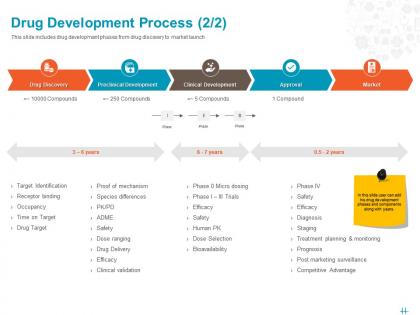
The image depicts the second part of a two-part presentation slide series detailing the drug development process, from initial discovery to market launch. This particular slide focuses on the latter stages including preclinical development, clinical development, approval, and market release.
1. In the "Drug Discovery" phase, it mentions the start of the process with ~10,000 compounds, highlighting key activities such as target identification, receptor binding, occupancy, time on target, and drug target.
2. In "Preclinical Development," with ~250 compounds, the activities become more refined and include proof of mechanism, species differences, pharmacokinetics/pharmacodynamics (PK/PD), ADME (absorption, distribution, metabolism, and excretion), safety, dose ranging, drug delivery, efficacy, and clinical validation. This stage typically takes 3&6 years.
3. "Clinical Development" is the next phase with more rigorous testing on ~5 compounds, divided into various phases (Phase 0 microdosing to Phase I&III trials), focusing on efficacy, safety, human PK, dose selection, and bioavailability, and this phase lasts about 6 & 7 years.
4. The "Approval" stage filters down to 1 compound and is represented by a checkmark, signifying successful regulatory approval.
5. Finally, the "Market" stage is shown by an icon depicting a shopping bag, indicating the drug has been launched to the public. This stage involves Phase IV trials, safety, efficacy, diagnosis, staging, treatment planning and monitoring, prognosis, post-marketing surveillance, and competitive advantage. This can usually take about 0.5& 2 years.
A note is added stating, "In this slide a user can add his drug development phases and components along with years," indicating the template's interactive nature for customization.
Use Cases:
This comprehensive outline could have tangible applications across various industries involved in healthcare and pharmaceuticals.
1. Pharmaceuticals:
Use: Training on drug development process
Presenter: R&D Training Coordinator
Audience: Research Scientists & New Employees
2. Biotechnology:
Use: Investor presentations on product pipelines
Presenter: Chief Scientific Officer
Audience: Investors & Stakeholders
3. Medical Education:
Use: Academic teaching about drug development
Presenter: Professor or Lecturer
Audience: Medical and Pharmacy Students
4. Healthcare Consulting:
Use: Consulting on pharmaceutical product life cycles
Presenter: Healthcare Consultant
Audience: Pharma Executives & Decision Makers
5. Regulatory Affairs:
Use: Understanding the approval process for new drugs
Presenter: Regulatory Affairs Specialist
Audience: Regulatory Affairs Teams & Policy Makers
6. Investment Banking:
Use: Financial analysis of pharmaceutical companies
Presenter: Investment Analyst
Audience: Institutional Investors & Financial Advisors
7. Clinical Research Organizations:
Use: Overview of clinical trial phase services
Presenter: Clinical Project Manager
Audience: Pharmaceutical Clients & Clinical Research Associates
Drug development process market ppt powerpoint presentation file pictures with all 2 slides:
Gain acceptance in entrepreneur circles with our Drug Development Process Market Ppt Powerpoint Presentation File Pictures. Your ideas will be generously applauded.
FAQs for Drug development process market ppt powerpoint
So basically after all the lab work, there are four phases. First up is Phase I - just 20-100 people testing if it's safe, takes about a year. Phase II gets pricey and risky, that's where they check if it actually works with 100-300 patients over 1-3 years. Then Phase III is the big one - thousands of people for up to 4 years to really nail down benefits and catch side effects. FDA review tacks on another 6 months to 2 years because bureaucracy, you know? Whole process runs 10-15 years typically. Definitely build in extra time though - delays happen constantly in pharma.
So preclinical research is like your safety net before burning through millions on human trials. Lab dishes and animal testing - that's where you figure out if your drug actually works and won't kill people. Honestly, most compounds fail here, which is probably for the best. You're checking three main things: does it work, is it toxic, and how does the body handle it. My old roommate worked in this field and said it's brutal how many promising drugs just... don't make it. But if something passes? Then you've got a real shot at clinical trials.
So clinical trials are basically how we prove drugs work and won't kill people before they hit shelves - FDA won't budge without them. Phase I starts small, like 20-100 people, just checking if it's safe. Then Phase II bumps up to hundreds to see if it actually does anything useful. Phase III is the big one - thousands of people, comparing it to whatever's already out there. That's honestly where most drugs crash and burn because the standards get brutal. Oh, and Phase IV continues after approval for long-term monitoring. Your timeline and budget totally depend on which phase you're dealing with.
So basically they test drugs in three phases with more people each time. First phase is just safety stuff with small groups - figuring out dosing and whether people get sick. Then phase two brings in a few hundred people to see if it actually works while still watching for side effects. Phase three is the big one - thousands of patients comparing your drug to whatever's already out there. The FDA goes through everything with a fine-tooth comb afterward. Honestly, the paperwork alone is insane. They document literally everything, even minor headaches. You'll want to start organizing your data collection early because these regulatory folks don't mess around when reviewing safety stuff.
So regulatory stuff is a total maze depending where you're launching. FDA in the US means going through IND/NDA with those three trial phases - pretty straightforward process honestly. Europe's different though, you need EMA approval via their centralized route for most new drugs. Japan's PMDA is similar phases but man, their documentation is way more intense and those regulatory meetings? Brutal compared to FDA folks. Each place has its own post-market rules and pricing headaches too. Seriously though, get local regulatory consultants involved early because timelines are all over the place between countries.
Dude, the whole biotech/genomics thing is completely changing drug development. Instead of just throwing random compounds at diseases and hoping something sticks, scientists can actually target specific genes and proteins now. The coolest part? They're making treatments based on your exact DNA - like, literally customized medicine for YOU. Short sentences work too. Genomics also helps doctors figure out beforehand which patients will actually respond to certain drugs, so no more wasting time on treatments that won't work. Honestly, it's kind of mind-blowing how precise everything's getting. If you're working on any drug projects, definitely get genetic testing involved early - it'll save you tons of headaches later.
Okay so pharmacokinetics and pharmacodynamics are like your blueprint for drug formulation. PK shows how the body handles your drug - absorption, metabolism, all that stuff. PD is what the drug actually does when it hits its target. You can't formulate anything decent without both pieces. They determine dosing, delivery method, whether it'll even work at all. Honestly, skipping PK/PD data is just asking for trouble later. I learned this the hard way on a project once! Check both early in development and you'll dodge so many problems down the road.
Honestly, these partnerships are pretty brilliant. Universities have all the cutting-edge research and patient access that pharma companies desperately need but can't get internally. Pharma brings the money and regulatory expertise - plus they actually know how to get stuff to market, which academics are terrible at. It's like the perfect match where each side covers what the other sucks at. Universities do the cool science, companies handle the boring business stuff. Oh and if you're thinking about partnerships, just find someone whose strengths fill your biggest weaknesses. That's really all there is to it.
Dude, the regulatory stuff will absolutely crush you if you're not prepared. FDA wants rock-solid preclinical data before you even think about human trials - toxicology studies, manufacturing scale-up, the whole IND application nightmare. Plus clinical trials are stupid expensive (I'm talking millions), and finding the right patients is harder than it sounds. Oh, and designing protocols that actually answer your questions? That's an art form. Honestly, start talking to clinical research orgs now and triple whatever timeline you're thinking. Maybe quadruple the budget too.
Dude, pharma companies are completely rethinking how they develop drugs now. Gone are the days of making one pill for everyone - now they're designing trials around specific genetic markers right from the start. Wild how much has shifted lately. Smaller patient groups mean faster approvals since response rates are way higher. But here's the catch - your market shrinks, so pricing becomes this whole nightmare to figure out. Oh, and if you're working on anything new? Hunt for those biomarkers early. Trust me, it'll save you so much pain down the road.
So basically, patents are what make drug development worth the insane costs - companies need that 10-15 year exclusivity to make back billions in R&D. Otherwise nobody would bother, honestly. These patents also help with licensing deals and partnerships, which can totally change your development timeline. Yeah, generics flood in once patents expire, but that's how the game works. One thing I learned - always map your IP landscape super early and build those patent timelines into your financial projections. It'll save you headaches later.
Honestly, money controls everything in drug development - we're talking $1-3 billion per approved drug, which is just insane. Companies have to be brutal about cutting candidates at each stage because most will fail anyway. Early compounds get axed if the market projections don't look good enough to justify those massive Phase II/III costs coming up. They'll always pick diseases with bigger patient populations or better pricing over rare conditions. My old mentor used to say the science doesn't matter if you can't sell it. When you're pitching pipeline stuff to leadership, make sure your commercial case is rock solid alongside the data.
Oh man, patient advocacy groups are way more powerful than people realize. They basically push pharma companies to prioritize certain diseases and fund research that might otherwise get ignored. Rare diseases are where they really shine - I've seen them completely change development timelines. These groups also help with patient registries, which makes recruiting for trials so much easier. Plus they fight for endpoints that actually matter to patients, not just what looks good on paper. Honestly, if you're developing anything, talk to these groups early. They'll tell you stuff no consultant ever could about what patients really need.
Dude, AI is seriously changing drug discovery right now. Machine learning can crunch through crazy amounts of data to predict which compounds might actually work - before you waste time in the lab. You'll find ML algorithms that spot drug targets, predict molecular behavior, even forecast side effects super early. The speed difference is insane compared to old-school trial-and-error methods. My cousin works in pharma and says it's cut their timeline by like half. If you're doing any discovery work, definitely find partners with this tech. Worth every penny.
So drug development ethics is basically a minefield - you've got informed consent (people need to actually get what they're signing up for), fair participant selection without targeting vulnerable groups, and rock-solid data integrity. Don't cherry-pick results even when they suck! Risk-benefit analysis is huge too. Transparent reporting matters - publish everything, not just wins. Oh and equitable access is becoming a bigger deal these days. Honestly I'd set up an ethics board from day one because navigating this solo sounds like a nightmare.
No Reviews