

Drug discovery and development timeline




Try Before you Buy Download Free Sample Product
 Impress Your
 Audience
 100%
100% Editable
 Save Hours
 of Time


Construct the ideal formula with our Drug Discovery And Development Timeline. Ensure all components fit exactly.
People who downloaded this PowerPoint presentation also viewed the following :
Content of this Powerpoint Presentation
Description:
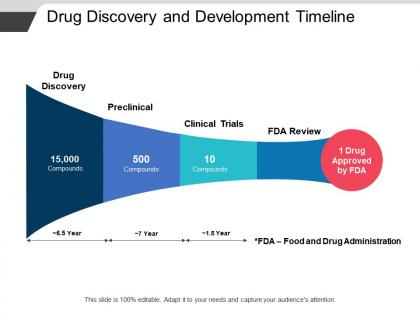
The image is a PowerPoint slide titled "Drug Discovery and Development Timeline," which illustrates the typical stages and duration of developing a new pharmaceutical drug. The timeline is segmented into four phases:
1. Drug Discovery:
This initial phase involves screening approximately 15,000 compounds over an estimated period of 6.5 years to identify potential candidates for development.
2. Preclinical:
Out of the initial pool, around 500 compounds are selected to undergo preclinical testing. This stage typically spans about 7 years and includes laboratory and animal testing to evaluate safety.
3. Clinical Trials:
From the preclinical phase, roughly 10 compounds move on to clinical trials, which last around 1.5 years. These trials are conducted with human participants to assess efficacy and safety.
4. FDA Review:
Finally, the process culminates with the FDA review, where on average, only 1 drug is approved. The footnote clarifies that "FDA" stands for Food and Drug Administration.
Use Cases:
Drug development timeline is relevant and can be used across several industries related to pharmaceuticals and healthcare:
1. Pharmaceuticals:
Use: Educating on drug development processes
Presenter: R&D Director
Audience: Research scientists, new employees
2. Biotechnology:
Use: Illustrating the timeline for biotech drug development
Presenter: Biotech Project Manager
Audience: Investors, stakeholders
4. Healthcare Consulting:
Use: Advising healthcare businesses on product lifecycles
Presenter: Healthcare Consultant
Audience: Healthcare executives, strategy teams
5. Medical Education:
Use: Teaching students about the drug approval process
Presenter: Academic Professor
Audience: Medical and pharmacy students
6. Healthcare Investment:
Use: Assessing the timeline for drug market entry
Presenter: Financial Analyst
Audience: Investors, financial advisors
7. Regulatory Affairs:
Use: Training on the regulatory aspects of drug development
Presenter: Regulatory Affairs Specialist
Audience: Regulatory affairs teams, compliance officers
8. Healthcare Marketing:
Use: Preparing marketing strategies based on drug development stages
Presenter: Marketing Manager
Audience: Marketing teams, brand strategists
Drug discovery and development timeline with all 5 slides:
Facilitate joyful events with our Drug Discovery And Development Timeline. Invite folks to indulge in fun filled activities.
FAQs for Drug discovery
So there's four main stages you'll deal with. First, find your biological target, then discover compounds that mess with it. Preclinical testing comes next - lab and animal studies to check if it's safe and actually works. Honestly, this is where most drugs die a horrible death, but whatever. Clinical trials are the final gauntlet: Phase I tests safety in humans, Phase II checks if it works, Phase III does big confirmation studies. Each phase has regulatory hoops to jump through. Timeline? Plan on 10-15 years minimum and don't get attached to early candidates - most won't make it.
Yeah, tech has sped things up for sure - we're looking at 10-15 years now instead of the usual 15-20. AI can predict how molecules will behave and spot good compounds way faster than old-school methods. Plus high-throughput screening tests thousands at once, which is pretty wild when you think about it. Computational stuff helps weed out the losers early too. COVID vaccines were a perfect example - that mRNA development happened crazy fast. I'd still pad your project timelines though, just in case. But honestly? You'll see quicker lead compound identification and smarter clinical trials compared to even a few years back.
So preclinical studies are basically your safety net before testing on humans. First they do cell studies in labs, then move to animals - usually mice and rats, sometimes primates. Most drugs actually crash and burn at this stage, which honestly saves tons of headaches later. They're checking how toxic your drug is, what dose works, and if it even does what you want. The whole process involves pharmacokinetic studies (how your body handles the drug), toxicology tests, and disease model testing. Takes about 3-6 years but you need all this data for your FDA application.
Honestly, regulatory stuff will add at least 2-3 years to whatever timeline you're thinking. You'll be drowning in preclinical testing first, then slogging through Phase I, II, and III trials - FDA's watching every step. The IND application? Thousands of pages of pure torture. And don't even get me started on what happens when FDA sends back questions or wants more studies. That's months down the drain right there. I learned this the hard way, so here's my take: get regulatory consultants involved early and budget for 10-15 years total, not those crazy optimistic 5-7 year estimates people throw around.
Okay so first you've got target identification and lead discovery - takes like 2-3 years. Then preclinical testing to make sure your drug doesn't kill people (kind of important lol). After that it's the FDA marathon: Phase I for safety, Phase II for does-this-actually-work, then Phase III with massive trials. Each phase runs 1-3 years and honestly the whole thing is exhausting to think about. You're looking at 10-15 years total plus hundreds of millions in costs. Map out these phases early though - you'll thank yourself later when you can spot the bottlenecks coming.
So basically they start by running computer models to narrow down millions of compounds - saves tons of time. Then it's lab testing for the survivors. You're hunting for that magic combo: kills the bad stuff, doesn't kill you, and actually gets absorbed properly. The dating app comparison is spot on tbh! High potency means nothing if the drug can't reach its target. Short, brutal tests weed out the losers fast. Setting your standards early is clutch - otherwise you'll burn months on compounds that were never gonna work anyway.
So clinical trials are basically these safety checkpoints before drugs can hit shelves. Phase I tests safety on small groups, Phase II checks if it actually works on bigger groups, and Phase III does massive comparison studies. It's kinda like beta testing but for something that could kill you if it goes wrong. Each phase needs the previous one's data plus regulatory approval to move forward. The whole thing usually takes 6-7 years and costs insane money - we're talking hundreds of millions. Honestly, if you're budgeting for this stuff, add extra padding because drugs fail left and right.
So here's the thing - personalized medicine actually makes drug discovery take *longer*, not shorter. Weird, right? You've got to find biomarkers first, then develop those companion diagnostic tests, plus run these smaller trials for specific patient groups. It's honestly a pain in the preclinical phase. But here's what's cool - your success rates go way up because you're hitting the right patients from day one. The FDA's been surprisingly good about adaptive trials too. Bottom line: expect longer upfront work, but way more predictable results once you hit clinical trials.
Ugh, honestly the worst part is when your target protein turns out to be totally irrelevant to the actual disease - like you've wasted 2-3 years for nothing. Then there's the pharmacokinetics nightmare where your compound gets broken down in like 20 minutes instead of hours. Most people I know run their ADMET studies way earlier now (all that absorption/metabolism testing) because finding out later is devastating. Oh and definitely set up kill points throughout your project. The failure rate is insane - we're talking 90% of compounds don't make it. Better to axe things fast when they miss benchmarks rather than keep throwing money at dead ends. Front-load your validation work too with multiple disease models.
Universities have all this cool research but no clue how to actually make drugs. Pharma companies? They've got the money and know-how but need fresh ideas. When they team up, it's honestly pretty brilliant - costs get split, that whole "valley of death" problem gets solved, and timelines shrink big time. The tricky part is finding partners who aren't on completely different planets timeline-wise. Oh, and make sure everyone's expectations match from day one or you'll be in for a headache later.
Honestly, AI drug design is where it's at right now. Companies are using machine learning to screen millions of compounds in days - used to take months. The failure rates in Phase II/III trials are finally dropping because predictive modeling helps figure out what'll actually work in humans before you waste years testing it. Digital twins are pretty cool too, though that sounds like sci-fi lol. Regulatory folks are being more flexible with adaptive trials and real-world data. I'd watch companies already using these AI tools - they're cutting discovery timelines by like 30-40%. It's honestly about time pharma caught up with tech.
Ugh, patent laws are such a nightmare for drug timelines. You file patents super early to protect your stuff, but then the 20-year clock starts ticking immediately - not when you actually sell the drug. Clinical trials alone take like 10-15 years, so you're basically in a constant race against patent expiration. Companies try to game this with continuation patents and stuff. Honestly the whole system feels broken sometimes. But yeah, you've gotta plan around those patent deadlines from the very beginning or you'll get screwed later when your exclusivity runs out right after launch.
Yeah, AI's totally changing the game here. Drug discovery used to take like 10-15 years, but now we're looking at maybe 3-5 years for certain stages. Machine learning can spot promising compounds way faster than the old methods, plus it predicts how drugs'll behave in your body before they even make them. Wild, right? The pattern recognition stuff is insane - it finds things in huge datasets that researchers would never catch. DeepMind and a bunch of biotech startups are already getting real results in trials. If you're in pharma, definitely look into AI partnerships. The competitive edge is getting pretty huge honestly.
Yeah, market pressure definitely speeds things up - sometimes too much honestly. Companies start running studies in parallel instead of one after another when they see competitors getting close. Patent cliffs are the worst though. Once a blockbuster drug's about to lose exclusivity, they'll just dump entire teams on backup programs. The problem? Racing ahead can totally backfire if you mess up later trials - costs a fortune. My take is find something actually different early on, or you're just scrambling to catch up with everyone else. Speed matters but not if it tanks your whole program.
Honestly, the worst thing is when you don't validate your target properly at the start - then you're screwed later when nothing works. Synthesis issues will kill you too, especially when the chem team can't make what looked easy on paper. Regulatory stuff changing halfway through? Total nightmare. I'd definitely pad your timelines and have backup compounds ready from day one. Oh, and get regulatory people involved early - way cheaper than fixing things later when you realize you needed completely different studies.
No Reviews