


New Drug Development Process Flowchart For Clinical Trial Phases With Decision Points




Try Before you Buy Download Free Sample Product
 Impress Your
 Audience
 100%
100% Editable
 Save Hours
 of Time


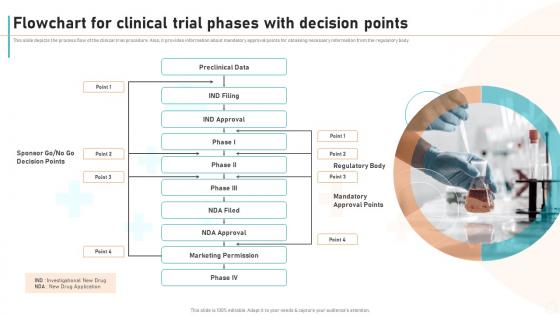
This slide depicts the process flow of the clinical trial procedure. Also, it provides information about mandatory approval points for obtaining necessary information from the regulatory body.
People who downloaded this PowerPoint presentation also viewed the following :
New Drug Development Process Flowchart For Clinical Trial Phases With Decision Points with all 6 slides:
Use our New Drug Development Process Flowchart For Clinical Trial Phases With Decision Points to effectively help you save your valuable time. They are readymade to fit into any presentation structure.





FAQs for New Drug Development Process Flowchart For Clinical Trial Phases
So drug development basically goes: find promising compounds in the lab, test on animals for safety, then three phases of human trials. Phase I is just safety with small groups. Phase II checks if it actually works. Phase III compares it to existing treatments with way more people. The whole process is insane - we're talking 10-15 years and hundreds of millions of dollars (seriously, how is healthcare so expensive?). After Phase III you submit everything to the FDA and pray they approve it. Each phase has specific goals you've got to hit before moving on, so there's no skipping steps unfortunately.
So preclinical is all the lab stuff - petri dishes, lab mice, making sure your drug won't straight up kill people. That's where most compounds fail tbh, even the promising ones. Clinical trials are the human testing part, which honestly feels like forever. You start small with safety studies, then work up to massive trials with thousands of patients. The whole preclinical phase usually takes 3-6 years, then clinical adds another 6-10 years on top. It's basically a decade-plus commitment if you're lucky and everything goes right.
So the FDA is basically watching over every step of drug development. You can't move between trial phases without their approval first. They'll dig through all your safety and efficacy data, then decide if your drug actually makes it to market. Plus they inspect facilities and can yank drugs later if problems pop up. Honestly, the whole process involves way more paperwork than you'd expect - it's kind of insane. But here's the thing: start talking to them early through pre-submission meetings. Getting aligned on your strategy from the beginning will save you major headaches down the road.
So first thing - you gotta figure out what protein or pathway is actually causing the problem. That's your target. Then comes the fun part (kidding, it's tedious) - screening millions of compounds to see what sticks to your target. High-throughput screening is clutch here. Computer modeling saves you cash by testing stuff virtually first. Don't sleep on natural sources either - plants and ocean critters have some wild compounds. Oh, and prep yourself for disappointment because most candidates will totally bomb later on. Cast a wide net early and double-check any promising hits with different tests before you get your hopes up.
So clinical trials basically have three phases. First one's just safety testing - they give it to like 20-100 people to see what dose won't kill you (sounds harsh but that's literally what it is). Then Phase II gets more interesting because you're actually seeing if the thing works, testing on a few hundred people with your target condition. Phase III is the big kahuna - thousands of participants, your drug vs whatever treatment doctors use now. The whole time you're tracking side effects and measuring all sorts of biomarkers. Oh, and you gotta decide upfront what "success" looks like or you'll be scrambling later trying to figure out if it actually worked.
Ugh, recruitment is seriously the worst part of running trials. Most studies can't even hit their enrollment numbers on time, which completely screws up timelines and budgets. You need enough people for decent stats, plus if half your participants bail midway through, the data becomes a nightmare and regulators start asking annoying questions. I'd say start planning way earlier than feels necessary - like, months ahead. Don't make your inclusion criteria super narrow or you'll be searching forever. The sites with solid patient relationships always do better at keeping people enrolled. Trust me, it always takes twice as long as you think it will.
Safety and efficacy problems kill most drug candidates - that's where you'll see the biggest losses. Poor pharmacokinetics is another major issue (drug can't reach its target or hangs around too long). Manufacturing headaches and regulatory roadblocks add to the mess. The failure rate? Absolutely brutal - we're talking 90%+. What's frustrating is many of these problems could be caught earlier with better preclinical testing and biomarker work. More rigorous early screening would save everyone a ton of headache down the line, but companies often rush ahead anyway.
So pharmacogenomics is basically a game-changer - you can spot genetic variations that predict how patients will respond to drugs. Clinical trials get way more targeted because you're grouping people by their genetic profiles instead of just throwing everyone together. Success rates go up, safety problems drop. You'll catch non-responders super early too, which saves crazy amounts of cash on compounds that would've flopped anyway. Honestly, once you see the data it's hard to go back to the old methods. Start building genetic screening into Phase I and you won't regret it.
Okay so the main things: informed consent is huge - people need to actually get what they're agreeing to, not just sign papers. Risk-benefit has to make sense too. Don't cherry-pick only healthy participants if sick people will actually use the drug, that's just bad science. Data integrity can't be messed with, obviously. Honestly, get a really good ethics review board because they'll spot problems you totally missed. Oh and protecting vulnerable populations is critical - some people can't advocate for themselves properly. Trust me, cutting corners on ethics will bite you later.
So AI is basically revolutionizing drug discovery right now. You can predict if compounds will actually work before spending money making them. The cool part? Machine learning digs through huge datasets to find drug targets and spot toxicity issues super early. Plus it's great at finding new uses for drugs we already have - which honestly saves so much time and cash. These algorithms help you figure out which candidates are worth pursuing and avoid those brutal late-stage flops. My advice? Start where your data quality is solid, that's where you'll see results fastest.
Dude, it's brutal - we're talking 10-15 years and billions just to get one drug approved. Most crash and burn in Phase II or III trials after you've already dumped crazy money into them. Regulatory stuff is a nightmare too, like one tiny safety flag can kill everything. Oh and patent cliffs are rough because companies are racing to make their money back before generics flood the market. My cousin works in pharma and says it's honestly depressing how many promising treatments just vanish. If you're investing, definitely look at pipeline diversity - companies with multiple shots on goal survive the inevitable failures way better.
So basically post-market surveillance is just watching drugs after they're already being sold to everyone. Healthcare workers and patients report weird side effects to databases like the FDA's system. Clinical trials are super limited - they only test a few thousand people for a short time. But when millions start taking something? That's when you see the rare stuff or problems that take years to show up. My cousin works in drug research and she's always going on about how people need to actually report side effects properly. The amount of data flowing through these systems daily is honestly crazy.
Patient feedback is huge in drug development, especially during Phase II and III trials. People report side effects, how they're feeling day-to-day, whether the drug actually makes life better. The FDA now requires these patient-reported outcomes for most approvals - which honestly makes so much sense. Companies also set up advisory boards early on so they understand what actually matters to patients living with the condition. Not just lab numbers, but real stuff. If you're involved in any trials, definitely push for meaningful patient input. Otherwise you end up with something that works on paper but doesn't help anyone's actual life.
Honestly, it's all about money and time - companies can't fund everything forever. Drug development takes like 10-15 years and costs over a billion bucks, so they're constantly deciding what's worth continuing. Really promising drugs get axed if the market's too small to make back that investment. Sucks but that's business. Teams will streamline trials or find partners to split costs. Oh and they love those fast-track FDA pathways when possible. My take? Always pad your timelines with extra buffer. Trust me, stakeholders would rather hear "18 months" upfront than get surprised later.
Dude, the whole drug development space is getting crazy right now. AI is completely changing how companies find targets and design trials - like, the speed is insane. Personalized medicine isn't just a buzzword anymore either. They're actually using genomic profiling to customize treatments for your specific DNA. Gene therapies are expanding way beyond rare diseases too. Oh, and digital therapeutics are getting FDA approval left and right - didn't see that coming five years ago. Platform tech is speeding everything up. Honestly think the biggest plays will be combo therapies mixing traditional drugs with digital stuff.
-
Thanks for all your great templates they have saved me lots of time and accelerate my presentations. Great product, keep them up!
-
“I really like the convenient operation and professionalism I saw on the SlideTeam website. I want to express my regards and appreciation to the team.”