

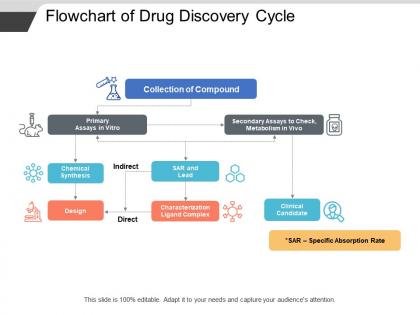
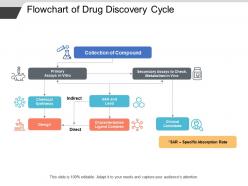
Flowchart of drug discovery cycle




Try Before you Buy Download Free Sample Product
 Impress Your
 Audience
 100%
100% Editable
 Save Hours
 of Time


Experience the dazzling effect of our Flowchart Of Drug Discovery Cycle. You will be floored by their absolute brilliance.
People who downloaded this PowerPoint presentation also viewed the following :
Flowchart of drug discovery cycle with all 5 slides:
Our Flowchart Of Drug Discovery Cycle have catchy designs. The enthusiasm they create is contagious.
FAQs for Flowchart of
Okay so drug discovery has four big phases. First you find your biological target and validate it - this part is crucial because if you mess up here, you'll waste years. Then comes screening thousands of compounds to find "hits" that actually work. Optimizing those hits into better lead compounds is honestly where the real chemistry magic happens. After that, it's preclinical testing in animals to check safety and efficacy. If that goes well, you move to human trials. The whole thing takes 10-15 years and costs insane amounts of money, so don't rush the early validation work.
Honestly, target ID is probably the most crucial step - it shapes your whole discovery program. Pick a crappy target and you're screwed from day one (been there!). Your choice affects everything: assays, screening, what kind of drugs you can even make. Some targets are just nightmares to work with. Look, I know it's tempting to jump straight into screening, but don't. Seriously spend the time validating your biology first. Yeah it feels slow, but trust me - you'll thank yourself later when you're not stuck with six months of useless data. Balance the cool novel stuff with what's actually doable.
So high-throughput screening is like the shotgun approach to drug discovery - you test thousands or millions of compounds against your target protein super fast using robots and automated assays. Basically you're throwing everything at the wall to see what sticks. The whole point is finding compounds that bind to your target or mess with cell behavior in interesting ways. You need solid compound libraries though, otherwise you'll spend forever chasing garbage results. It's your first big filter before diving deeper into promising hits. Pretty neat how much you can screen in just days now.
So medicinal chemistry is where you're actually designing the molecules that become drugs. Your chemists will take lead compounds and tweak them - boosting potency, cutting toxicity, fixing how the body processes them. Honestly the best teams I've seen have their med chem people talking constantly with the biologists and pharmacologists. They'll cycle through tons of variations, test them, then redesign based on what they learn. It's kind of repetitive but that's how you find gold. Just make sure you get them involved early in preclinical - don't wait.
So basically, your drug's gotta get absorbed, move around the body, get broken down, then eliminated - that's the PK side. PD is all about how well it binds to its target and what happens downstream. Molecular weight, how fat-loving it is, stuff like that really drives both. Think of it like a crazy obstacle course where each step screws with the next one. Patient age and genetics throw another wrench into things too. Oh, and drug interactions - those can totally mess up your predictions. You really want to nail this early because PK/PD problems still kill most drugs in trials.
So preclinical is basically all the lab work before you touch humans - cell cultures, animal testing, that whole mess. You're trying to figure out if your drug is even worth the headache. Clinical trials come after, when you actually test on people. The FDA gets way more involved once you hit clinical trials. Preclinical? You're just weeding out the duds. But clinical means informed consent forms, mountains of paperwork (seriously, it's insane), and actual oversight. Timeline-wise, you're looking at 3-6 years minimum for preclinical before you can even file your IND. It's a slog, honestly.
Think of biomarkers as molecular breadcrumbs showing if your drug actually works. They help identify the right patients and measure effects in early trials - way better than waiting for clinical endpoints. Honestly, I've seen too many programs crash late because they didn't use them. You can predict who'll respond to treatment and make go/no-go calls faster. The cost savings alone are worth it. My advice? Build your biomarker strategy from day one, not as an afterthought. It'll save you major headaches down the line.
Dude, you've gotta think about FDA stuff from the very beginning - it's not something you tack on later. Your whole study design, what endpoints you pick, how you collect data... all of that gets shaped by regulatory requirements. The pathway you go with (505(b)(1) vs 505(b)(2)) will totally change your timeline and budget. Plus your preclinical work needs to hit GLP standards, and obviously you can't touch humans without IND approval first. I learned this the hard way on a project once. Seriously though, sketch out your regulatory game plan early or you'll be scrambling later.
So AlphaFold's protein folding thing is huge right now. Companies are using transformer models - literally the same tech as ChatGPT - to design new drug compounds super fast. Way faster than old school methods. Machine learning's gotten scary good at catching toxicity issues and drug interactions before you waste years in development. Oh, and they can screen millions of compounds on computers first - no lab needed initially. Honestly, it's wild how much time this saves. DeepMind and Atomwise are doing some crazy stuff if you want to see what's coming next.
So here's the deal with patents - you get 20 years from filing, but clinical trials can burn through like 10-15 of those years. Pretty brutal timing. Companies file strategically and use continuation patents to squeeze out more coverage (it's basically pharmaceutical chess). That exclusivity window is make-or-break time for recovering R&D costs before generics crash the party. Oh, and don't treat patent strategy as something you'll figure out later - build it into your discovery timeline from the start. Trust me on that one.
Dude, it's massive because universities have all the brilliant research but zero cash to actually make it happen. Like, we're talking $2.6 billion to get one drug approved - that's insane. Academic labs discover cool stuff all the time, but pharma companies are the ones with deep pockets and regulatory teams who know how to navigate the FDA nightmare. Put them together and you've got innovation plus the resources to actually execute. Oh, and hit up conferences if you can - that's where most of these partnerships start. Industry folks are always scouting for the next big discovery.
PROs basically make you rethink your whole trial design - can't just rely on lab values anymore. You're gonna need specific questionnaires, way longer follow-ups, different stats to actually capture quality of life stuff. Honestly it's a headache because your protocol gets so much messier, but the data becomes actually useful to docs and FDA. The trick is figuring out which PROs match your drug's action early on. Then you design endpoints around patient experiences instead of just biomarkers. Sample size calculations get trickier too. But yeah, it's worth the extra complexity in the end.
Ugh, the failure rate is insane - like 1 in 5,000 compounds actually make it to market. Your lab results look amazing, then boom, doesn't work in humans or causes weird side effects. Takes 10-15 years too, which is just soul-crushing. It's basically expensive gambling but with beakers. What actually helps though? Don't just chase potency early on - focus on whether the compound will even behave like a drug should. Also, make friends with doctors who'll tell you straight up if patients actually need what you're making. Saves you from chasing something totally pointless for years.
So basically you flip the whole "one drug for everyone" thing and get super specific with genetic profiles right from the start. Way more focused but honestly a lot messier too. You've gotta find your patient groups early, build diagnostics with the drug, run these tiny targeted trials. Success rates are way better though - and patients actually get treatments that work for them. Oh and definitely think about biomarkers from day one, not as an afterthought. It's pretty cool stuff once you get into it.
So you'll want to track potency first - basically how well your compound actually binds to whatever you're targeting. Selectivity matters too because hitting random off-targets is never fun. ADMET stuff like solubility and metabolic stability are critical, plus you can't ignore safety metrics like cytotoxicity. Honestly, the practical side trips people up - can you even make this thing at scale without going broke? Oral bioavailability is another big one if that's your delivery route. My advice? Set up some kind of weighted scorecard early on. Trust me, ranking candidates objectively beats going with your gut every time.
No Reviews