


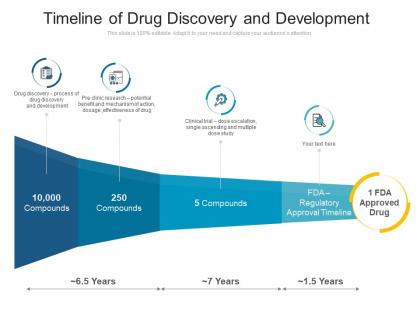
Timeline of drug discovery and development




Try Before you Buy Download Free Sample Product
 Impress Your
 Audience
 100%
100% Editable
 Save Hours
 of Time


Our Timeline Of Drug Discovery And Development are topically designed to provide an attractive backdrop to any subject. Use them to look like a presentation pro.
People who downloaded this PowerPoint presentation also viewed the following :
Timeline of drug discovery and development with all 2 slides:
Use our Timeline Of Drug Discovery And Development to effectively help you save your valuable time. They are readymade to fit into any presentation structure.
FAQs for Timeline of drug
So basically you start with target identification, then hunt for promising compounds - they literally screen thousands. Preclinical testing comes next and takes forever (3-6 years), but you need that safety data. Clinical trials happen in three phases: Phase I is small groups for safety, Phase II tests if it actually works, Phase III scales up big time. The whole thing? 10-15 years minimum and costs are insane. Oh and definitely pad your timelines because something always goes wrong. I learned that one the hard way.
Preclinical research eats up 3-6 years, then you're looking at 1-2 years for Phase I trials. Phase II takes another 2-3 years, Phase III drags on for 3-4 years. Regulatory review tacks on 1-2 more years at the end. It's honestly exhausting when you're in the thick of it, but each phase exists for solid reasons. Your timeline will shift depending on what therapeutic area you're in - some move faster than others. Also, tons of drugs fail at each stage, so you might be doing this dance multiple times. I always pad my timelines with extra buffer because something always goes sideways.
Honestly, AI and machine learning are crushing it right now - they predict which compounds will work before you blow years testing duds. High-throughput screening is pretty wild too, letting you test thousands at once (seriously satisfying to watch). CRISPR creates way better disease models than old methods. There's also computational modeling for drug interactions and organ-on-chip tech that actually mimics human biology instead of those janky cell cultures. The sweet spot is combining them - your AI data flows straight into screening protocols. I'd figure out your biggest pipeline bottleneck first though.
So these partnerships usually cut 2-4 years off drug development timelines, which is huge. Universities bring the cool new targets and early compounds, but they're terrible at the clinical trial stuff - that's where pharma companies shine with their regulatory expertise and infrastructure. Risk gets spread around too since everyone's sharing costs and potential failures. Honestly, the whole thing works pretty well when partners mesh right. Just don't mess up the IP agreements at the start or you'll be dealing with lawyer headaches for years. My old professor always said that's where most collaborations fall apart.
So the FDA is basically your final gatekeeper - they review everything from your trial data to how you're manufacturing the stuff. You need their thumbs up for Phase I, then each phase after that, plus commercial launch obviously. Takes forever though, like 10-15 years because they're obsessed with safety (which I get, but still). The paperwork is absolutely insane. Get a regulatory consultant early - seriously, don't wait. They know all the submission tricks and can save you from expensive mistakes that'll set you back months.
Yeah the pandemic totally changed how drug development works. COVID vaccines got made in months instead of years because regulators fast-tracked everything and money wasn't an issue for once. Companies started doing trial phases at the same time rather than one after another. Honestly, it's wild how much bureaucratic nonsense just vanished when lives were on the line. The good news? They didn't actually skip safety steps, just cut the waiting around. A lot of these faster approval processes are here to stay now, which could help with other urgent medical stuff too.
Safety problems tank most drugs in trials, plus they just don't work as well as expected. Poor pharmacokinetics is huge too - the drug gets broken down too fast or can't reach the right spot. Sometimes researchers are targeting completely the wrong biological pathway (which is honestly pretty embarrassing). Even drugs that work might not be profitable enough to justify continued development. Lab results rarely translate to humans - it's kind of depressing how often promising compounds flop. My advice? Set up early checkpoints so you fail quickly and cheaply instead of burning millions in late-stage trials.
Getting patients involved early actually speeds things up - sounds backwards but it's true. They catch problems during design that would've tanked your trial later. Like, they'll tell you if your endpoints make sense or if nobody's gonna want to do your protocol. Way better than finding out after you've blown two years on the wrong approach. Plus patients know what outcomes actually matter to them vs what we think matters (spoiler: often different). Oh, and they're surprisingly good at spotting recruitment issues before they happen. Start this during protocol design though, not after - saves you from those painful mid-study pivots.
Okay so preclinical testing is where you prove your drug won't kill people before moving to human trials. You're doing lab work and animal studies to figure out toxicity, dosing, how the body handles it - all that fun stuff. Takes 3-6 years and costs a fortune, which honestly sucks but regulators won't budge on it. Most drugs actually crash and burn at this stage. Design your studies with your end patients in mind from the start though. Without rock-solid data here, your IND application gets tossed immediately and you're back to square one.
So AI is pretty crazy at screening compounds - like millions of them in hours vs months the old way. The algorithms can predict which ones might actually work and spot drug targets way faster. Honestly, it's getting impressive how good they are at this. But here's what matters: they're only speeding up the research part, not clinical trials where the real time and cash gets burned. You'll probably see discovery drop from 6-7 years to maybe 3-4, but don't expect magic overnight. Look for companies that mix the AI with people who actually know biology.
Ugh, ethics in pharma is messy. Animal testing is obviously the big one - you want reliable data but hate using more animals than necessary. Then there's patient safety during trials, which honestly keeps me up at night sometimes. The consent paperwork alone is brutal with all those regulatory hoops. But here's what really gets me: companies chase profitable diseases while ignoring stuff that mainly affects poor countries. Access issues are huge too - who actually gets these treatments once they're approved? My advice? Get your team talking about this stuff from day one, not when you're already in crisis mode.
Honestly, market access shapes discovery way more than people realize. Your team finds out early that payers won't cover certain drug classes? You're gonna pivot to different compounds fast. Companies do this all the time - they'll rush rare disease programs because pricing's more flexible there, or just dump "me-too" drugs when markets get too crowded. It's super strategic. Best move? Get your market access people involved during target selection. Don't wait until you're planning launch - that's way too late.
Oh man, drug discovery is basically built on learning from epic wins and disasters. Thalidomide completely changed how we do safety testing - now everyone front-loads that stuff because nobody wants another tragedy. Clinical trials got way more rigorous too after watching so many promising drugs crash and burn in Phase III (which honestly still happens more than it should). The big successes pushed companies to invest heavily in target validation and biomarkers. Meanwhile, all those spectacular failures? They forced better predictive models and patient selection. Seriously, study both the blockbusters AND the flops - you'll learn more about managing risk than from any textbook.
Honestly, AI and machine learning are where the real action is - they're already shaving 30-40% off early discovery in some cases. Companies are using digital twins to fail fast and cheap, which actually speeds everything up. The regulatory folks have gotten way more flexible too with adaptive trials and rolling submissions. COVID was wild because it proved you can squeeze a decade of work into 18 months when everyone's actually working together. Though I guess that was a pretty unique situation. I'd definitely watch how AI develops in your specific area - that's probably gonna be your biggest timeline game-changer.
Look, funding basically makes or breaks how fast drug discovery actually happens. Consistent money means your team can focus on research instead of constantly hunting for grants - which is honestly exhausting. Government funding gives you longer timelines but man, the bureaucracy is brutal. Private investors push for quicker results, sometimes too quick, but they'll dump serious cash when you really need it. My advice? Don't put all your eggs in one basket. Mix your funding sources early so you're not screwed if one stream disappears halfway through your work.
-
Topic best represented with attractive design.