

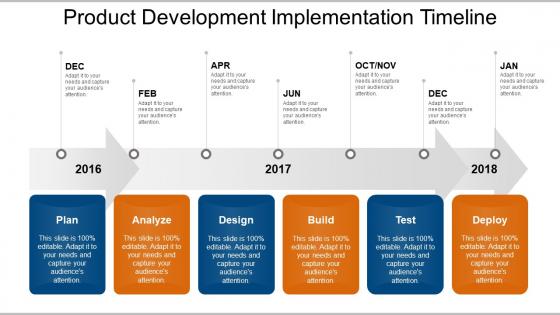
Product Development Implementation Timeline Powerpoint Graphics





Try Before you Buy Download Free Sample Product
 Impress Your
 Audience
 100%
100% Editable
 Save Hours
 of Time


Draw folks away from baseless arguments with our Product Development Implementation Timeline Powerpoint Graphics. Bring all the jaw jaw to an end.
People who downloaded this PowerPoint presentation also viewed the following :
Product Development Implementation Timeline Powerpoint Graphics with all 5 slides:
Analyze causes of any delays with our Product Development Implementation Timeline Powerpoint Graphics. It helps carry out an in house assessment.

FAQs for Product Development Implementation
So you've got ideation first, then market research and design/prototyping. Testing comes next - honestly this is where most teams burn through their time, but it's worth it since you catch the major problems here. Development and launch wrap things up. Don't expect to nail it on the first go though, you'll definitely cycle back through some steps. Oh and definitely map out your milestones early! I learned this the hard way - always build in extra time for those "wait, this isn't working" moments that always pop up.
Honestly, market research is a game-changer for your dev timeline. It validates your ideas upfront so you're not scrambling to pivot later when you realize nobody wants what you built. User interviews and competitor analysis should happen before you even touch code - trust me on this one. You'll actually know which features to prioritize instead of guessing. Plus stakeholders love concrete data when you're asking for resources. The research also reveals potential roadblocks early, so your timelines won't be completely unrealistic. I learned this the hard way on my last project.
Dude, getting your teams to actually talk to each other is huge for hitting deadlines. Engineering, design, marketing - if they're chatting from day one, you'll spot problems way before they blow up your timeline. No more of that annoying thing where someone works for weeks then gets told "uh, that's totally wrong." Weekly standups are solid for keeping everyone on the same page. Honestly, the whole "work separately then hope it fits together" thing is such a waste of time. You end up solving stuff faster when people aren't working in their own little bubbles.
Honestly, Agile just makes way more sense than the old way of doing things. Instead of waiting months to see if your project actually works, you're shipping stuff every 2-3 weeks. Real users can tell you what sucks before you've wasted tons of time building the wrong thing. When priorities shift (and they always do), you can actually change direction without starting over. Your team won't get stuck building features that seemed brilliant in meetings but nobody wants. I'd start with 2-week sprints - you'll be shocked how much clearer everything becomes.
Don't try measuring everything at once - you'll lose your mind. During discovery, I'd stick to user interviews and how well you're validating problems. Design phase? Focus on usability results and how many iterations you're cranking through. Development gets into sprint velocity and bug tracking (boring but necessary). Launch time is all about adoption rates and whether people actually like what you built. After that, retention becomes your best friend. Honestly, pick maybe 3-4 things per stage and actually look at them weekly. Most teams collect tons of data then never check it.
Yeah, feedback loops will add time for sure - usually 2-4 weeks per cycle. Most people think it's just reading comments, but there's actually a ton of work processing everything. You've got usability tests, surveys, stakeholder input, then figuring out what's actually worth fixing vs what's just noise. Honestly, some feedback is just... not helpful lol. But here's the thing - plan for these cycles upfront instead of cramming them in later. Don't treat them like optional extras or you'll hate yourself when deadlines start slipping.
Honestly, scope creep kills more projects than anything else - people keep adding "just one more thing." Requirements that aren't crystal clear from day one will bite you later. Getting everyone on the same page upfront is huge, otherwise you're building something nobody actually wants. Teams that don't talk regularly? Recipe for disaster. Same goes for skipping proper testing because you're "running out of time." Build in buffer time from the start - something always goes sideways. Don't let those "tiny changes" slide without checking how they'll mess with your timeline. Oh, and document everything or you'll forget what you agreed on three weeks ago.
Honestly, prototyping is a lifesaver because you'll catch issues early when fixing them won't make you want to cry. Test your ideas with real users right away instead of just hoping they'll love what you're building. Your team stays on the same page too - I've seen projects completely derail because everyone thought they were making different things. Start super rough though. Sketches, basic wireframes, whatever. Don't waste time making things pretty at first (I learned this the hard way). Test fast, make changes, then slowly polish as you figure out what actually works.
So for product timelines, I'd start with something your team already uses - maybe Asana or Trello if you want that visual Kanban vibe. Microsoft Project works too but honestly feels overkill half the time. Gantt charts are great when you need to show dependencies clearly. ProductPlan and Roadmunk are pretty solid if you're doing actual product roadmaps - they're designed for exactly this stuff. But real talk? Sometimes a good spreadsheet does everything you need, especially for quick stakeholder updates. Don't overthink it - you can always upgrade later if things get more complex.
Ugh, regulatory stuff is such a pain but you're looking at 6-18 months easily. Healthcare and finance are the worst for this. You've got compliance reviews, testing protocols, approvals - the whole circus. And they love changing rules halfway through your project because why not make life harder? Don't wait until launch to think about this though. I learned that the hard way on my last project. Figure out what regs you need during concept phase and run compliance checks alongside development when you can. My cousin works in medtech and she always says treat regulatory like a core feature, not something you tack on later.
Look, concept validation is basically your reality check before you waste tons of time building stuff. You're testing if people actually want what you're thinking of making - way better to find out early when pivoting doesn't hurt your soul (or wallet). I learned this the hard way honestly. Simple prototypes work great, or just talk to potential users. Doesn't need to be some fancy process. Catching problems now saves you from those brutal redesigns later when you're already emotionally invested. Think months of work versus a few conversations upfront.
Honestly, I always pad my timelines by 15-20% right from the start because something always goes sideways. When it does, figure out what's actually critical vs what would just be cool to have - then cut the fluff without mercy. Running tasks in parallel instead of one-after-another can help you catch up too. But here's the thing - don't wait until you're drowning to tell people about delays. I learned that the hard way once. Talk to stakeholders early, explain the trade-offs, and most people get it if you're upfront about what's happening.
Set up weekly check-ins right away and make your expectations super clear from the start. Shared dashboards are clutch - everyone stays in the loop without constantly bugging you for updates. Document every decision immediately because people have terrible memories about what was actually agreed on. Friday update emails are honestly a lifesaver, even when you feel like nothing's happening. I'd rather overcommunicate than have someone feeling blindsided later. Oh, and do a RACI matrix upfront so people know exactly when their input matters and when they can just chill.
Dude, AI can seriously save you weeks on dev work. All that repetitive testing stuff? Automate it. Documentation is the worst part of any project, but AI can knock out first drafts while you actually code. It's pretty wild for rapid prototyping too - you can iterate way faster than doing everything manually. Predictive analytics will catch problems before they blow up your timeline, which honestly saved my ass last month. Automated workflows keep everyone on the same page without endless Slack threads. Just don't go crazy at first. Pick testing or docs to start with, then build from there.
Honestly, it's pretty simple math - longer timelines mean you're paying your team more while competitors might beat you to market. Shortening deadlines works but gets pricey quick. You'll need extra developers, overtime, or contractors. Rushing usually backfires too. Technical debt from cutting corners costs way more to fix after launch than just doing it properly the first time. I've seen this happen so many times it's not even funny. Best approach? Map out realistic milestones from the start and build in small buffers. Way better than scrambling to make huge timeline changes halfway through.
-
Use of icon with content is very relateable, informative and appealing.
-
Innovative and Colorful designs.