

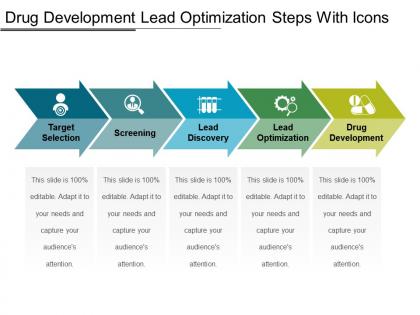
Drug development lead optimization steps with icons




Try Before you Buy Download Free Sample Product
 Impress Your
 Audience
 100%
100% Editable
 Save Hours
 of Time


Our Drug Development Lead Optimization Steps With Icons are faithful to the context. They ensure the correct essence emerges.
People who downloaded this PowerPoint presentation also viewed the following :
Drug development lead optimization steps with icons with all 5 slides:
Clearly explain what the clues indicate with our Drug Development Lead Optimization Steps With Icons. It helps decipher available evidence.
FAQs for Drug development lead optimization
Honestly, the stages are pretty simple when you break them down. Hit identification comes first from your screening data. Then hit-to-lead optimization where you fix the obvious junk. Lead optimization is where things get messy - balancing potency, selectivity, ADMET properties while trying to stay sane. Candidate selection wraps it up when you finally pick your winner. One thing I learned the hard way though? Define your criteria for moving between stages upfront. Otherwise you'll get stuck optimizing the same compounds forever and never actually progress anything. Trust me on that one.
Honestly, lead optimization is a total game-changer for avoiding expensive disasters later. You'll catch bioavailability problems and toxicity issues upfront instead of watching your compound crash during Phase II trials - which costs a fortune. It's way cheaper to fix things early when you can still tweak the structure easily. Plus you enter clinical trials with something that actually has a shot at working. I learned this the hard way watching projects fail late-stage. Get your ADMET properties sorted first, trust me on this one.
Honestly, computational modeling is like having a crystal ball before you waste time synthesizing stuff that might suck. QSAR models and molecular docking can show you which modifications are worth pursuing - way better than the old "make everything and hope for the best" method. The predictions aren't perfect, obviously, but they're getting scary good at catching problems early. I'd mess around with free tools like SwissADME first to see if you actually like this approach. Then maybe upgrade to the fancy commercial platforms once you're hooked. Saves so much headache in the long run.
Focus on potency, selectivity, and ADMET properties first. Potency shows you're actually hitting your target. Selectivity keeps you from screwing up other pathways - trust me, off-target effects will come back to haunt you. ADMET data (absorption, distribution, metabolism, excretion, toxicity) tells you if it'll work in real life or just in a dish. Don't forget physicochemical stuff like lipophilicity and solubility either - they affect everything else down the line. Oh, and set hard cutoffs for each metric beforehand. Otherwise you'll just rationalize keeping mediocre compounds because you spent months on them.
So basically SAR studies show you which molecular tweaks actually help vs hurt your compounds. You modify different parts systematically and test them - way better than just guessing randomly. Though honestly, you'll still hit plenty of dead ends even with good data. The patterns you find help prioritize what to try next and avoid modifications that historically flop. I'd start by mapping the most critical functional groups first, then work outward from there.
Honestly, the worst thing you can do is obsess over one property at a time - it's like playing whack-a-mole but way more expensive. Don't just chase potency numbers. ADMET and selectivity matter from day one, trust me. I've watched entire teams burn months making giant structural jumps without understanding their SAR first (painful to witness). Set up a scoring system early that weighs everything you care about. Otherwise you'll constantly flip-flop on priorities. Multiparameter optimization sounds fancy but it's really just common sense - balance all your factors instead of tunnel vision on one shiny metric.
Here's the thing - if your lead compound needs 15+ synthetic steps with crazy expensive reagents, you're basically dead in the water before you start. Your budget will be toast. Even worse is when your small-scale chemistry completely falls apart at kilogram scale for tox studies. I've seen this nightmare way too many times. Get process chemists involved during lead optimization, not after - they'll spot the manufacturing disasters early. Bottom line: can you actually make tons of this stuff without going bankrupt? If not, find a new lead.
So for virtual screening, most people go with Schrödinger Suite or OpenEye OMEGA. Glide (part of Schrödinger) is huge for molecular docking - like everyone uses it. OpenEye's got solid conformer generation tools too. MOE is decent, pharma companies love that one for some reason. AutoDock Vina's free if you're on a budget, but honestly the interface kinda sucks. They all have pretty brutal learning curves though. I'd say start with whatever your lab already pays for, then maybe mess around with the free options later to see how results compare. Way easier than learning everything from scratch.
Start with SAR studies - systematically tweak functional groups to see how it changes potency and selectivity. That's honestly where I'd begin since it's the most straightforward. Bioisosteric replacements are clutch for swapping out problematic groups while keeping your activity intact. Don't sleep on ADMET properties either - work on solubility, permeability, and metabolic stability early through smart structural modifications. Fragment-based approaches can save you if you hit a wall. Oh, and map your SAR systematically instead of just throwing darts at the board.
Honestly, AI-driven molecular design is everywhere right now. Machine learning can predict ADMET properties way faster than old-school methods - saves ridiculous amounts of time and cash. Cryo-EM structures are giving us better targets for structure-based design too. DNA-encoded libraries are becoming massive for hit identification. The coolest part? Everything's getting integrated now. You can run virtual screening, synthesize stuff, and test it all in one tight loop. Fragment-based discovery is getting pretty wild too, way more sophisticated than before. Definitely check what AI platforms your company has access to - some are game-changers.
Dude, AI tools are seriously changing the game for lead optimization. Instead of spending weeks in the lab, you can predict which compounds will work in just hours. Virtual screening lets you test massive databases, and ADMET prediction is getting ridiculously good these days. The algorithms catch structure-activity patterns that we'd totally miss otherwise. Honestly, it's kind of mind-blowing how fast this stuff is advancing. My advice? Don't go crazy with it right away. Pick one specific problem you're dealing with and test an AI tool on some old data first. See how it performs before diving in completely.
PK/PD are absolutely critical - they tell you if your compound will actually work in people. So many promising drugs crash and burn because teams skip ADMET stuff early on, which honestly drives me crazy. You've got to understand absorption, distribution, metabolism, elimination (the PK side) so your drug hits the target at the right levels. Then PD shows the concentration-response relationship - basically does it do what you want? The trick is baking both into optimization from day one instead of treating them like some final hurdle.
Honestly, start with in vitro - it's way cheaper and you'll know fast if your compound even hits the target or if it's gonna be toxic. Cells in a dish don't lie about the basics. But here's the thing, they also don't tell you the whole story. That's where in vivo comes in to humble you because what works in the lab doesn't always work in an actual living system. You need that real bioavailability and distribution data. Screen modifications in vitro first, then test your winners in animals. Saves you tons of headaches later.
Start with SAR - mess around with different functional groups and see what happens to your potency. Binding assays are your friend here, run them constantly. Fragment-based stuff works well if you're dealing with weak hits that need a major boost. But honestly? Don't get tunnel vision on just potency. I've watched so many people optimize the hell out of binding only to realize their compound can't even cross a cell membrane. Use docking to guide you, but actually test everything. Build that SAR map and let it tell you where to go next.
Honestly, regulatory stuff controls everything about your timeline - there's no way around it. You're basically working backwards from FDA review periods because they don't give a damn about your internal deadlines. IND filing is the big milestone, which means getting tox studies, manufacturing data, and clinical protocols done months ahead of time. Here's the thing though - regulatory feedback can totally derail you and send you back to square one. I've seen it happen so many times. Build in way more time than you think for regulatory prep, and get your reg team involved super early when you're picking compounds. Trust me on this one.
-
Colors used are bright and distinctive.
-
Innovative and attractive designs.