

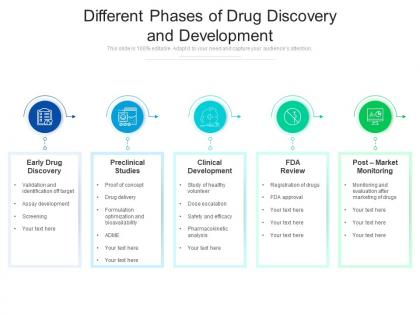
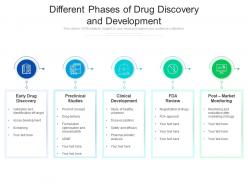
Different phases of drug discovery and development




Try Before you Buy Download Free Sample Product
 Impress Your
 Audience
 100%
100% Editable
 Save Hours
 of Time


Our Different Phases Of Drug Discovery And Development are topically designed to provide an attractive backdrop to any subject. Use them to look like a presentation pro.
People who downloaded this PowerPoint presentation also viewed the following :
Different phases of drug discovery and development with all 2 slides:
Use our Different Phases Of Drug Discovery And Development to effectively help you save your valuable time. They are readymade to fit into any presentation structure.
FAQs for Different phases of drug
So basically you've got four main stages: target identification, lead discovery, preclinical testing, then clinical trials (Phases I-III). First you find your biological target, then screen a bunch of compounds for promising leads. Preclinical is where things get expensive - lab work, animal studies, safety checks. Honestly the timeline here is brutal, like 10-15 years and billions of dollars. Clinical trials start small with safety in humans, then scale up to big efficacy studies. Oh and figure out which stage you're tackling first because each one needs completely different expertise and funding. Can't really wing it.
So preclinical is when you're testing on cells and animals - basically making sure your drug won't kill people and actually does something useful. Think lab work, petri dishes, mouse studies. Way cheaper and faster honestly. Clinical trials? That's the expensive part where real humans volunteer to test it. Takes you through three phases over like 5-10 years and costs a fortune. Preclinical usually runs 3-6 years by comparison. Oh and don't underestimate how much paperwork the clinical side involves - it's brutal.
So HTS lets you test thousands of compounds against your protein target super fast - like having robots do all the tedious work for you. Way better than the old school method of testing stuff one by one. You'll screen entire chemical libraries to find what actually binds or messes with your target. Gets you tons of data quickly so you can spot the promising hits. Then you narrow those down for more testing. Oh, and definitely spend time setting up your assays right from the start because crappy setup = crappy results.
Honestly, AI is a game-changer for drug discovery. Instead of wasting months testing random compounds, machine learning can predict which ones actually have potential. You'll be able to spot promising drug targets way faster and even design totally new molecules from scratch. The pattern recognition is insane too - it catches stuff in huge datasets that would take researchers forever to find manually. Plus it flags potential side effects super early, which saves tons of headaches later. My advice? Find AI platforms that focus on whatever therapeutic area you're working in. That's where you'll see the biggest impact on your timeline and budget.
Honestly, the potency vs safety thing will drive you nuts - fix one and the other goes to hell. ADMET problems are brutal too. Your compound crushes it in the lab but then has garbage bioavailability or gets chewed up by metabolism way too fast. Selectivity's another nightmare since you need to nail your target without hitting random stuff that'll cause toxicity. Oh, and timeline pressure makes everything worse when you're scrambling to optimize while everyone's breathing down your neck. Pick your battles early though - don't try fixing every single issue at once or you'll lose your mind.
Honestly, regulatory guidelines are like your GPS for trial design - they'll tell you exactly what endpoints to hit, which patients to recruit, safety stuff, all of it. FDA and EMA have super specific requirements depending on your indication, so dig into those guidance docs early. I've watched teams completely restart because they ignored this step (ouch). Your stats plan, sample sizes, even how you structure phases - it all flows from what regulators want. Oh and definitely book that pre-IND meeting once you've got your protocol sketched out. Trust me, it's way better than scrambling to fix things later.
Look, PK and PD are huge because they show if your drug actually works in real people. PK tracks how the body handles your compound - you know, absorption, metabolism, all that stuff. PD is what the drug does once it hits the target. Without both? You're screwed honestly. I've seen brilliant compounds that get wiped out before reaching their target, or they get there but way too weak to do anything. Oh and here's the thing - start ADME studies early in discovery. Trust me on this one. Way cheaper than finding out later your amazing molecule is basically useless in vivo.
Look, patient diversity is huge for drug development - you can't ignore it. Different genetic backgrounds and ethnicities metabolize drugs completely differently. What's safe for one group might be totally ineffective or even dangerous for another. The FDA finally requires diversity data (about time, right?), but you should've been doing this anyway. Build those diverse patient networks early instead of panicking later. Your preclinical models need to actually reflect real populations too. Oh, and age matters more than people think - older patients process everything differently than your typical 25-year-old study participant.
Honestly, biomarkers are a game-changer because they let you see if your drug is actually doing what it's supposed to do early on. No more guessing games. You can track whether you're hitting the right pathway and spot safety issues before they blow up your trial. Plus they help you find the patients who'll actually respond to your drug - saves tons of money on late-stage failures (trust me, those hurt). The trick is picking good ones upfront during discovery. I always tell people to spend extra time validating them because crappy biomarkers will mess you up later. It's like having GPS versus driving blind.
Okay so the big ones are informed consent and making sure people actually get what they're signing up for - not just checking a box, you know? Safety's obviously huge, plus that risk-benefit thing has to make sense. Don't go after vulnerable groups just because recruitment's easier (sketchy but happens). Privacy protection is a must. You'll need ethics committee approval too. Oh and participants can bail anytime without consequences. Honestly, I always think - would I want my sister in this study under these exact same conditions? That usually tells you everything.
Dude, AI is completely changing drug discovery right now. Algorithms can predict how molecules behave and even design new compounds from scratch. The speed is insane. Labs are running thousands of experiments at once instead of doing everything manually - honestly saves so much time and money. Digital twins let you simulate trials before they actually happen, which is pretty cool. My cousin works in pharma and says everyone's scrambling to figure this out. You should definitely look into partnerships with tech companies or maybe invest in some computational platforms if you haven't already.
Honestly, it's pretty smart - universities are amazing at discovering new stuff but absolutely suck at the business side. They'll find some breakthrough mechanism but have no clue how to deal with FDA paperwork or manufacture anything at scale. Pharma companies are the opposite - tons of money and regulatory experience, but they might totally miss the coolest research happening in some random lab. Put them together and suddenly you can actually get discoveries to patients way faster. I mean, both sides hate admitting they need each other, but the partnerships that work are incredible. Definitely worth pursuing if you're in either world.
Dude, you NEED to patent early - like discovery phase early. Patents give you 20 years of exclusive rights from when you file, which sounds great until you realize your drug won't hit market for 10-15 years. So basically half your protection gets eaten up during development. It's honestly pretty brutal timing-wise. File too early and your patent dies right when you launch. Wait too long and competitors can swoop in. You'll want a solid IP lawyer to help map this out with your dev timeline. The whole thing's a balancing act but worth getting right.
Honestly, bring patients in way earlier than you think - like right at target identification. Patient advisory boards are gold for this stuff. They'll tell you what actually bugs them day-to-day, not just what looks good on paper. Use patient-reported outcome measures when designing studies. Quality of life matters more than some biomarker nobody cares about, you know? Digital tools can track their real experiences between visits too, which is pretty cool. Oh, and patient advocacy groups - they're surprisingly direct about unmet needs. Set up regular check-ins during preclinical work so you're solving actual problems instead of just... theoretical ones.
Honestly, bioinformatics is everywhere in drug discovery now. You can mine genomic data to find targets, predict how compounds will bind to proteins, even guess side effects before doing any actual lab work. The computational power is insane these days - like, we're basically simulating entire biological processes. Algorithms help you sort through thousands of potential compounds so you're not wasting time on duds. Saves a ridiculous amount of money too. If you're not using it yet, definitely pick up the basics. Your research will be so much faster. Trust me on this one.
-
Qualitative and comprehensive slides.
-
Informative presentations that are easily editable.
-
Very unique and reliable designs.