Business timeline powerpoint slide deck
Try Before you Buy Download Free Sample Product
Audience
Editable
of Time
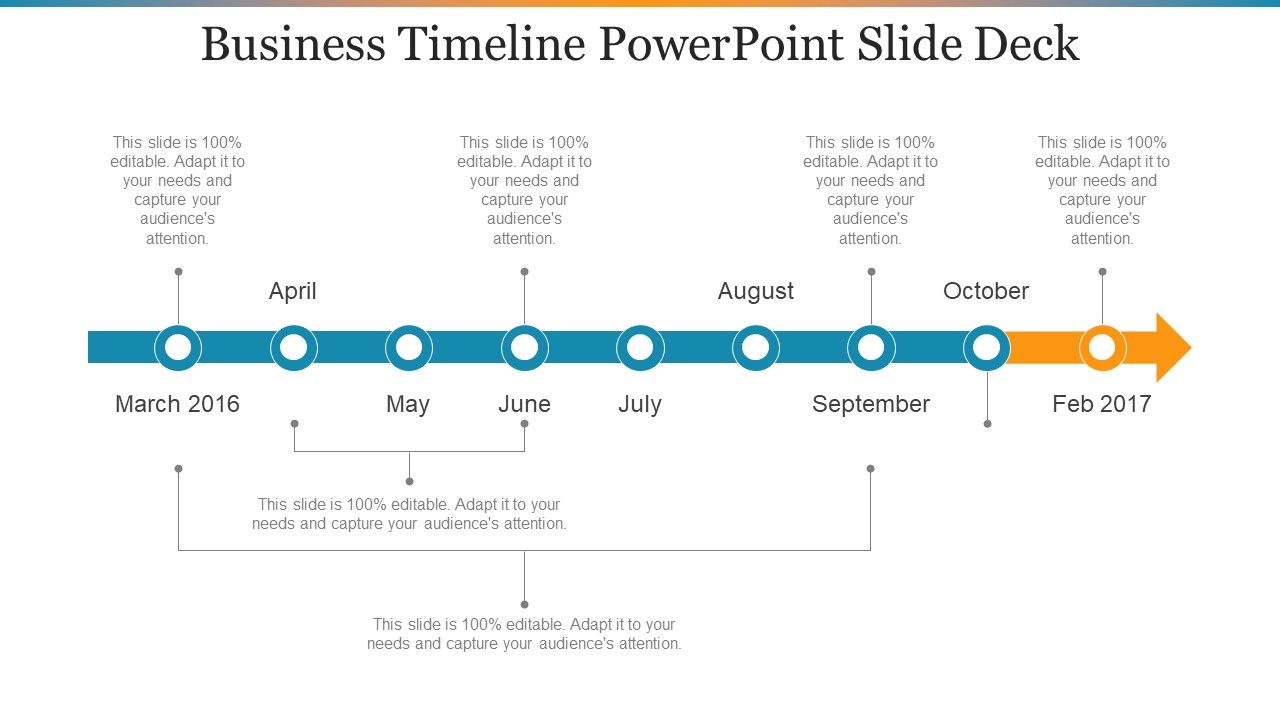
Display a timeline for a business plan with our business timeline PowerPoint slide deck. This presentation slide of timeline PowerPoint slide has been created to let the users visually track their project schedule and you can create a visual mapping of event or goals on horizontal line.With this timeline design template you can create a formal business plan intended for investors, and write a narrative for your business predictions. You can try this project timeline PowerPoint slide where you can enter the project start date, mention the names of team members and add their assignments to the project calendar. If you have less time than this business project planning timeline layout is the perfect choice for you to track the status of your project and you can present your successful business strategies for the upcoming years. If you want to showcase your business status in the form of a chronological order this slideshow would be really useful for you. Display your elegance with our Business Timeline Powerpoint Slide Deck. Deliver your thoughts in your inimitable stlye.
People who downloaded this PowerPoint presentation also viewed the following :
Content of this Powerpoint Presentation
Description:
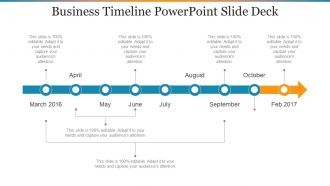
The slide is a PowerPoint titled "Business Timeline PowerPoint Slide Deck," presenting a chronological sequence of business events from March 2016 to February 2017. The professional layout, with a color transition in October, indicates a significant event or milestone.
Use Cases:
Ideal for showcasing project timelines and milestones, this versatile slide is applicable across various industries:
1. Technology and Software Development:
Use: Tracking product development, feature rollouts, or software updates.
Presenter: Project Managers or Product Leads.
Audience: Stakeholders, investors, or cross-functional teams.
2. Construction and Engineering:
Use: Outlining project phases, from conceptual design to final inspection.
Presenter: Construction Managers or Engineers.
Audience: Clients, contractors, or regulatory bodies.
3. Finance and Banking:
Use: Highlighting financial milestones, fiscal quarters, investment rounds, or compliance dates.
Presenter: Financial Analysts or Compliance Officers.
Audience: Shareholders, board members, or regulatory agencies.
4. Healthcare and Pharmaceuticals:
Use: Detailing drug development stages, clinical trials, or healthcare initiatives.
Presenter: R&D Managers or Healthcare Administrators.
Audience: Healthcare providers, investors, or regulatory agencies.
5. Marketing and Advertising:
Use: Demonstrating campaign timelines, market research, or product launches.
Presenter: Marketing Directors or Campaign Managers.
Audience: Clients, marketing teams, or company executives.
6. Education and Nonprofit:
Use: Showcasing program development, fundraising events, or strategic planning.
Presenter: Program Directors or Education Administrators.
Audience: Board members, donors, or institutional partners.
7. Retail and Manufacturing:
Use: Laying out product schedules, supply chain timelines, or store openings.
Presenter: Supply Chain Managers or Retail Planners.
Audience: Suppliers, retail partners, or internal management.
8. Legal and Compliance:
Use: Tracking legal cases, compliance deadlines, or policy implementation.
Presenter: Compliance Officers or Legal Counsel.
Audience: Corporate executives, legal teams, or regulatory bodies.
This timeline presentation slide is a valuable tool for visually presenting your company's journey and milestones, facilitating clear communication in diverse business environments.
Business timeline powerpoint slide deck with all 5 slides:
Advise folks on handling disabilities with our Business Timeline Powerpoint Slide Deck. It will generate care for the concern.
FAQs for Business timeline
So first you'll want to validate your idea actually works, then get some funding together. Launch your MVP and start tracking those first revenue numbers - that's when it gets real. Breaking even is huge, then you're thinking about scaling up, hiring people, maybe expanding into new markets. Honestly the timeline is all over the place depending on what you're building. I'd map out goals every 3-6 months in year one, then quarterly after that. Oh and don't stress if you miss some - most founders do. The key is just staying on track with the bigger picture stuff.
Honestly, business timelines are game-changers. They're like having a GPS for your strategy - you'll see exactly where you're headed and when stuff needs to happen. What's cool is how you can spot those nasty bottlenecks before they bite you. Plus your goals suddenly make sense together instead of feeling random. Resource planning becomes way easier too. My approach? Start with the big goals first, then work backwards to figure out all the little steps. Everyone stays on the same page, which is harder than it sounds when things get crazy.
Microsoft Project is pretty much the go-to if you need heavy-duty project management stuff. Asana and Monday.com are solid for teams working together. But honestly? I've seen people make killer timelines in plain old Google Sheets - sometimes simple works best. GanttProject's free if you want something fancier than spreadsheets but don't need all the bells and whistles. Timeline Maker and Lucidchart are good for presentation-ready visuals. My advice: start with whatever your team's already comfortable with, then switch if it's not cutting it.
Look, quarterly reviews are the bare minimum - but monthly check-ins work way better if you can swing it. Whenever something big hits (new competitor, economy goes weird, whatever), don't wait for your next scheduled review. Just adjust immediately. Here's what actually works: build some wiggle room into your timeline from the start. That way you're not freaking out every time something changes. Set those calendar reminders for the deep quarterly reviews, then make a super simple process for when you need emergency updates. Trust me, you'll need them more than you think.
Honestly, focus on icons and color coding first - they'll do most of the heavy lifting. Different icons for launches, funding rounds, partnerships, whatever. Then pick colors that actually make sense together (I've seen some truly awful timeline designs lol). Bold markers help break things up so it's not just a text dump. Add short descriptions with key numbers under each point. Oh, and use different line thickness for major vs minor stuff - makes a huge difference. White space is your friend here. Sketch it out first before you start designing!
Yeah, so companies basically just follow their industry's natural beat. Tech moves crazy fast with those sprint cycles because if you don't, someone else will crush you. Meanwhile pharma companies are planning like 10+ years out - all those clinical trials and FDA hoops, you know? Retail's wild though, they're probably already ordering Christmas stuff in February. Manufacturing needs those longer timelines for supply chains and scaling up production. Construction? Weather and project phases run the show there. Honestly, if you're fighting against your industry's typical rhythm, you're just making life harder for yourself and missing good opportunities.
Look, investors want to see you've actually thought this through instead of just throwing ideas at the wall. Your timeline proves you get what needs to happen and when. It builds trust because you're showing realistic milestones and deadlines - not some fantasy schedule. Plus everyone knows exactly what to expect and by when. Honestly, most people underestimate how much credibility this gives you. Just make sure you pad it a bit because everything always takes way longer than you think it will. Trust me on that one.
So basically add benchmark markers and industry trends alongside your regular milestones - like revenue growth, market shifts, when competitors launched stuff, economic events that actually messed with your decisions. Way better than just "we launched product X in March" you know? You'll spot timing patterns and figure out why some periods killed it while others didn't. Makes your presentations way less boring too honestly. I'd start with maybe 3-5 external data points that match up with your biggest business phases. Oh and past performance metrics help a ton for context.
Honestly, the worst thing you can do is be way too optimistic about timing. I've been burned by this so many times! Tasks always take longer than you think, especially when other people are involved. Build in extra time for random stuff that comes up - revisions, approvals, your boss suddenly having "just one quick change." Also, don't get crazy detailed or you'll spend forever updating it. But don't be so vague that nobody knows what's happening either. Get other people involved in planning since they'll catch problems you missed. Check in regularly so you can pivot when things inevitably go sideways.
Dude, timelines literally save my butt on every project. You can see all your tasks and deadlines laid out visually, which helps catch those annoying bottlenecks before they screw everything up. Plus your team actually knows what's due when instead of constantly asking. I mean, it's basically like having GPS for project management – sounds cheesy but it's true. You'll spot resource conflicts way earlier and figure out realistic delivery dates. Oh, and you can tell when someone's getting buried under too much work. Just start with your big milestones and work backwards from there.
Dude, timeline slides are seriously a game changer. Your whole team stays on the same page about deadlines instead of constantly asking "wait, when's that due?" Short sentences hit different than long ones, but basically you'll catch problems way before they blow up. Stakeholders love them too - they get the big picture instantly without wading through tons of details. Oh and here's the thing I've noticed: when people see how their piece fits into everything else, they actually care more about hitting their dates. Try it on your next project kickoff and watch how much smoother things run.
Oh man, this is such a big thing people don't think about! Western teams are all about hitting deadlines and sticking to schedules. Asian cultures? They want time to build relationships and get everyone on board first. Latin American teams are smart - they always pad their timelines because stuff comes up. Middle Eastern colleagues factor in religious holidays and family time, which makes total sense. My advice? Ask about local holidays and how they make decisions before you even start planning. Trust me, it beats scrambling later when nothing goes according to your original timeline.
Pick 5-7 metrics that actually move the needle for your business model - don't get caught up tracking every possible data point. Obviously you need the financial basics: revenue, cash flow, burn rate. But also watch customer acquisition cost, lifetime value, and MRR if that applies to you. Operational stuff matters too though - team size, product milestones, customer satisfaction scores. I swear by setting up a simple dashboard you can actually review monthly without wanting to cry. Just make sure each metric connects back to what you're really trying to accomplish. Quality over quantity here.
Look, when everything hits the fan, your timeline basically saves your ass. It shows exactly what got screwed up and where you need to focus first. Instead of panicking about "everything being broken," you can see which specific milestones are toast and figure out realistic recovery dates. Honestly, stakeholders stop freaking out as much when you show them actual visuals instead of just saying "yeah, we're behind schedule." The trick is updating it constantly during the crisis - even when you're busy putting out fires. Otherwise you're just guessing at timelines later.
Yeah, digital transformation totally speeds everything up. Those 6-month product cycles? Now they're 6 weeks if you're lucky. Customers expect stuff instantly - like, why would they wait? Meanwhile you're competing with startups that can launch features while you're still arguing about budget in meetings (honestly the worst part). That whole "take time to perfect it" mentality will kill you. I've watched so many companies crash because they couldn't keep up. Better to ship something decent now than wait months for perfection. Build wiggle room into your timelines from day one.
-
Qualitative and comprehensive slides.
-
Editable templates with innovative design and color combination.