

Input process output model sample ppt presentation




Try Before you Buy Download Free Sample Product
 Impress Your
 Audience
 100%
100% Editable
 Save Hours
 of Time


Display your business model with our input process output model sample PowerPoint template. Our designing team has crafted this overwhelming presentation design for you. To accomplish what you desire can only be possible if you have planned it in the right way. Managers always find it difficult to maintain the balance in their life. Our input process output presentation visual enables you to focus on your daily activities in a chronological manner by following an input process output cycle. Inputs are the resources invested in accomplishing a task including time, money, and effort. Process refers to what is done in order to accomplish a task. The output is the accomplishment of the task itself. You can use this input process output PPT slideshow to highlight your work order processes and what time you need to work on the other aspects. So, download this presentation graphic slide to achieve the best results and then share it with your audience. Enable folks to increase their assets with our Input Process Output Model Sample Ppt Presentation. It facilitates acquisitions.
People who downloaded this PowerPoint presentation also viewed the following :
Content of this Powerpoint Presentation
Description:
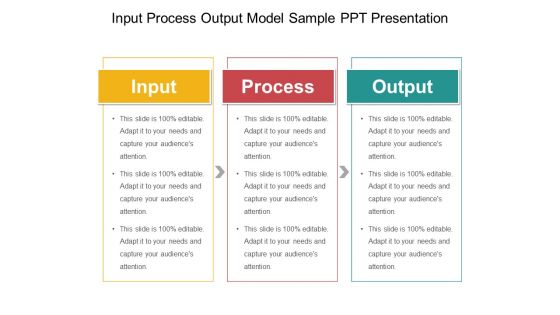
The image is of a PowerPoint slide titled "Input Process Output Model Sample PPT Presentation." It illustrates the Input-Process-Output (IPO) model, which is a commonly used approach in systems thinking and process design. The slide is divided into three sections, each labeled with one of the components of the model: Input, Process, and Output.
Each section has placeholder text stating "This slide is 100% editable. Adapt it to your needs and capture your audience's attention," suggesting that these areas are meant for customization to describe a specific scenario or system. The Input section is where the initial data or resources required for a process are listed, the Process section describes the actions taken to transform inputs into outputs, and the Output section details the results or products of the process.
Use Cases:
The IPO model is a fundamental framework that can be applied in various industries to optimize workflows and improve efficiency:
1. Manufacturing:
Use: Streamlining production lines
Presenter: Operations Manager
Audience: Production Staff
2. Information Technology:
Use: Designing software development workflows
Presenter: Systems Analyst
Audience: Development Team
3. Education:
Use: Planning and evaluating educational programs
Presenter: Curriculum Developer
Audience: Educators and Administrators
4. Healthcare:
Use: Managing patient care processes
Presenter: Healthcare Administrator
Audience: Medical Staff
5. Finance:
Use: Developing new financial products
Presenter: Financial Planner
Audience: Investment Analysts
6. Marketing:
Use: Creating marketing campaign strategies
Presenter: Marketing Manager
Audience: Marketing Team
7. Hospitality:
Use: Enhancing guest service delivery
Presenter: Hotel Manager
Audience: Service Staff
Input process output model sample ppt presentation with all 5 slides:
Avoid a build up of emotion with our Input Process Output Model Sample Ppt Presentation. They enable a dispassionate approach.
FAQs for Input process output model
So IPO basically breaks down into three parts - Input (your raw data/materials), Process (where you actually do stuff with it), and Output (what comes out the other end). Input's whatever you're starting with - could be user data, requests, materials, whatever. Process is honestly the most interesting part because that's where your algorithms or workflows do their thing and transform everything. Then output is just your final result. I always trace through these three when something's not working right. Makes it way easier to spot where things are going wrong instead of just staring at the whole mess.
Try the IPO model - it's basically input, process, output. First, list everything going into your project (resources, team skills, requirements). Then map out what actually happens to all that stuff (your workflows, checkpoints, etc). Finally, nail down what you're supposed to get out of it - deliverables, milestones, whatever. I swear this thing saved my last project from turning into total chaos. You'll catch problems way earlier, and everyone stops asking "wait, what am I supposed to do again?" Just sketch it out for whatever you're working on now. Trust me, you'll immediately see where things are getting weird.
So basically feedback stops your IPO model from being this one-way thing where you just hope everything works out. You get your output, then actually check if it's what you wanted - kinda like GPS recalculating when you miss a turn. Without it, you're just gonna keep making the same mistakes over and over. Pretty frustrating tbh. The trick is measuring your results against whatever goal you had, then tweaking your inputs for next time. Makes the whole thing way more useful since you're actually learning from what happened instead of just crossing your fingers.
Honestly, the IPO thing is pretty brilliant for this stuff. Break everything into input, process, output and suddenly you're not staring at one giant mess anymore. You'll actually see where things are breaking down - like maybe your inputs are fine but the middle part is totally screwed up. Way easier to fix one piece than rebuild the whole thing, you know? I used this last month when our workflow was a disaster and it saved me hours of headache. Just grab a whiteboard and map it out next time you're stuck.
Oh definitely manufacturing first - raw materials go in, assembly line does its thing, finished products come out. Tech companies work the same way with requirements turning into actual software through coding and testing. Restaurants are basically doing this too when they transform ingredients into meals. Even marketing teams follow this pattern, taking campaign briefs and turning them into ads. Healthcare uses it for patient workflows as well. Honestly once you notice it, you'll see input-process-output literally everywhere in business - it's kind of wild how universal it is.
Honestly, automation can save you so much headache with data input. Start with sensors and IoT devices - they grab info way more accurately than typing everything manually. OCR tech is amazing for scanning documents, and APIs pull data straight from other systems without you touching anything. Voice recognition and mobile apps speed things up too. Real-time validation catches mistakes right away instead of finding them weeks later (learned that the hard way). I'd look at whatever tasks eat up most of your time or cause the most errors first. That's where you'll see the biggest wins.
Honestly, just compare what you actually got vs what you planned for. Look at the metrics that matter for your specific goals - could be quality scores, customer happiness, revenue, whatever makes sense for your thing. Don't fall into the trap of tracking stuff that looks good on paper but doesn't mean anything (I've definitely been guilty of this). Get feedback from the people actually using your output since they'll tell you if it's working. Set up check-ins every so often to see if you're creating real value or just spinning your wheels. The key is measuring what counts, not what's easiest to track.
Honestly, the hardest part is just getting everyone on the same page about inputs and outputs. Sounds basic but it's a nightmare - people have totally different ideas about data needs and what the final thing should even look like. Then you get those awkward handoff moments between team members working on different pieces. Someone tweaks their part without telling anyone and suddenly nothing connects properly. I'd probably start with some kind of shared doc that maps everything out clearly, assign who owns what. Oh and definitely do regular check-ins because catching these misalignments early saves you from wanting to pull your hair out later.
Look, IPO is super basic compared to Six Sigma or Lean. It's literally just inputs → process → outputs. That's it. Six Sigma has all those statistical tools and phases, Lean focuses on cutting waste - but IPO? It just helps you see what goes in, what happens, and what comes out. Honestly think of it more like a thinking exercise than an actual improvement method. My old manager used to say start with IPO to map everything out first, then throw Six Sigma or Lean at it to actually fix things. Makes sense when you think about it that way.
Profile your code first - that's where you'll find the real bottlenecks, and they're usually not where you think. Cache stuff you use a lot, switch to better sorting algorithms, break big tasks into parallel chunks. Memory optimization helps too, plus cut out pointless data transformations. Honestly, the measuring part is what most people skip, but you gotta check if your changes actually worked. Do one thing at a time though. Make a change, test it, then move on. Otherwise you'll have no clue what fixed what.
So basically you've got three steps happening in order. Raw data comes in first - clicks, sensor stuff, whatever. Processing happens next where you filter and crunch numbers to make sense of it all. Then boom, you get your output as reports or dashboards. It's kinda like cooking, honestly. You throw in ingredients, do your magic in the kitchen, then serve up something people can actually use. The processing part is where the real work happens - that's what turns garbage data into something worth looking at. Without good processing you're just moving junk around.
Yeah totally! IPO works great for the whole dev process. Your inputs are user requirements, design docs, code from other modules - all that stuff you need upfront. The process part? That's just you writing code, testing, debugging. Basically all the messy work we do every day. Outputs are your finished features, compiled apps, APIs for other teams to hit. Pretty simple concept honestly. I'd map out your current project this way - helps you figure out what you actually need before diving into code. Also makes it way clearer what "done" looks like, which... trust me, that's half the battle sometimes.
Break down each IPO stage super specifically - document your inputs with data types, sources, and validation rules. Most people totally half-ass the process section and just write "magic happens here" which drives me crazy. Actually map out the logic step-by-step: decision points, calculations, error handling. Output formats and destinations matter too. Put everything in a shared doc your team can find (good luck with that). Bottom line - someone should be able to run your process just from reading what you wrote.
Honestly, the IPO model is great for this stuff because you can actually see what's broken. Map out your inputs, process, and outputs separately - then track metrics for each piece. If something's not working, you'll know if it's bad data coming in, your workflow is messed up, or the final results are off. Way easier than just randomly trying to fix things, you know? The stages connect to each other too, so you start spotting patterns pretty quick. I'd pick one process you want to improve and break it down that way first.
Honestly the biggest thing people get wrong is thinking IPO flows in a straight line - like input goes to process, then output, boom done. Real life? Way messier. You've got feedback loops where outputs mess with your next inputs, stuff happening at the same time instead of neat little steps. Plus everyone thinks it's just for computer nerds, but I use it for random stuff like figuring out why my morning routine sucks or how to run better team meetings. Don't box yourself into that rigid A→B→C thinking - it's more like a flexible way to untangle how things actually work.
-
Commendable slides with attractive designs. Extremely pleased with the fact that they are easy to modify. Great work!
-
Visually stunning presentation, love the content.