


Academic research proposal powerpoint presentation slides
Our Academic Research Proposal Powerpoint Presentation Slides are topically designed to provide an attractive backdrop to any subject. Use them to look like a presentation pro.
Our Academic Research Proposal Powerpoint Presentation Slides are topically designed to provide an attractive backdrop to a..





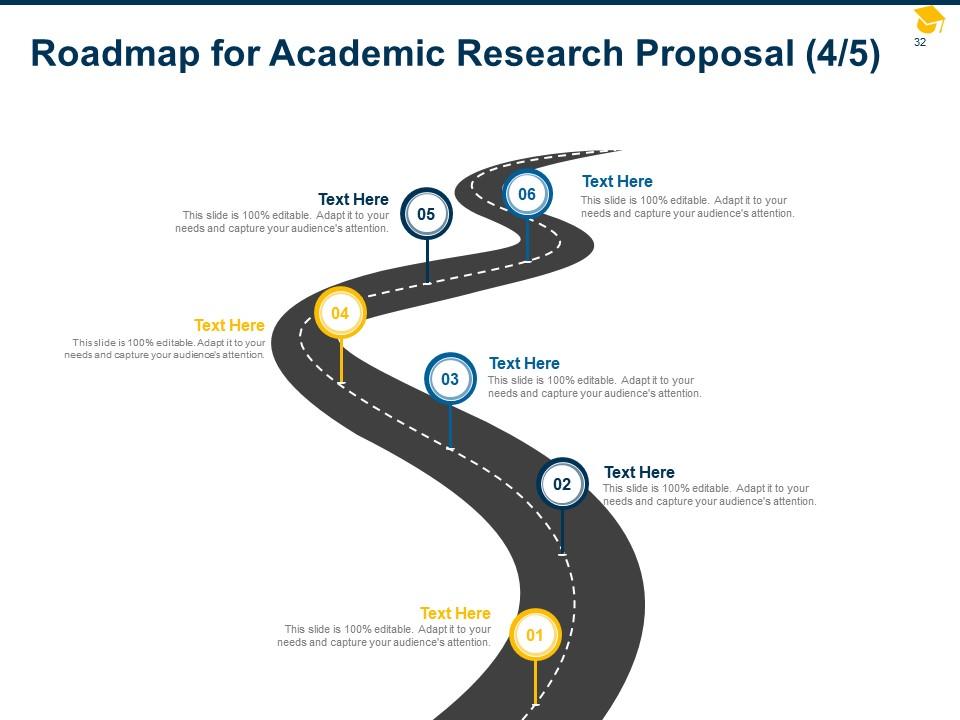

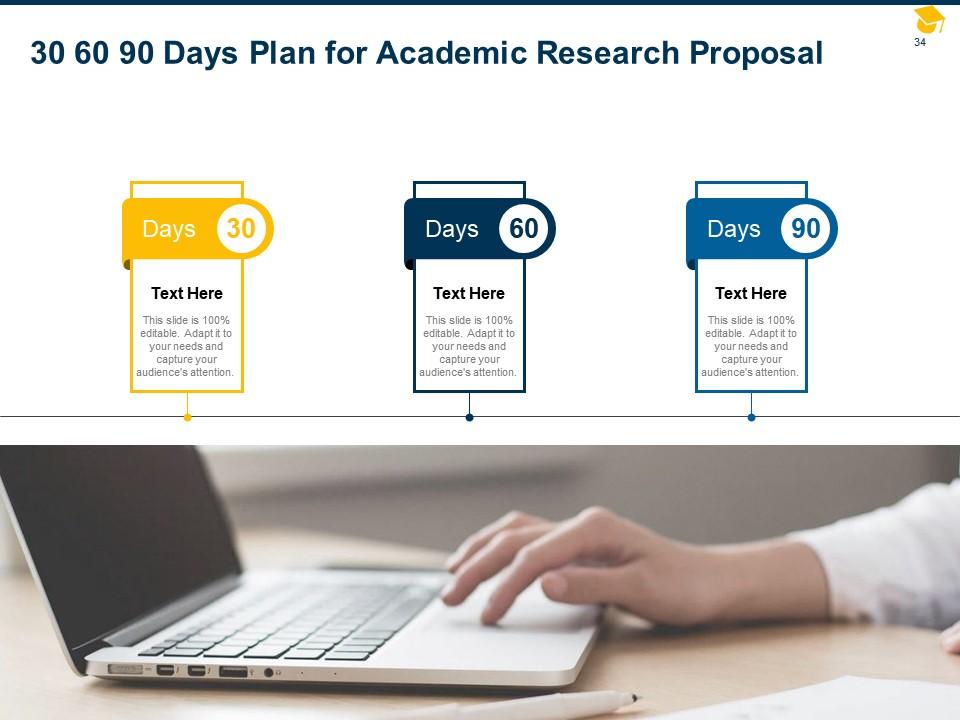















-

- Google Slides is a new FREE Presentation software from Google.
- All our content is 100% compatible with Google Slides.
- Just download our designs, and upload them to Google Slides and they will work automatically.
- Amaze your audience with SlideTeam and Google Slides.
-

Want Changes to This PPT Slide? Check out our Presentation Design Services
-

- WideScreen Aspect ratio is becoming a very popular format. When you download this product, the downloaded ZIP will contain this product in both standard and widescreen format.
-

- Some older products that we have may only be in standard format, but they can easily be converted to widescreen.
- To do this, please open the SlideTeam product in Powerpoint, and go to
- Design ( On the top bar) -> Page Setup -> and select "On-screen Show (16:9)” in the drop down for "Slides Sized for".
- The slide or theme will change to widescreen, and all graphics will adjust automatically. You can similarly convert our content to any other desired screen aspect ratio.
Compatible With Google Slides

Get This In WideScreen
You must be logged in to download this presentation.


Do you want to remove this product from your favourites?
PowerPoint presentation slides
If your company needs to submit a Academic Research Proposal Powerpoint Presentation Slides look no further. Our researchers have analyzed thousands of proposals on this topic for effectiveness and conversion. Just download our template, add your company data and submit to your client for a positive response.

People who downloaded this PowerPoint presentation also viewed the following :
Content of this Powerpoint Presentation
As a university student, you are bound to conduct research-based studies for higher education. It is part and parcel of your academic years. Different types of academic research namely experimental studies, observational studies, literature reviews, case studies, and others are often conducted to contribute to the creation of new knowledge. These researches are quite methodical and rigorous.
To begin with your research, you need to write an Academic Research Proposal to convince a supervisor or academic committee that your topic and approach are sound. Doing so will help you gain approval to proceed with the research.
An Academic Research Proposal PowerPoint Presentation demonstrates components of a research proposal to an audience. It includes informative slides with concise text, and visuals, to convey the research proposal's content clearly. Hence, these PPTs serve as an effective tool to communicate the research plan and highlighting objectives as well as methodologies.
To prepare a hassle-free Academic Research Proposal PPT with high-quality visuals, check out A4 academic research proposal templates.Click here
For presenting your proposal in an articulate and attractive way, there are various templates offered by Slide Tech Systems. Each of these popular templates is 100% editable and customizable.
You can also go through the Roadmap For Academic Research Proposal Needs One Pager Sample Example Document for more help. Click here
Here are a few of the important Academic Research Proposal PowerPoint Presentation slide templates you must take a note of:-
Template 1 Cover Letter for Academic Research Proposal
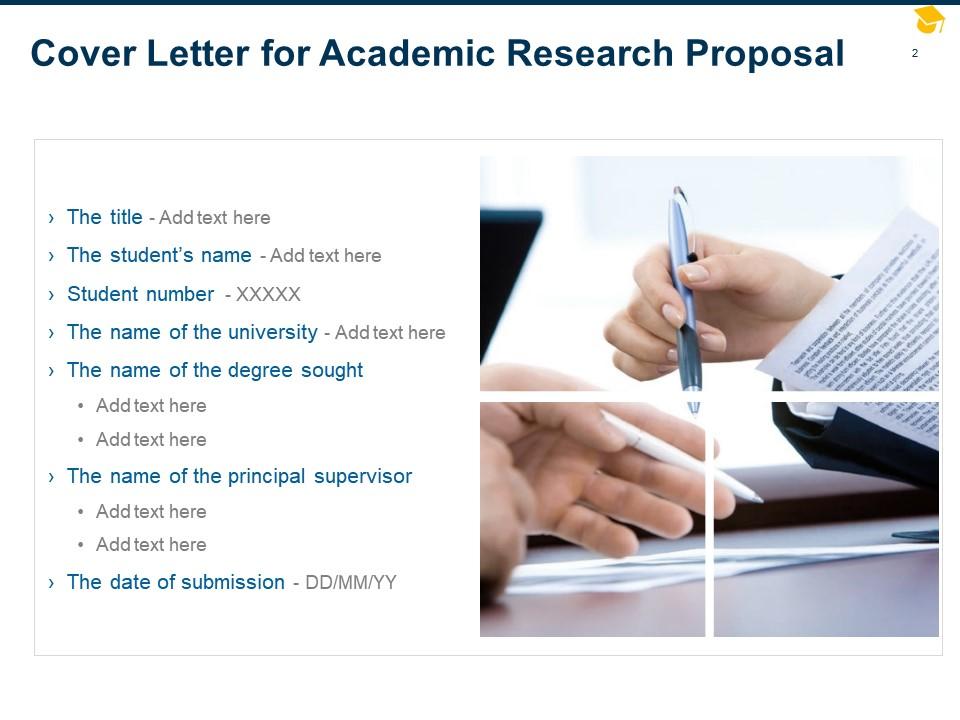
Writing a Cover Letter is a must for academic research proposals. It helps to introduce your proposal, highlight its significance and establish a significant connection with the recipient. It also provides essential information about your educational background and institutional affiliation. So, it does help support your credibility as a researcher. A cover letter should be concise, well-organized, and tailored to the recipient and as per the context of your proposal submission. Using this slide for a Research Proposal PPT, you can grab the attention of the reader by creating a strong impression.
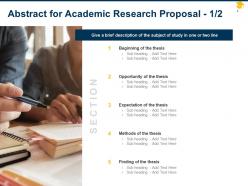
Template 2 – Abstract for Academic Research Proposal 1/2
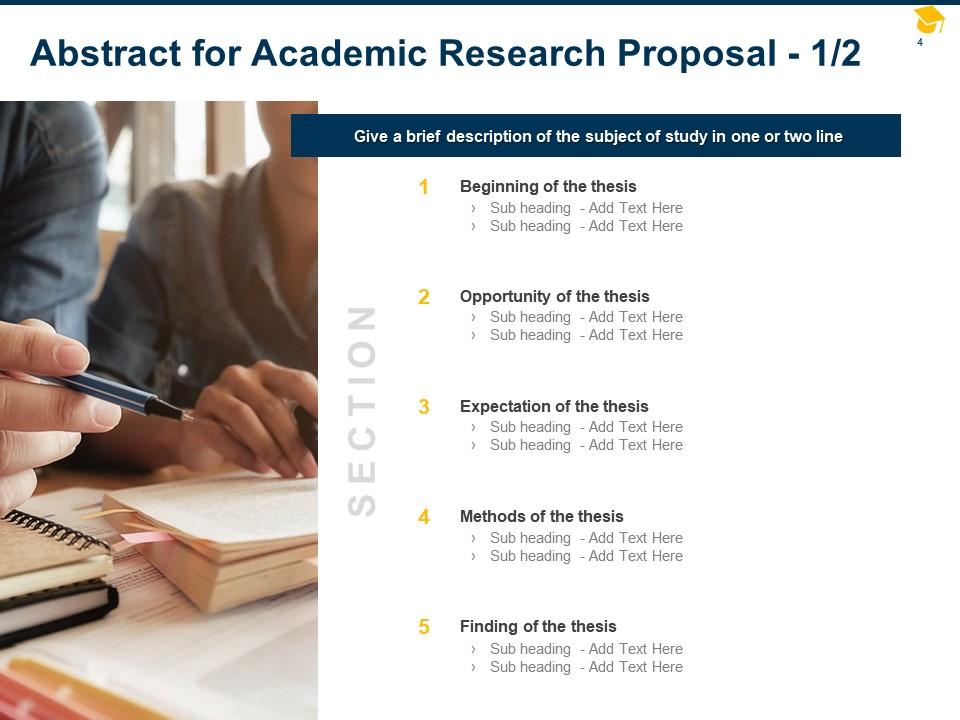
The abstract provides a summary of your Academic Research Proposal, for example, what your purpose was, what was learnt, and what was the conclusion. It is usually written in about 150-300 words in a manageable format which allows readers to quickly comprehend the essence of your research. To write an abstract, you need to break down your research into its core components. This helps clarify your ideas and focus on the objectives of your study. To simplify the process of writing an abstract, you can use this abstract for the academic research proposal slide. It includes the beginning of the thesis, opportunity and expectations of the thesis, etc. to make your abstract stand out.
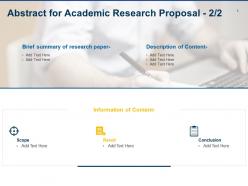
Template 3 - Abstract for Academic Research Proposal - 2/2
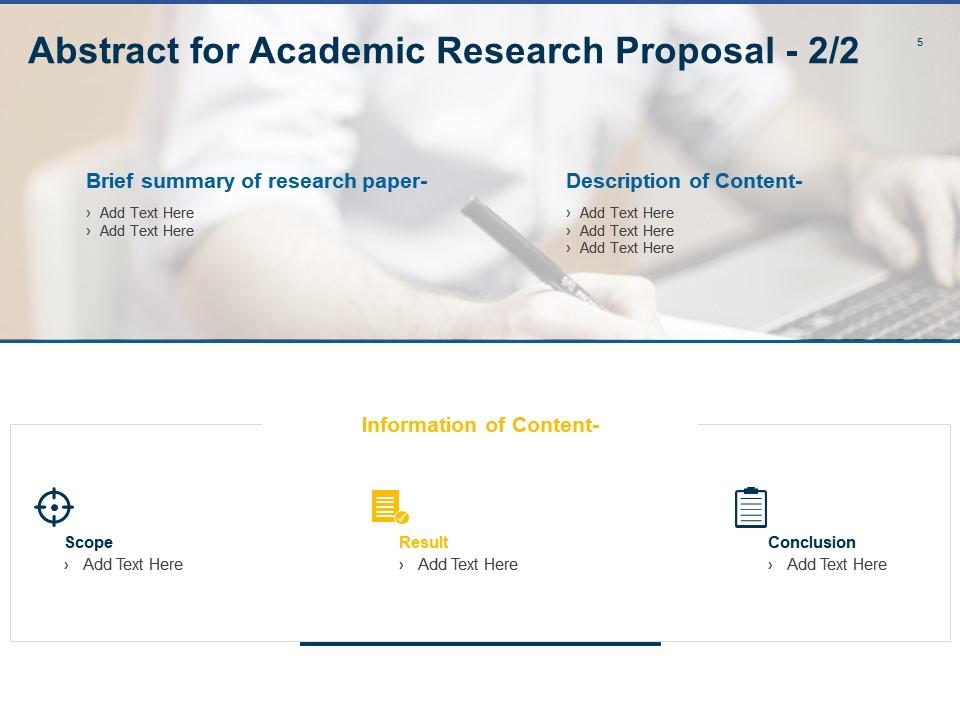
A well-crafted abstract is a must.to quickly assess the significance, and feasibility of your research, influencing the reader’s decision on whether to support your work or not. Apart from this, an abstract can increase the visibility and discoverability of your research. Thus, ensuring that it reaches a wider audience and contributes to scholarly discussion. Since, a brief summary written as an abstract plays a crucial role in the evaluation process by the reviewers. Choose this slide, which comprises summary and description of the content along with its scope, result, and conclusion.
Template 4 - Introduction of Study for Academic Research Proposal

An introduction is an initial level pitch of an idea. It should be designed to generate interest in the reader wanting them to read further. In a Research Proposal Powerpoint Presentation, you must mention the beginning of the topic, knowledge of the research area, the background and significance of the study along with research experience in a specific field as mentioned in the slide above.
Template 5 - Problem Statement - Overview for Academic Research Proposal
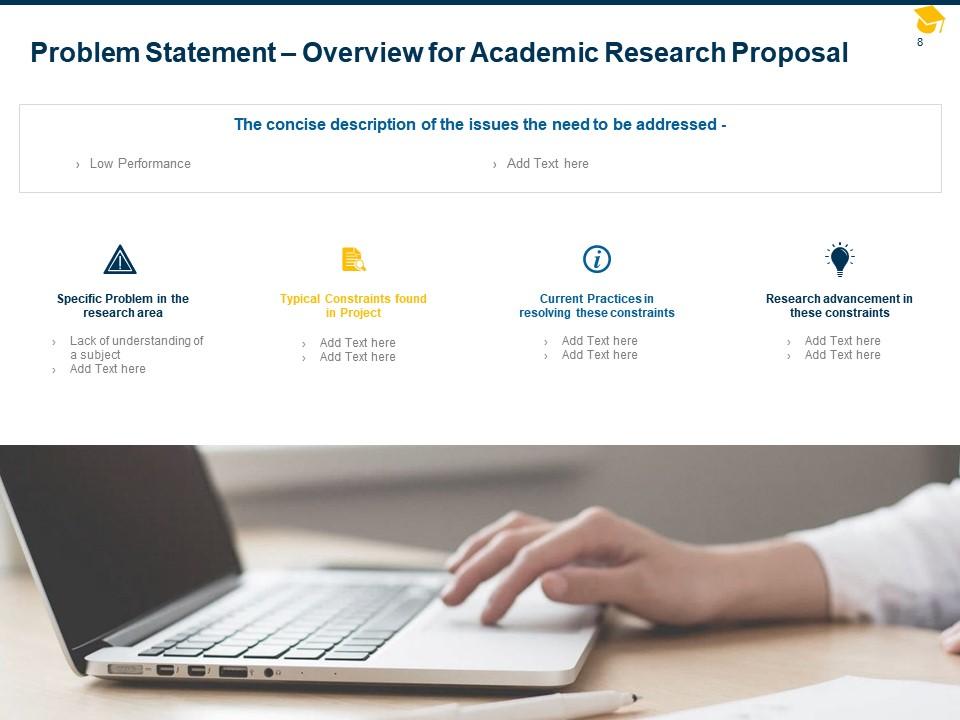
The Problem statement explains why the issue you are about to tackle is important. Additionally, it identifies the gap in knowledge that the researcher seeks to investigate. It articulates the need for the study of a particular topic by highlighting the significance of the issue. Simply put, it is your opportunity to explain why you care and what you propose to do in the way of researching the problem. This is why a well-defined problem statement helps to establish the scope and focus of the research and highlight potential implications or consequences of the problem, thereby emphasizing the need for a systematic investigation to address it.
Template 6 - Research Question/ Hypothesis for Academic Research Proposal - 1
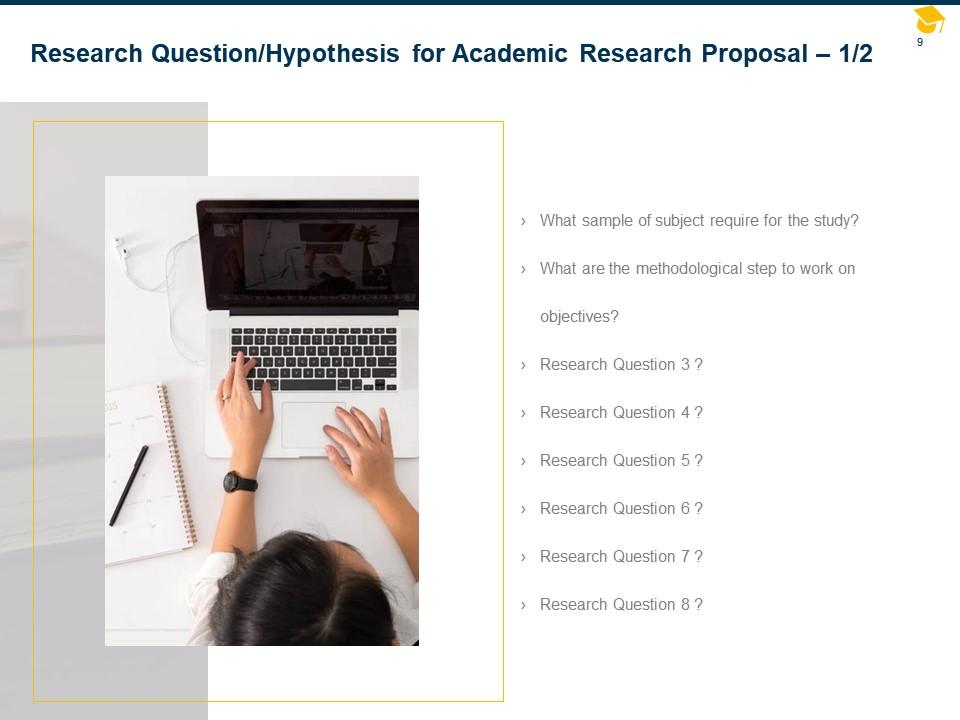
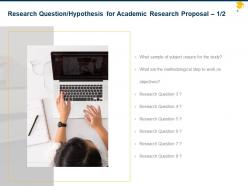
The Research Question or Research Hypothesis describes the problem statement. Further, it provides details of the issue under study. These questions also add focus to the problem statement, and guides data collection and analysis. So, we can say that a research question is an asset which sets the context of research. Formulating a concise and significant question ensures that the study remains relevant, enabling the researcher to clearly communicate the purpose and scope of the study to reviewers, collaborators, and stakeholders.
Template 7 - Research Question/ Hypothesis for Academic Research Proposal - 2
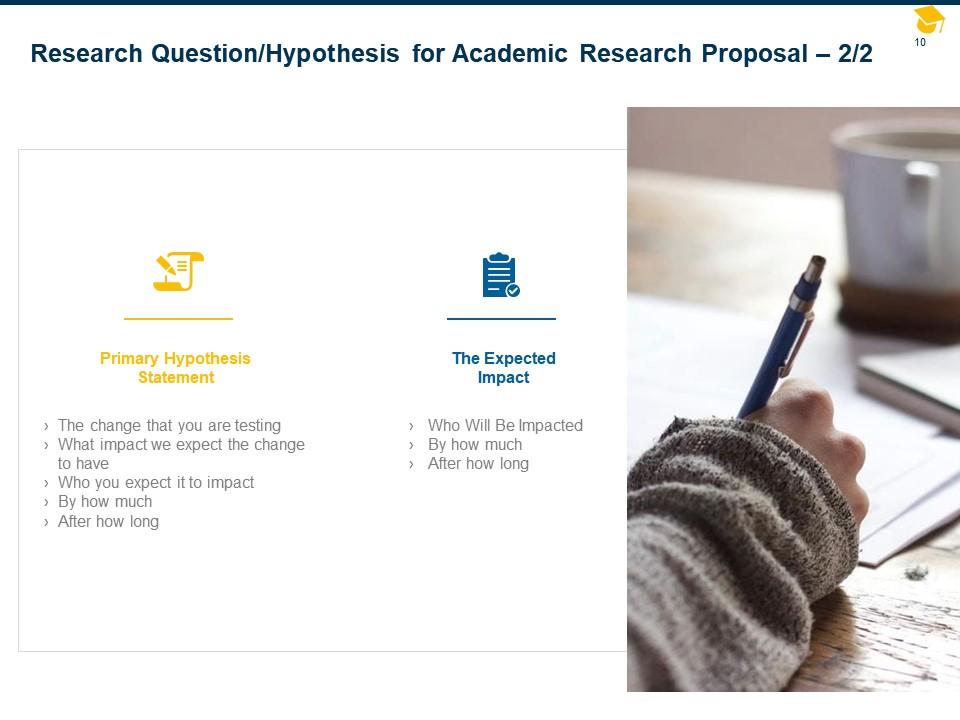
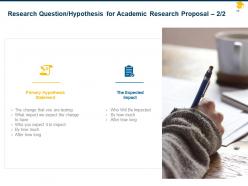
It is critical that a research question or hypothesis should have a brief mention of the impact or outcome that the research is expected to create. This PPT slide showcases the change that you are testing, what impact we expect to have, who you expect it to impact, who will be impacted,etc.
Template 8 - Key Assertions/ Objectives for Academic Research Proposal
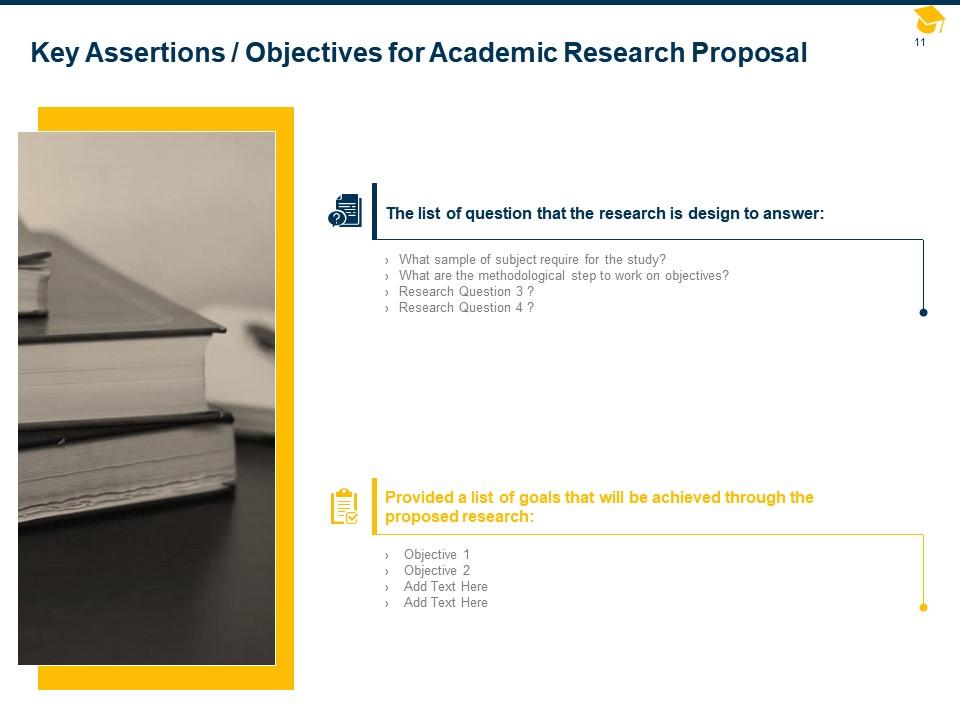
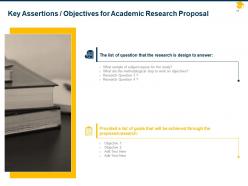
Research objectives are the results that you desire to achieve by conducting research. It should be specific, quantifiable, attainable, realistic, and time-bound. The objectives should also be relevant and logical. In this Research PPT slide, you can see two important sections, one with a list of questions that the research is designed to answer and another with a list of goals expected to be accomplished through the proposed research.
Template 9 - Research Method Overview for Academic Research Proposal - 1
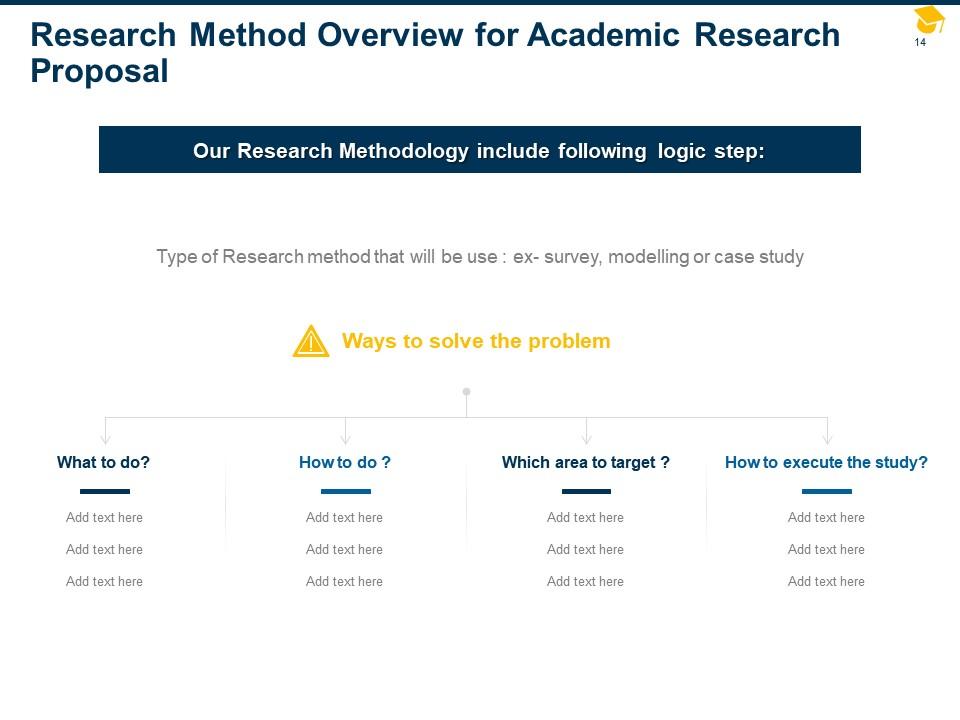
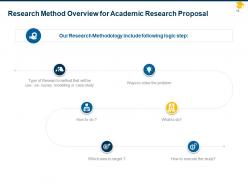
A research method overview summarizes the ways to solve the problem. The researcher is expected to showcase detailed information on methodology adopted for performing an analysis. Having a clear and crisp method summary is the critical component of any research project.
Template 10 - Research Method Overview for Academic Research Proposal – 2
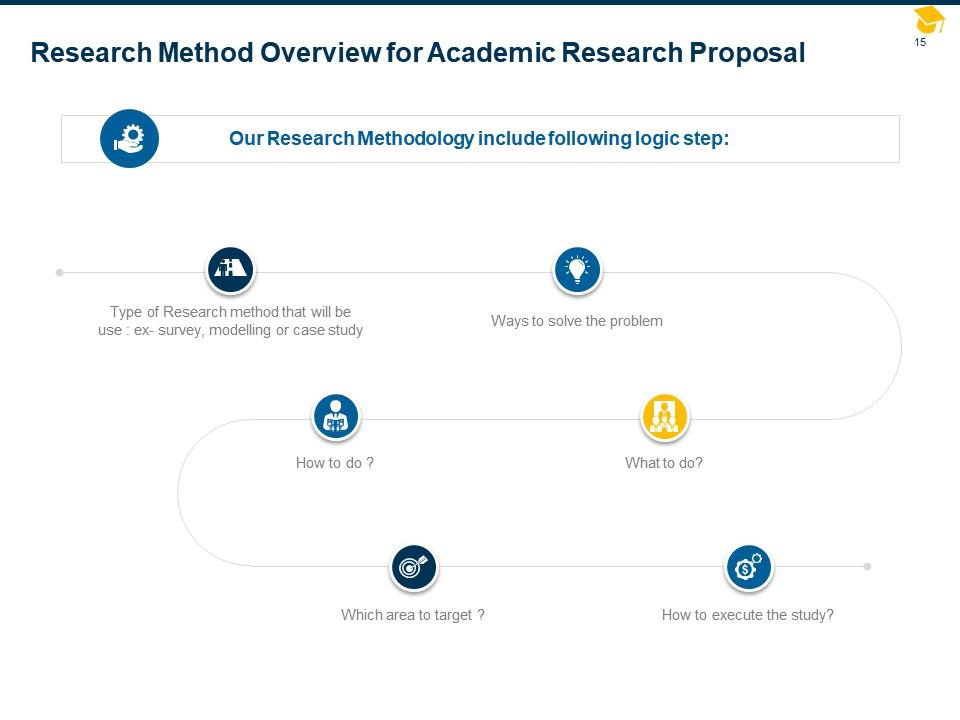
Writing an overview for a research method requires you to describe the materials used in the study, elucidate how the materials were prepared for the study and describe the research protocol. Other than these essential facts, it is necessary to explain about measurements and statistical tests done to analyze the data.You can use this Research Proposal PPT slide for an impressive powerpoint presentation It highlights key points such as type of research methods used, steps to follow (how and what to do), areas to target and tips to execute the study.
Why opt for our Research Proposal PPT Templates?
A research proposal plays a vital role in shaping the trajectory of research projects. In addition, it also enables securing funding, and contributing towards the progress of knowledge across disciplines. A well-written and presented research proposal will determine the quality and importance of your project. It will also indicate your capability to conduct the proposed research. So, do not compromise with your selection for the best research proposal PPT Slide templates.
PS If you are planning to start writing your Academic Research Proposal and need help finding out the right template for your powerpoint presentation, check out a list of these well- crafted templates!
Academic research proposal powerpoint presentation slides with all 34 slides:
Use our Academic Research Proposal Powerpoint Presentation Slides to effectively help you save your valuable time. They are readymade to fit into any presentation structure.
-
Appreciate the research and its presentable format.
