


Planning thesis proposal powerpoint presentation slides






Try Before you Buy Download Free Sample Product
 Impress Your
 Audience
 100%
100% Editable
 Save Hours
 of Time


Do you need to give a presentation for planning thesis? Not to worry! We have come up with our 29 slides content-ready Planning Thesis Proposal Powerpoint Presentation Slides. This PPT presentation sample file will help you present your topic and will also save you a lot of time as you do not have to make this from the start. This PowerPoint sample deck has slides like abstract, introduction, thesis statement, methods or approach, limitations, preliminary discussion & results, work plan, implication of research, list of references and many more. This PPT deck example also has various additional slides like dashboard, timeline, post in notes, matrix, circular designs etc. The best part is that this sample file is fully editable, and you can change color, text, shapes as per your need. So just download thesis presentation ppt Slides and be a step ahead of your peers. Our Planning Thesis Proposal Powerpoint Presentation Slides enable expression. Your views get channeled effectively.
People who downloaded this PowerPoint presentation also viewed the following :
Content of this Powerpoint Presentation
A thesis proposal represents a gateway to greatness for students, academicians, and researchers who want to enter the world of practical work and get funding for their ideas. If approved by the competent authority of the university, it is the first step that gives wings to their thoughts.
However, even the best researchers risk having their dreams shattered, as their proposals are not professional enough.
A research proposal for thesis is required to ensure you make your logic and ambition clear. Get the best PPT Template to showcase this here.
At SlideTeam, we realize that getting a planning thesis proposal cleared is so critical that no one should take any chances. Hence, we have curated an expert-knowledge-driven template that, when presented, offers both sophistication and the sound backing of conceptual clarity that the candidate possesses. The aim is to ensure that the thesis proposal is approved based on the strength of its ideas and the innovative and exciting way it is presented. Stakeholders should feel lucky to have found a thesis proposal that they are fully confident of backing.
Even better, each of the templates is 100% editable and customizable. You get structure, a starting point, and the capability to customize a presentation to the audience profile.
Let’s explore!
Template 1 Title Page of Thesis PPT Template
This is a ready-made PowerPoint Template to help you streamline the organization of your Thesis Proposal. Incorporate this professional and appealing PPT Slide to depict the name of the university you are working with, and your thesis topic. The design of the slide allows for impressive visual representation of your key idea. Grab this flexible PPT Template to outline how your planning thesis proposal will flow. Download now!
Template 2 Abstract of the Thesis Presentation Slide

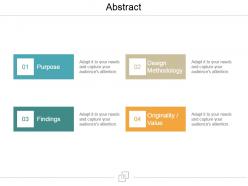
Looking for the ideal framework to use your thesis proposal to catch the attention of the reviewers, and have them genuinely interested. Use this ready-made PowerPoint Template and elaborate on the structure your thesis follows. It all starts with the purpose, as the slide depicts. Showcase your design methodology next with this pre-designed PowerPoint Slide. The findings will be showcased after this, the clutter-free template also gives you a segment to elaborate on the originality/value the thesis adds. Grab this ready to use PowerPoint Template now. Download now!
Template 3 Introduction to the Thesis Proposal PPT Template
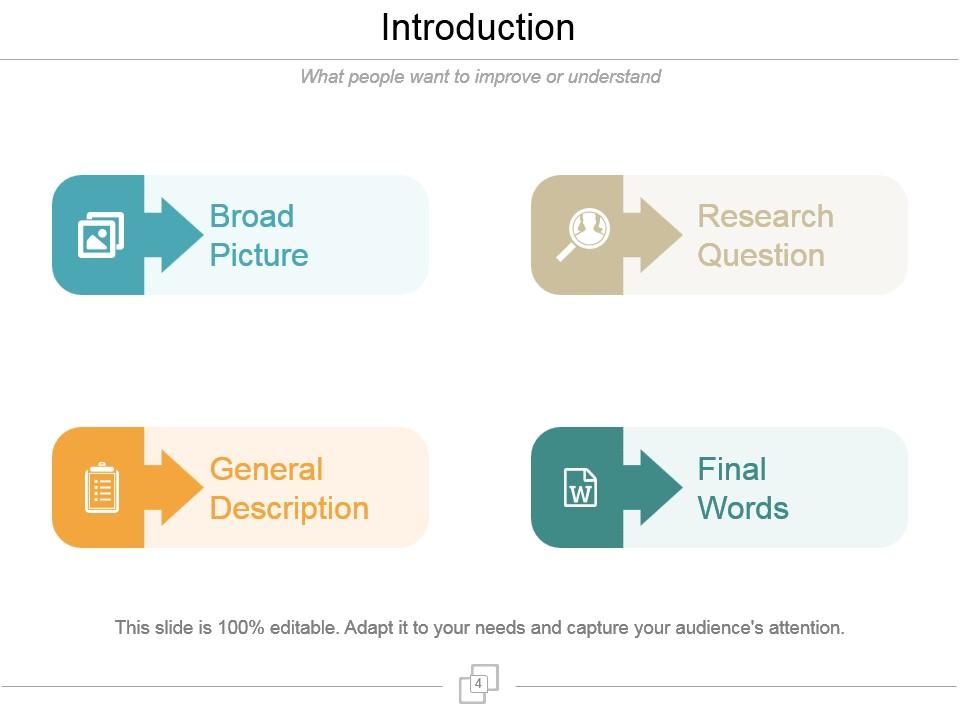
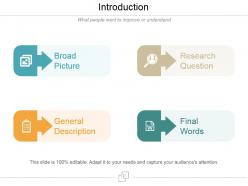
This ready to use PowerPoint Template outlines the broad picture, research question, general description, and the final word that you would be saying as part of the thesis. It is a content-ready PowerPoint Diagram showcasing how the thesis will contribute to the greater body of knowledge around the concept. Use this professional and appealing introduction to showcase your thesis work as the epitome of professionalism, curiosity, and discipline. Download now!
Template 4 Thesis Statement PPT
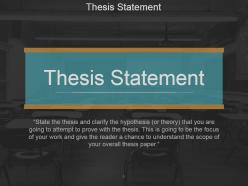
Here is another top-class PowerPoint Template showcasing the main idea and the core point of the thesis. You can use this PowerPoint Template to state the thesis. In addition, you can clarify the hypothesis (or theory) that you are going to attempt to prove with the thesis. This is going to be the focus of your work and give the reader a chance to understand the scope of your overall thesis paper. Download now!
Template 5 Methods or Approach to conducting the Thesis Slide

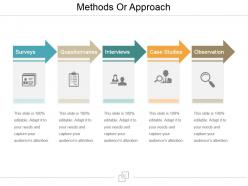
Use this PowerPoint Template for setting and explaining the methods or approach you would be using to divide the tasks linked to conducting the thesis on-the-ground. These are surveys, questionnaires, interviews, case studies and observations. Get this well-crafted PowerPoint Slide to ensure that the thesis use a mix of approaches to crosscheck and verify results obtained for greater credibility and closer link with the hypothesis.
Template 6 Preliminary Discussion & Results PPT Template
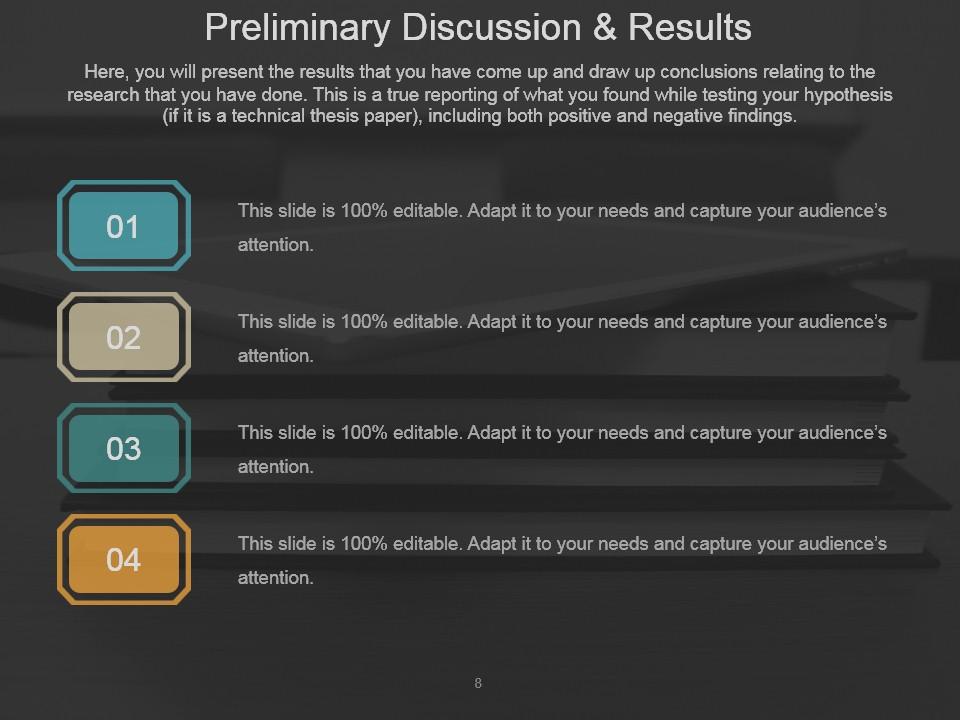
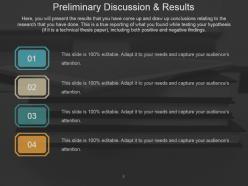
This is a ready-to-use PPT Template for researchers to present the results that they come up with and draw up conclusions. This inference or the results are related to the research that you have done and the slide explains this beautifully. The slide aids in true reporting of what the researcher found while testing your hypothesis (if it is a technical thesis paper), including both positive and negative findings.
Template 7 Work Plan with Timetable PPT Slide
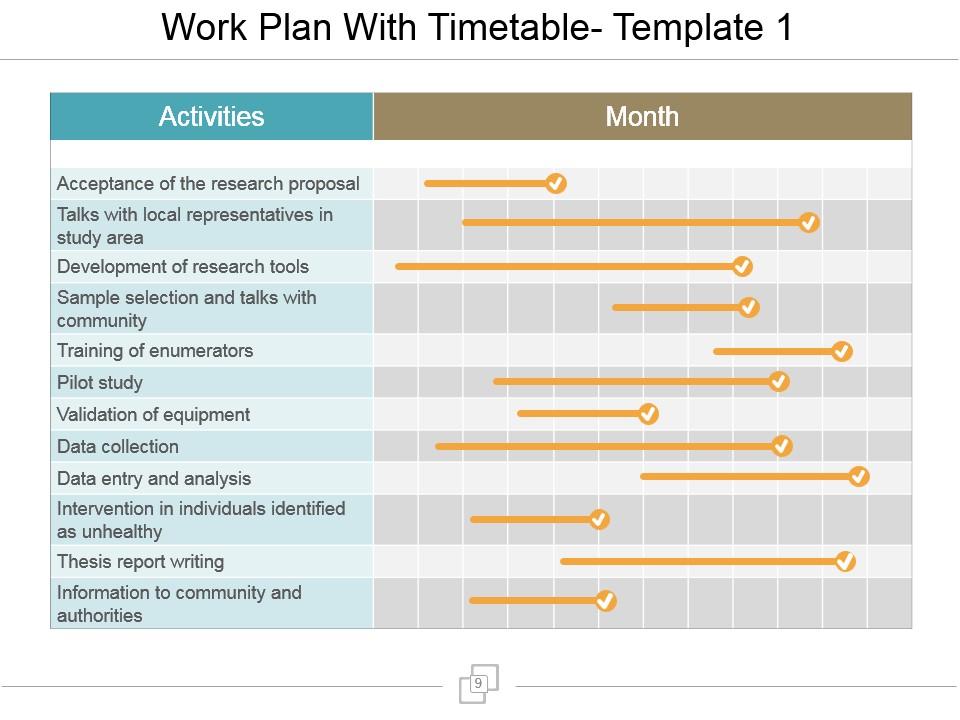
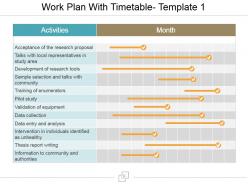
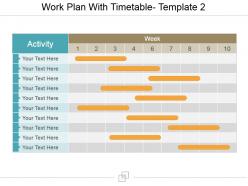
This is a predesigned PowerPoint Template to help you draw up a plan for execution of tasks and activities month-wise. For instance, acceptance of the research proposal could take a couple of months. This is followed by development of research and at least a dozen more tasks, structured around a timeframe. This professional and appealing PowerPoint Template is perfect to draw up a comprehensive work plan that you can easily adhere to and execute as well.
Template 8 Stage-Wise Thesis Work Plan PPT Template
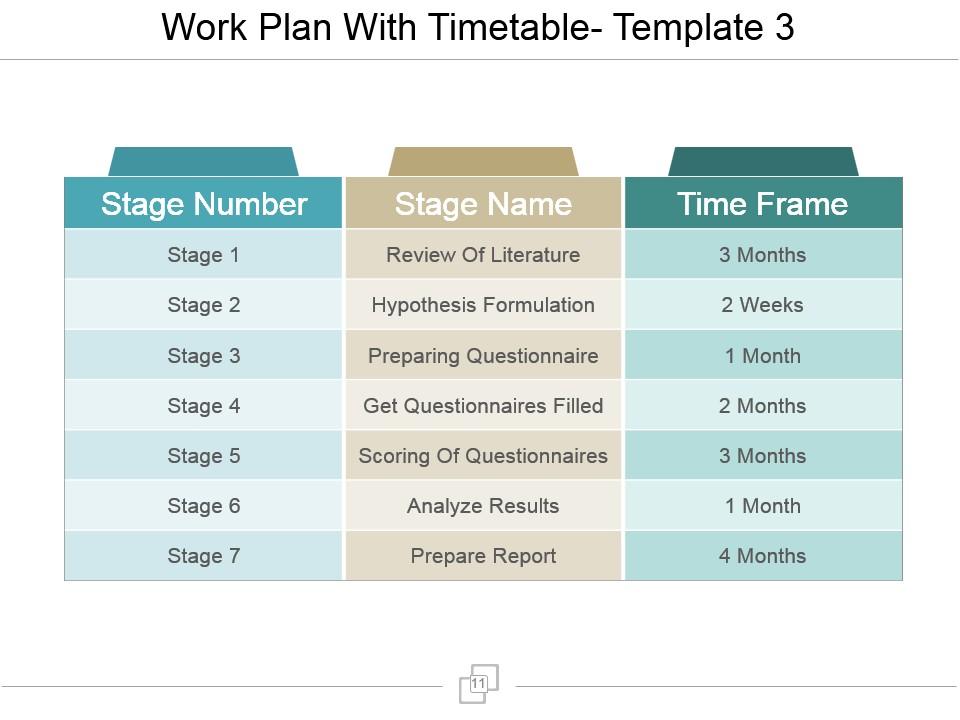
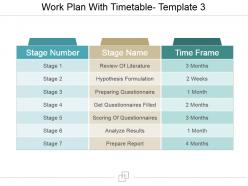
This is a top-notch Thesis Proposal PPT Template to help you outline a comprehensive, stage-wise schedule of work stages involved in the thesis. The slide is a perfect companion to list the seven stages and inform the approver of the expected completion of time frame of each. It includes review of literature as the first stage, with the preparation of the report being the seventh stage.
Template 9 Implication of Research
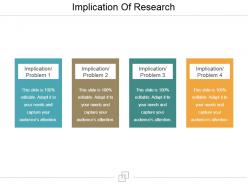
This is where the Thesis Proposal gives real juice to approving authority/team. Create a professional and well-crafted implication of research teaser with this PPT, listing the problem and the difference the thesis result and research will make to the domain. This PPT Template provides space to give four such implications on problems, with editability and customizable features meaning that the user can add or reduce this answer. Download now!
Template 10 List of References and Bibliography Slide
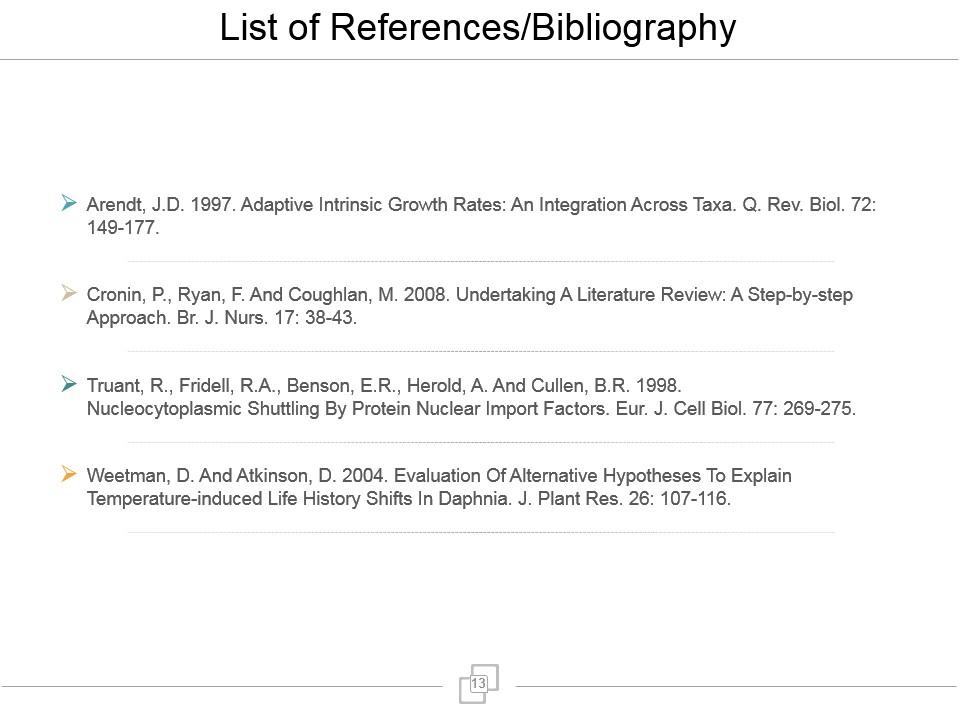
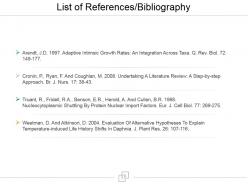
It is a ready-made PowerPoint Template exhibiting the list of references and the books and other sources you consulted for knowledge and firming up your views on the topic. The specified format and stylesheet to be followed varies according to the main sponsor/approving authority guidelines.
*****
THESIS PROPOSAL MATTERS
A thesis is the real base of knowledge, and lays the foundation for all new products and services to emerge. Yet, before the thesis materializes into concrete reality it requires the fuel of money, support and backing of intellectual forces. Make your route to all of these, and more, a lot more convenient and easier with SlideTeam’s PPT Templates.
PS Understand Sample Thesis Proposal Template and how to master it here.
Planning thesis proposal powerpoint presentation slides with all 29 slides:
Use our Planning Thesis Proposal Powerpoint Presentation Slides to effectively help you save your valuable time. They are readymade to fit into any presentation structure.



FAQs for Planning thesis proposal
So you need a solid research question first - that's your foundation. Most people mess this up by going way too broad, trust me. Then you'll want a lit review showing you actually know what's already out there. Your methodology section explains how you're gonna do the research. Oh, and include a timeline that's realistic because everything takes longer than you think. Bibliography obviously. The trick is making sure it all flows together logically. Honestly, I spent forever on my research question but once I nailed that down, everything else just clicked into place way easier.
Honestly, just dive deep into recent papers and hunt for what's missing. I keep this messy doc where I write down every time someone says "future research should..." - those little throwaway lines are actually treasure. Pay attention when researchers are arguing with each other too, since that usually means there's something worth digging into. Maybe try making a simple spreadsheet tracking what's been studied vs what hasn't? Different populations, methods, contexts that nobody's touched yet. Once you map it out, the gap will probably smack you in the face.
Look for what nobody's figured out yet - that's your goldmine. Make it specific enough that you can actually handle it, but not so narrow that nobody cares. Honestly, avoid yes/no questions because they're just... boring? Go for "how" or "why" instead - way more interesting to dig into. Check if you can realistically pull it off with whatever time and resources you've got. Here's a good test: explain it to your roommate or whoever. If they're like "oh that's actually cool," you're onto something. Write down a few versions and pick whichever one doesn't make you want to fall asleep.
Skip the chronological approach and go with 3-4 themes instead. Foundation stuff first, then the big debates in your field. I totally bombed this part initially - just summarized everything like an annotated bibliography (ugh). What you actually want is synthesis - show how sources connect to each other AND your question. Build each section so it points toward the gap you're filling. Don't include random tangents that seem cool but aren't relevant. Actually critique the work instead of just describing what Smith said, then what Jones said. Your ending should make it obvious how you'll add something new to the conversation.
Your research question should drive everything. Qualitative stuff like interviews works great for understanding human behavior - honestly, ethnography is so underrated. Testing hypotheses? Go quantitative with surveys or experiments. Mixed methods are clutch when you need both numbers AND the story behind them, but people don't use them enough. Case studies work well too if you're building on existing work. Don't pick a method first then force your question to fit. That's backwards and you'll hate yourself later.
Look, you've gotta spell out why anyone should care about your research. What's the actual hole you're filling? Like maybe previous studies totally missed how this affects working moms, or current policies are based on outdated assumptions. Then get concrete about who wins here. Will doctors have better tools? Could this change how schools handle things? I'm always surprised how many people forget to mention real-world impact beyond just adding to academic knowledge. Throw in some numbers if you can - "affects 2 million people" hits harder than vague claims. End by saying what's different once your work exists.
Think of scope as your thesis boundaries - stops you from going totally off track. I've watched people start researching campus food and somehow end up analyzing global hunger patterns lol. Write down your main research question first. Then figure out what you're NOT studying, which methods you'll actually use, and realistic timelines. Your advisor needs to know what you're promising to deliver too. Short sentences work best for this stuff. Without clear limits, you'll definitely spiral into trying to answer everything and miss your deadlines.
Okay so first - be brutally honest about what you actually have to work with. Time, money, data, your current skills, all of it. Don't try to learn three totally new methods while writing your thesis (learned this the hard way). Pick something you're genuinely excited about but that won't destroy your sanity. Break that big ambitious idea into chunks - do the main piece now, save the rest for later papers. You want it challenging enough to matter in your field but realistic enough that you'll actually finish the damn thing instead of getting stuck forever.
Don't be vague about your research question - committees can smell "I'll wing it" from a mile away. Keep your scope reasonable too, nobody's finishing a decade-long project for their thesis. Your lit review should find the actual gap you're filling, not just dump every source you found. Oh and fix your citations properly - sounds dumb but advisors get genuinely annoyed by sloppy formatting. Timeline needs to be real... like, "writing: 2 weeks" is laughable. I learned that one the hard way. Talk to your advisor constantly before you submit anything official.
Dude, get feedback early - it's basically a sanity check before you waste months going down the wrong path. Your advisor knows what actually works and what crashes and burns with committees. Peers are great too because they'll catch stuff that makes perfect sense to you but sounds like gibberish to everyone else. You know how you get tunnel vision with your own work? Yeah, that's real. They'll also help you prep for those brutal committee questions. Even share messy drafts - honestly, sometimes the rough versions get better feedback anyway. Don't wait until it's "perfect."
Hook them right away with why anyone should care about your research - you've got maybe 30 seconds before they zone out. Go problem → gap → your solution → methods → what you expect to find. Visuals are your friend because slides packed with text are brutal to sit through. Practice your timing! Also prep for the inevitable curveball questions. Skip the academic jargon unless you want blank stares. Your conclusion should hit hard and show what you're actually adding to the field. Oh, and rehearse out loud multiple times. There's no substitute for that.
Yeah definitely include a timeline! Committees need to see you're not just throwing ideas around. I'd work backwards from your defense date - figure out literature review, data collection, analysis, writing phases. Writing always takes WAY longer than you think (learned this the hard way lol). Build in extra time because something will definitely break or go wrong. Be realistic but show you're making consistent progress. Oh and use actual dates/milestones instead of just "I'll analyze data sometime in spring" - that looks super vague.
Okay so first thing - get Zotero or Mendeley for your sources. Seriously, you'll thank me later when you're not scrambling to find that one paper again. I'm obsessed with XMind for connecting ideas visually, but that's just me being extra. Google Docs works fine for writing, though Scrivener's pretty cool if you want something fancier. Trello's good for tracking deadlines too. Don't overthink it though - just pick one writing app and one way to stay organized, then actually stick with them. That's honestly the hardest part.
Ugh, first thing - hunt down your department's thesis proposal guidelines. They're always hidden somewhere on the grad school site, or just bug your advisor for them. Every school has different formatting rules, page limits, all that fun stuff. Don't skip checking the deadlines either! I totally screwed myself once and had to redo my entire format like days before it was due. Such a mess. Make yourself a little checklist from their requirements. Way easier than trying to remember everything when you're stressed and caffeinated out of your mind.
So you'll definitely need IRB approval if your research involves real people - consent forms, data privacy, potential harm, all that stuff. Vulnerable populations or minors? Flag it immediately. Honestly, most schools make it mandatory anyway, so just get started early. Think about how you're storing data and keeping people anonymous too. Even lit reviews can have ethical issues if you're dealing with sensitive topics - kinda crazy but true. The approval process is painfully slow, like weeks sometimes, so don't wait until the last minute or you'll be scrambling.
-
Out of the box and creative design.
-
Design layout is very impressive.
-
Easily Editable.
-
Unique and attractive product design.
-
Excellent products for quick understanding.
-
Content of slide is easy to understand and edit.
-
Unique design & color.