

Acquisition strategy plan powerpoint layout




Try Before you Buy Download Free Sample Product
 Impress Your
 Audience
 100%
100% Editable
 Save Hours
 of Time


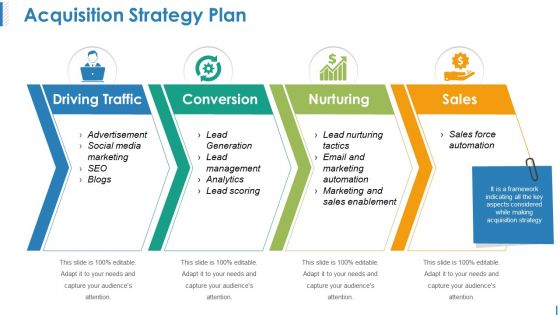
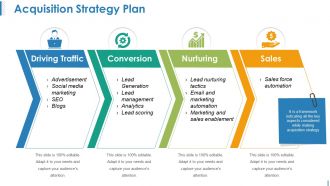
Acquisition management is very important for any business organization to grow. Choose our acquisition strategy plan PowerPoint Layout slide to create impactful presentations. Our acquisition PPT template is designed by dedicated team having innovative designers. To engage the audience in the presentation slide, you need to ensure that it is professionally designed and every detail should be highlighted in the correct manner. Our strategic acquisition Presentation slideshow is perfect for you if you are looking for a design where you can highlight the concept of acquisition using different stages along with the use of professional icons. Mergers and acquisitions have become an integral part of companies now a days, so that they can expand into new markets and acquire new technologies and skill sets. You can use our PPT graphic to demonstrate the business acquisition aspects in a professional manner. Whatever you desire to achieve, can be done with our PPT slideshow. We also have other strategic designs available that can be perfect for your presentation. Just browse through our range of related categories of slides. You have all the buzzwords at your command. Deploy them on our Acquisition Strategy Plan Powerpoint Layout.
People who downloaded this PowerPoint presentation also viewed the following :
Acquisition strategy plan powerpoint layout with all 5 slides:
Our Acquisition Strategy Plan Powerpoint Layout are of high pedigree. Created by well-bred designers.


FAQs for Acquisition strategy
So you'll need target identification, due diligence framework, integration planning, and financial modeling as your main pieces. First figure out your strategic rationale - what gaps you're filling or new capabilities you want. Build your screening criteria and valuation approach from there. Integration is where deals actually die though, so don't skip that part! Set up clear governance for decisions and risk assessment. Timeline management matters way more than people think. Honestly, just start with a simple one-pager covering these basics before you go down any rabbit holes with detailed planning.
Figure out what you're actually trying to accomplish first - filling gaps, entering new markets, whatever. Use that to filter prospects through databases and competitor research. I always make a scoring matrix because shiny deals will totally distract you from what actually makes sense. Financial health and culture fit matter just as much as the business case. Your network is huge here - investment bankers, industry people, advisors often know about deals before they go public. Oh, and set up Google alerts for companies that might be looking to sell. Trade publications are goldmines for this stuff too.
Track your financials first - revenue growth, cost savings, EBITDA bumps, ROI timeline. But the strategic stuff is where companies actually mess up. Customer retention, employee turnover (losing key people sucks), market share, how smoothly operations are meshing. Oh and culture integration - sounds fluffy but it'll kill deals. Timeline-wise, are you hitting milestones? I'd set up monthly tracking instead of waiting for quarterly check-ins. Way easier to fix things early when they're not completely broken yet.
Dude, you really can't wing acquisitions without doing your homework first. Market analysis shows you where the growth is happening and what competitors are up to. Think of it as your cheat sheet - you'll spot undervalued companies, understand what stuff actually costs, and figure out if a deal makes sense for your goals. Red flags like oversaturated markets? You'll catch those early too. I'd start by picking 3-5 markets that seem promising and really dig into the trends. Way better than making expensive mistakes, trust me.
Due diligence is your safety net before signing anything - it checks if everything the company told you is actually true. You'll dig into their financials, legal stuff, operations, and how they stack up against competitors. Basically like inspecting a house before buying it, but with way more spreadsheets (seriously, so many spreadsheets). The whole process affects your final offer and deal terms. Sometimes you'll even discover deal-breakers that make you walk away completely. Get your legal and finance teams on the same page early, and don't rush through your checklist - that's where people mess up.
Dude, cultural fit is absolutely huge - I can't stress this enough. When cultures don't mesh, good people bail, productivity tanks, and your timeline goes to hell. I've watched deals that seemed like slam dunks completely implode because leadership ignored how wildly different the two companies operated day-to-day. Look at communication styles and decision-making processes during due diligence. Map out those differences early so you're not blindsided later. Honestly, some of the messiest acquisitions I've seen could've been avoided if someone had just... paid attention to this stuff upfront.
Look, there are basically three ways to handle this. Complete integration means merging everything - systems, teams, the works. But sometimes you bought them FOR their differences, right? That's when preservation makes sense, like keeping that startup energy intact. My personal favorite though? Symbiotic integration - you combine the boring stuff like finance and HR but let them keep doing what they do best independently. Oh, and decide this BEFORE you close the deal. I've seen too many companies figure it out later when everyone's already freaking out about who they report to.
Honestly, your competition basically controls your whole M&A playbook. You're either buying to stay ahead or playing catch-up - sometimes just blocking them from getting good targets. When rivals start consolidating, you gotta move quick before prices get crazy or someone else swoops in. Map out what your competitors suck at and try to acquire those exact capabilities. That's where you create real advantages. Also - and this is key - figure out who they're probably eyeing next and bump those companies up your priority list. It's basically corporate chess but with way more money involved.
For acquisition forecasting, start with DCF models - they're honestly the backbone of everything. You'll value the combined entity's future cash flows and figure out if this deal even makes sense. Throw in a contribution analysis so you can see what each business unit brings to the table (makes integration way smoother). Sensitivity analysis is a must because your assumptions will be off somewhere - they always are. Pro forma financials help you model the merged P&L and balance sheet. Build your DCF foundation first, then use the other models to stress-test everything and make sure your numbers actually hold up.
Dude, tech is a game-changer for M&A stuff. AI helps you spot good targets way faster than the old-school methods. Due diligence gets crazy thorough with digital tools - they analyze financials, customer reviews, everything in real time. Most companies worth buying these days are tech companies anyway, so you kinda have to play that game. Automation speeds up the whole process too, from finding targets to actually merging them. Oh, and invest in solid data analytics tools first. They're pricey upfront but one good deal pays for everything.
Okay so first things first - get your lawyers involved immediately. I can't stress this enough because trying to fix legal stuff after you've already shaken hands is a nightmare. Due diligence is huge - dig deep into their financials, IP, any lawsuits they've got brewing, compliance issues, all that fun stuff. Antitrust approval might slow you down depending on your industry, so build that timeline in early. Your purchase agreement needs solid reps and warranties, plus indemnification coverage. Oh and if you're doing any kind of earnout payments, nail down those terms upfront. Trust me on this one.
Honestly, start by figuring out who you need to talk to and what they actually care about. Your employees are gonna worry about their jobs, customers just want to know if you'll still be around to help them, and investors... well, they're all about the money. Don't wait around for gossip to start flying - get ahead of it. Set up different ways to reach each group regularly. Be upfront about what's happening and when, but also what you can't say yet (there's always something). Oh, and pick specific people to handle messaging so you're not getting mixed signals everywhere. Seriously though, sketch out that stakeholder list today.
Honestly, the worst mistake is getting emotionally attached to a deal and missing obvious warning signs. Don't expect those synergies to be as amazing as they look on spreadsheets either - they never are. Culture clash will sink you faster than bad numbers, trust me. Some people rush through without thinking about integration, others get paralyzed analyzing everything to death. Both suck. Oh, and nail down your financing first thing - I've seen perfect deals die because someone couldn't get the money together. Start planning how you'll actually merge things before you even sign anything.
Track both the money stuff and operational metrics - revenue synergies, cost savings, EBITDA improvements, plus whether you're actually hitting those original deal numbers. Employee retention and customer churn are huge too. Monthly scorecards comparing actual vs. projected performance work well, and definitely benchmark against what the target would've done alone. The soft metrics honestly tell you more than hard numbers in those first 12-18 months - learned that the hard way. Oh, and start measuring from day one because you can't fix what you're not watching.
Honestly, ESG deals are everywhere right now - everyone's buying companies with good sustainability stories since investors won't shut up about it. Tech-first targets are huge too, especially anything with AI or automation baked in. Cross-border M&A is picking up because supply chains are still a mess from covid. What's really interesting is how many acqui-hires we're seeing - companies literally just buying talent instead of products. Smart move if you ask me. Just heads up though, regulators are being way more annoying about approvals lately. You'll want to start building relationships with potential targets early and update your due diligence to cover all this new stuff.
-
Designs have enough space to add content.
-
The Designed Graphic are very professional and classic.