

Action plan for enhancing team capabilities mentorship training for encouraging team collaboration





Try Before you Buy Download Free Sample Product
 Impress Your
 Audience
 100%
100% Editable
 Save Hours
 of Time


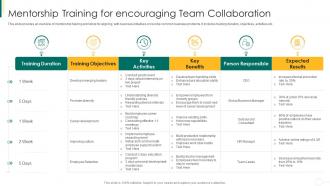
This slide provides an overview of mentorship training workshop for aligning with business initiatives or resolve common business problems. It includes training duration, objectives, activities etc.
People who downloaded this PowerPoint presentation also viewed the following :
Action plan for enhancing team capabilities mentorship training for encouraging team collaboration with all 9 slides:
Use our Action Plan For Enhancing Team Capabilities Mentorship Training For Encouraging Team Collaboration to effectively help you save your valuable time. They are readymade to fit into any presentation structure.








FAQs for Action plan for enhancing team capabilities mentorship training for
Honestly? Start with trust - without it you're screwed no matter what apps you use. Make sure everyone knows their role so people aren't tripping over each other (been there, it's messy). Communication is huge too. Set up regular check-ins to stay aligned. Oh, and psychological safety matters way more than people think - your team needs to feel safe calling out problems. Good tools help but they're not magic. Focus on how you'll make decisions together first, then figure out the rest. The fancy stuff comes later.
Honestly, templates are game-changers for team presentations. Your whole team starts organizing info the same way - problem, solution, next steps - so nobody's digging through slides looking for the actual point. I used to waste so much time building decks from zero every single time. With a standard format, people know exactly where to find what they need. Meetings get way more focused too. Everyone's brain is already wired for the structure, so you'll spend less time explaining and more time deciding. Start simple though - maybe just 3 slides. Trust me, your team updates will feel completely different.
Look, modern teams literally can't function without good tech tools anymore. Slack or Teams keeps everyone chatting instantly, video calls replace those awkward conference room meetings, and project management apps track who's doing what. The transparency is huge - no more "wait, what's the deadline again?" confusion. Oh, and distributed teams? Forget coordinating anything complex without these platforms. Just don't pick something super complicated that'll frustrate everyone. Find tools that actually match how your team already works, not the other way around.
Track project deadlines and completion times - that's your baseline stuff. But honestly? The real magic happens when you start asking your team how things actually feel. Quick surveys about communication and support tell you way more than spreadsheets sometimes. I'd watch for concrete changes too - like people speaking up more in meetings or those endless email threads finally dying out. Quality improvements are huge if you can measure them. Pick maybe 2-3 things that actually matter for your team's goals and stick with those instead of tracking everything under the sun.
Poor communication kills teams faster than anything else. Unclear roles don't help either - people end up stepping on each other or working in their own little bubbles. Trust issues? That's when things get really messy. Start with super clear expectations and check in regularly. Set up shared channels so everyone can actually see what's happening. I know it sounds basic, but make sure people understand what their teammates do and why it matters. Oh, and don't assume collaboration just happens naturally - it won't. You need structured ways for the team to share updates and tackle problems together. Worth the effort though.
Honestly, visual stuff is a game-changer for brainstorming. People can actually point at things and build off each other's ideas way better than just talking in circles. I've noticed diagrams or even messy sketches help everyone stay on the same page - literally. Plus you avoid that awkward "wait, what were we talking about again?" moment that happens like every 10 minutes in regular meetings. Mind maps work great too, though I always forget to bring colored pens which bugs me for some reason. But yeah, once people can see the connections between ideas, everything clicks faster. Try sketching next time instead of just talking!
Start with making it safe to mess up - like, actually safe, not just saying it is. Do regular check-ins, both one-on-one stuff and with the whole team. Weekly "wins and challenges" rounds work surprisingly well - I've watched teams completely flip just from everyone sharing openly like that. Make sure feedback goes both directions too. Set some basic ground rules early on (assume good intentions, speak up when things feel weird). The boring truth? It's all about being consistent over time. Small actions that show you genuinely care about what people think and how they're doing.
Honestly, the way you set up your team totally changes how much stuff actually gets done. Flat structures are cool because everyone can just talk to each other directly - no weird chain of command nonsense. Though sometimes nobody knows who's supposed to make the final call, which gets awkward. With hierarchical teams, at least you know who's responsible for what, but info takes forever to travel up and down. People get scared to speak up too. Oh, and cross-functional setups? They're actually pretty solid for brainstorming since you've got all these different brains working together. Just pick whatever matches your goals and don't be afraid to switch it up if it's not clicking.
Oh man, there's so many options it's kinda overwhelming honestly. Slack's great for quick messages and Teams works too if you're already using Microsoft stuff. Project-wise, I'd go with Asana or Trello - both are super clean for tracking tasks. Google Workspace is clutch for sharing docs without the version control nightmare. Video calls are obviously Zoom or Teams. Here's the thing though - don't go crazy with like 10 different apps. Pick maybe 3-4 solid ones and actually stick with them, otherwise you'll just confuse everyone and nothing gets done.
Honestly, make feedback a weekly thing instead of waiting for stuff to blow up. Specific feedback beats generic "nice work" comments every time - that vague stuff doesn't help anyone actually improve. I usually go with a simple format: what worked, what sucked, what we'll try differently next time. Works pretty well. Don't just do the manager-to-employee thing either - peer feedback is gold. Maybe start with one feedback session per sprint? See how your team vibes with it first, then adjust from there.
Honestly, structure is everything. Send the agenda ahead of time - people hate walking into meetings blind. Give someone the timekeeper role, have another person take notes. Cameras on if you can swing it, though I get that's not always realistic. Use breakout rooms or digital whiteboards instead of just droning on for an hour. Nobody stays engaged that way. Actually pause after asking questions - like, count to five in your head. Sounds weird but it works. Oh, and start meetings by having someone recap last time. Gets everyone's brain in the right place immediately.
Honestly, different perspectives are like having extra brains on the problem. Someone who grew up in another country or studied art instead of business? They'll see angles you'd never think of. I've noticed teams with varied backgrounds catch mistakes faster too - they question things that seem "obvious" to everyone else. The weird ideas often turn into the best solutions anyway. Oh, and when you're brainstorming, don't just invite diverse people and ignore them. Actually listen when someone throws out something that sounds totally random at first. Those off-the-wall suggestions can surprise you.
Honestly, goal frameworks are just a way to get everyone on the same page about what you're actually doing. No more of that "wait, what's my part again?" chaos that derails everything. Pick something like OKRs or SMART goals - doesn't really matter which one, just be consistent. They'll force you to nail down who does what and when stuff needs to happen. Your meetings will suddenly have a point (revolutionary, I know). The best part? You can actually track if things are working instead of just hoping for the best. Just start with one framework for your next project and see how it goes.
Honestly, the trick is treating fights like puzzles instead of wars. When people start getting heated, dig into what's really bugging them - not just what they're arguing about on the surface. Actually listen too (I know, revolutionary concept). Look for stuff everyone agrees on and build from there. The whole thing works way better when people aren't scared to admit what they're actually worried about. Oh, and try that "pause and explore" thing when drama starts - sounds cheesy but it actually helps turn the mess into something useful.
Honestly, those team activities just help people see each other as real humans instead of "that person from accounting." When Sarah knows you're into hiking or whatever, she's way more likely to actually ask for your help later. It breaks down the weird formality that makes collaboration feel forced. Plus you discover random skills - like finding out the quiet guy is amazing at problem-solving. I'd start super small though, maybe just quick check-ins before meetings. Even that tiny shift changes everything. People speak up more when they're comfortable, and that's when the good stuff happens.
-
Great product with effective design. Helped a lot in our corporate presentations. Easy to edit and stunning visuals.
-
Designs have enough space to add content.
-
Wonderful templates design to use in business meetings.
-
Innovative and Colorful designs.
-
Very well designed and informative templates.