


Team skill capability assessment matrix organizational team building program




Try Before you Buy Download Free Sample Product
 Impress Your
 Audience
 100%
100% Editable
 Save Hours
 of Time


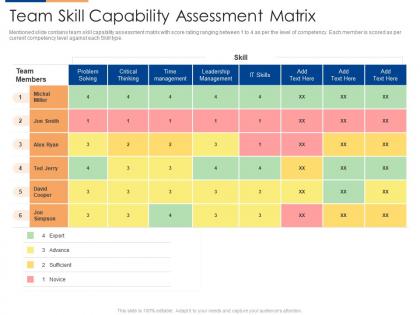
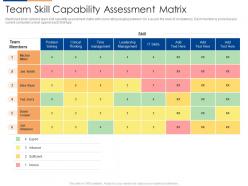
Mentioned slide contains team skill capability assessment matrix with score rating ranging between 1 to 4 as per the level of competency. Each member is scored as per current competency level against each Skill type.
People who downloaded this PowerPoint presentation also viewed the following :
Team skill capability assessment matrix organizational team building program with all 2 slides:
Use our Team Skill Capability Assessment Matrix Organizational Team Building Program to effectively help you save your valuable time. They are readymade to fit into any presentation structure.
FAQs for Team skill capability assessment matrix organizational
Honestly, I'd start with the obvious stuff - can they actually do the technical work you need? But the soft skills matter way more than people think. Communication, how they handle conflict, working with other teams. That's where projects usually fall apart anyway. Learning agility is huge since everything changes so fast. Even look for leadership potential in individual contributors - you never know when you'll need someone to step up. Oh, and adaptability for sure. Map this against your current team first and tackle the biggest gaps. Problem-solving capacity ties it all together.
Honestly, you need both the hard numbers and the softer stuff. Track your delivery velocity, code quality, sprint completion rates - that's your baseline. But here's where it gets interesting: dig into retrospective feedback and see how people are actually collaborating. Are they happy? Frustrated? Start small though - pick maybe 3-4 metrics that matter to your specific goals. Don't go crazy with dashboards right away. Focus on trends over time, not just weekly snapshots. Once you're comfortable reading the data, then you can get fancy with sentiment analysis and skill gap tracking. Trust me, the combination tells a way better story than numbers alone.
So there's a bunch of ways to tackle this. Start with a basic skills matrix - it's boring but you need that baseline info first. The Tuckman model is pretty useful for figuring out if your team's still in the drama phase or actually working together (forming, storming, norming, performing). T-shaped skills framework looks at both deep expertise and how well people collaborate across teams. Belbin's team roles thing is solid for understanding personalities, though honestly it can get weirdly academic sometimes. If you want to go all-in, the Team Effectiveness Model covers psychological safety, goals, accountability - basically everything. Pick whatever matches your biggest headaches right now.
Look at your company's strategic plan first - figure out what skills you actually need for the next 12-18 months. Then see where your team stacks up against those specific things. Honestly, most people just assess random skills instead of the ones that'll move the needle. Don't be that person. Map what you have vs. what the business actually needs to hit its goals. Oh, and definitely run this by leadership before you go down the rabbit hole - you want to make sure you're measuring stuff that matters to them too.
Diversity is honestly like a secret weapon for teams. Different backgrounds and thinking styles catch problems that cookie-cutter groups totally miss - I've watched it happen so many times. You can't just add up individual skills and call it done. Map out the cognitive stuff (how people think), functional expertise, plus demographic mix. These create weird synergies that boost your problem-solving way beyond what you'd expect. Start with an audit of what perspectives you're actually missing. Then weigh that into your capability scores. Homogeneous teams? They hit the same blind spots over and over.
Honestly, multiple perspectives beat just having your manager rate you every time. Get your teammates doing peer reviews or quick pulse surveys - they'll spot skill gaps your boss totally misses. 360-degree feedback works great too. Here's the thing though: people actually care more about the results when they're part of giving the feedback, not just receiving it. Nobody wants to feel like they're being judged in isolation, you know? Just make it consistent - maybe quarterly sessions focused on whatever competencies matter most. Way better than random one-off conversations that go nowhere.
Honestly, I'd start with response times and meeting participation - those tell you a lot right off the bat. Cross-functional project timelines are huge too. Look at whether people actually ask questions when they're confused (good sign!) and if they share knowledge without being asked. Conflict resolution speed is weirdly revealing - collaborative teams just hash things out faster. Oh, and check if workload gets spread around fairly or if the same people always get stuck with everything. Don't try measuring all this stuff at once though, you'll go crazy. Pick 2-3 metrics first, then add more later.
Honestly, quarterly works best for most teams. Stable team with slow projects? Yeah, twice a year is probably fine. But if you're dealing with constant role changes or new tech, every three months keeps you ahead of skill gaps. I've watched teams wait way too long and then totally panic when they realize they're missing key people for big projects - not fun. Just throw it on your calendar like any other planning thing. Trust me, you'll be glad you did when you're not scrambling later trying to figure out who can actually handle the work.
So I'd definitely check out 15Five, Lattice, or BambooHR first - they've all got decent skills tracking built right in. TalentGuard and AG5 are pretty solid too if you need something more heavy-duty for gap analysis. Honestly though? Don't sleep on a good Excel template if budget's tight. I know it sounds basic, but consistency matters way more than fancy software. Start with whatever HR platform you're already using - you might be surprised what assessment tools are just sitting there unused. Save yourself the headache of learning new software if you don't have to.
Hit up different people for their take - customers, leadership, other teams, plus your own team members. Quick surveys work, or just grab 15-minute chats about communication, delivery, that sort of thing. Stakeholders catch blind spots teams totally miss about themselves, which is honestly pretty eye-opening. Ask specific stuff though, not vague "how's it going?" questions. What happened last week? Give me examples. Then compare all that feedback with what you're seeing firsthand. That's how you actually figure out where the real gaps are.
Honestly, just make it feel normal instead of this huge scary thing. Schedule monthly team check-ins where everyone can actually say what's bugging them - yeah, it's weird at first but trust me, once people start being real with each other it's game-changing. Celebrate the small wins when they happen. Don't blame people when stuff doesn't work out. Try little experiments that won't break everything if they fail. The trick is building this reflection stuff right into how you already work, not making it some separate "improvement project." I'd probably do quick monthly reviews to see if you're actually getting anywhere or need to pivot.
Okay so first thing - make sure people know you're not trying to fire anyone or catch them screwing up. I've watched these things blow up when folks feel blindsided. Be upfront about why you're doing it and what happens with the results. Focus on growth stuff, not what they suck at. Let them help figure out their own development areas too - way better buy-in that way. Give people time to actually digest the feedback instead of rushing through it. Here's the big one though: you HAVE to follow up with real plans and support afterward. Can't just assess everyone then vanish into the ether, you know?
Don't get stuck looking at old resume stuff or what people did ages ago. What matters is what they can actually do right now. Technical chops are cool but honestly, I've watched genius coders completely wreck projects because they're impossible to work with. Communication and teamwork aren't just nice-to-haves anymore. Here's the weird thing - sometimes your "best" individual performers actually drag down everyone else's productivity. Focus on how your current team clicks together and what gaps are genuinely hurting your goals today, not theoretical problems.
Honestly, it really depends on where your team sits. Remote people? You've got to check their async communication and how they handle digital tools - can't just walk over and see what's up anymore. Office teams are easier in some ways since you can watch them collaborate in real time and see their leadership vibe up close. For remote folks, I'd do more project-based stuff and virtual pair sessions. Maybe look at how they communicate in Slack or whatever you use. Office teams though - group exercises and just observing how they work together is clutch. The key is matching your assessment style to how they actually operate day-to-day.
Look, you're basically conducting an orchestra here. Create that safe space where people actually tell the truth about their strengths and weaknesses - otherwise you'll just get polite BS that helps nobody. Set clear expectations about why you're doing this, and be vulnerable about your own gaps first. I've watched so many of these tank because leaders treated it like a performance review instead of actual development. Show genuine curiosity when people share their perspectives. Ask good questions and really participate - don't just sit there taking notes. Oh, and make it feel developmental, not like some corporate punishment. Your energy sets the whole tone, honestly.
-
Great experience, I would definitely use your services further.
-
Unique and attractive product design.
-
Perfect template with attractive color combination.
-
Visually stunning presentation, love the content.
-
Excellent work done on template design and graphics.