

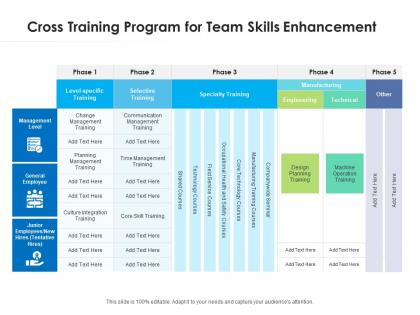
Cross training program for team skills enhancement




Try Before you Buy Download Free Sample Product
 Impress Your
 Audience
 100%
100% Editable
 Save Hours
 of Time


Our Cross Training Program For Team Skills Enhancement are topically designed to provide an attractive backdrop to any subject. Use them to look like a presentation pro.
People who downloaded this PowerPoint presentation also viewed the following :
Cross training program for team skills enhancement with all 2 slides:
Use our Cross Training Program For Team Skills Enhancement to effectively help you save your valuable time. They are readymade to fit into any presentation structure.

FAQs for Cross training program for
Cross training delivers enhanced cardiovascular fitness, injury prevention, improved muscular balance, reduced training monotony, and sport-specific skill development through diverse movement patterns. Athletes in swimming, cycling, and running find that incorporating complementary activities streamlines performance gains while minimizing overuse injuries, ultimately delivering competitive advantages and extended career longevity.
Businesses can implement cross training through job rotation programs, collaborative project assignments, mentoring partnerships, skill-sharing workshops, and structured knowledge transfer sessions. These approaches enhance team collaboration by breaking down departmental silos, improving communication across functions, and fostering mutual understanding of different roles, ultimately delivering stronger teamwork and operational flexibility.
Cross training reduces injury risk by distributing physical stress across different muscle groups, movement patterns, and impact levels, while addressing muscular imbalances and overuse concerns. Through strategic rotation between activities like swimming, cycling, and strength training, fitness enthusiasts enhance overall conditioning, improve joint stability, and maintain workout consistency, ultimately delivering sustainable fitness progress and reduced recovery downtime.
Cross training enhances cognitive flexibility by exposing employees to diverse problem-solving approaches, varied workflows, and different departmental perspectives, ultimately strengthening their adaptability and critical thinking skills. Through rotating between roles like customer service, operations, and technical support, organizations enable workers to develop broader mental frameworks, enhanced decision-making abilities, and improved innovation capacity, delivering more agile and versatile teams.
Effective cross training techniques for beginners include swimming, cycling, walking, bodyweight exercises, and yoga. These activities enhance cardiovascular health, build strength, and improve flexibility while minimizing injury risk, with many fitness newcomers finding that alternating between low-impact and resistance-based exercises ultimately delivers sustainable progress and long-term exercise adherence.
Cross training contributes to overall fitness by engaging different muscle groups, preventing overuse injuries, improving cardiovascular health, and enhancing functional strength through varied activities. This strategic approach enables athletes and fitness enthusiasts to build comprehensive endurance while maintaining motivation, with many finding that combining swimming, cycling, and strength training ultimately delivers superior performance outcomes and reduces injury risk.
Cross training program effectiveness can be measured through employee skill acquisition rates, productivity improvements across departments, reduced training costs, employee retention rates, and cross-functional project completion times. These metrics enable organizations to track operational efficiency, workforce flexibility, and knowledge transfer success, with many companies finding that comprehensive measurement ultimately delivers enhanced team collaboration and strategic competitive advantage.
Cross training can be tailored by identifying critical competencies for each role, mapping skill overlaps between departments, and creating targeted rotation programs that align with operational needs. Companies like manufacturing firms cross train production workers in quality control and maintenance, while financial services organizations train customer service representatives in sales and compliance functions, ultimately enhancing workforce flexibility and reducing operational vulnerabilities.
Best practices for integrating cross training include gradual activity introduction, maintaining workout frequency consistency, selecting complementary exercises, scheduling adequate recovery periods, and monitoring performance metrics. Through strategic combination of activities like swimming, cycling, and strength training, athletes enhance cardiovascular endurance, reduce injury risks, and prevent training plateaus, while many fitness enthusiasts find that varied routines deliver sustained motivation and improved overall performance.
Cross training enhances skill diversification by exposing specialized workers to complementary roles, new technologies, and varied problem-solving approaches within their organization. Through structured rotation programs, professionals in fields like healthcare, engineering, and finance develop broader competencies, improve adaptability, and increase their strategic value, ultimately delivering enhanced career resilience and organizational flexibility.
Cross training delivers enhanced motivation, reduced mental fatigue, improved confidence, and greater psychological resilience compared to repetitive traditional methods. By incorporating varied activities and skill development across different areas, employees experience increased engagement and reduced burnout, with many organizations finding that diverse training approaches ultimately boost morale and job satisfaction.
Technology streamlines cross training program management through learning management systems, skill tracking platforms, automated scheduling tools, and progress analytics dashboards. These solutions enable organizations to map employee competencies, assign targeted training modules, and monitor development progress in real-time, ultimately delivering enhanced workforce flexibility and operational efficiency across departments.
Cross training safety considerations include proper warm-up protocols, gradual intensity progression, equipment inspection, instructor qualifications, and participant health screening. These protocols enhance workplace preparedness by reducing injury risks, ensuring consistent safety standards, and building employee confidence across departments, with many organizations finding that comprehensive safety measures ultimately deliver better training outcomes and reduced liability exposure.
Cross training improves performance metrics by enhancing versatility, reducing injury rates, preventing skill plateaus, and building comprehensive fitness foundations across multiple disciplines. Athletes and teams increasingly find that diverse training approaches strengthen weaknesses, maintain peak conditioning year-round, and deliver competitive advantages through improved adaptability, endurance, and strategic performance consistency.
Common cross-training mistakes include doing too much too soon, neglecting proper warm-ups and recovery, choosing activities that are too similar, and lacking structured progression plans. Many fitness enthusiasts find that starting gradually with diverse activities like swimming, cycling, and strength training, while prioritizing rest days and proper form, ultimately delivers better results and reduces injury risk significantly.
-
Content of slide is easy to understand and edit.
-
Easily Understandable slides.