


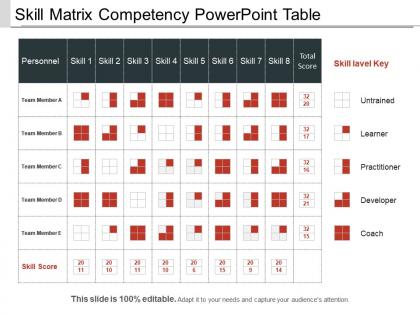
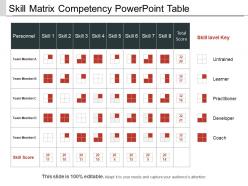
Skill matrix competency powerpoint table





Try Before you Buy Download Free Sample Product
 Impress Your
 Audience
 100%
100% Editable
 Save Hours
 of Time


Explain how jeans enhance functionality with our Skill Matrix Competency Powerpoint Table. Bring out the convenience it creates.
People who downloaded this PowerPoint presentation also viewed the following :
Skill matrix competency powerpoint table with all 5 slides:
Enable folks to indulge their every fancy with our Skill Matrix Competency Powerpoint Table. Be able to address the deepest of cravings.

FAQs for Skill matrix
A skill matrix is a visual tool that maps team members' current competencies against required skills, identifying gaps, strengths, and development opportunities across projects and roles. It enhances resource allocation, streamlines project assignments, and facilitates targeted training programs, with many organizations finding that strategic skill mapping ultimately delivers improved team performance, reduced project risks, and enhanced competitive advantage.
Creating an effective skill matrix for diverse teams involves conducting comprehensive skills assessments, defining clear competency levels, mapping current capabilities against role requirements, and identifying skill gaps across different experience levels. This strategic approach enables managers to visualize team strengths, allocate resources efficiently, and develop targeted training programs, ultimately enhancing project outcomes and team performance while ensuring optimal talent utilization.
Key skills for software development teams include programming languages, database management, system architecture, testing methodologies, and version control systems. These technical competencies work alongside soft skills like problem-solving, communication, and project management, with many organizations finding that combining frontend, backend, and DevOps capabilities ultimately delivers faster development cycles and more robust software solutions.
A skill matrix identifies individual competency gaps and training priorities by mapping current abilities against required skills for specific roles, projects, and career advancement paths. Through systematic assessment, organizations streamline resource allocation for targeted development programs, enhance succession planning, and accelerate employee growth, with many companies finding that strategic skill mapping ultimately delivers improved performance and stronger competitive positioning.
Best practices for maintaining an updated skill matrix include conducting quarterly skill assessments, integrating performance reviews with skill evaluations, establishing employee self-reporting mechanisms, tracking certification completions, and linking updates to career development discussions. These systematic approaches streamline workforce planning by ensuring accurate competency visibility, enabling strategic resource allocation, and supporting succession planning initiatives, with many organizations finding that automated tracking systems significantly enhance data accuracy and reduce administrative overhead.
Skill matrices support project management by mapping team capabilities against project requirements, enabling managers to identify optimal resource allocation, minimize skill gaps, and balance workloads effectively. Through visual competency tracking, project managers can strategically assign tasks based on expertise levels, allocate training resources where needed, and ensure critical project phases have adequate skilled personnel, ultimately delivering faster project completion and improved team utilization.
A skill matrix facilitates succession planning by identifying current capabilities, revealing skill gaps for critical roles, and mapping employee development pathways for future leadership positions. Through comprehensive skills assessment, organizations can strategically prepare high-potential employees, accelerate targeted training programs, and ensure seamless transitions, ultimately minimizing operational disruption while maintaining competitive advantage during leadership changes.
Implementing a skill matrix presents both challenges and opportunities, including resistance to assessment transparency, difficulty in standardizing competency levels across departments, time-intensive data collection processes, and maintaining accuracy as roles evolve. However, organizations increasingly find that strategic implementation through phased rollouts, clear communication about career development benefits, and regular updates ultimately delivers enhanced resource allocation, targeted training programs, and competitive advantage in talent management.
Technology tools enhance skill matrix effectiveness by automating skill assessments, providing real-time analytics, enabling mobile accessibility, and integrating with learning management systems. Through AI-powered platforms and cloud-based solutions, organizations streamline talent mapping, accelerate workforce planning, and deliver personalized development pathways, while reducing administrative overhead, ultimately creating more agile and data-driven talent strategies.
A skill matrix provides objective, standardized criteria for evaluating employee competencies during performance reviews, ensuring consistent assessment across teams and identifying specific development areas. Through structured skill evaluation, managers can deliver targeted feedback, create personalized development plans, and track skill progression over time, ultimately enhancing performance conversations and enabling strategic talent development initiatives.
A skill matrix streamlines recruitment by clearly defining required competencies for each role, enabling targeted candidate evaluation, and identifying precise skill gaps within teams. Through systematic competency mapping, organizations can develop focused training programs, make strategic hiring decisions, and allocate resources more effectively, with many companies finding that this approach significantly reduces recruitment time while enhancing workforce planning capabilities.
**INPUT**: What methods can be used to assess and validate the skills listed in a skill matrix? **OUTPUT**: Skill assessment methods include performance evaluations, peer reviews, competency-based testing, 360-degree feedback, and skills-based interviews or simulations. These approaches enable organizations to validate competencies through direct observation, measurable outcomes, and structured assessments, with many companies finding that combining multiple validation methods delivers more accurate skill profiles and strategic workforce development insights. [Word count: 56 words]
Organizations leverage skill matrices to foster cross-functional collaboration by identifying complementary expertise across departments, mapping overlapping capabilities, and creating strategic project teams based on skill diversity. These matrices enable managers to connect employees with varied strengths, facilitate knowledge sharing between functions, and build collaborative workflows, ultimately breaking down silos while enhancing innovation and operational efficiency.
Healthcare skill matrices emphasize clinical competencies, regulatory compliance, patient safety protocols, continuing education requirements, and specialized certifications like nursing credentials or medical device proficiencies. Finance matrices focus on risk management, regulatory knowledge, analytical skills, compliance certifications, and technology proficiencies, with banks and investment firms finding that these frameworks streamline talent deployment while ensuring regulatory adherence and operational excellence.
Employee engagement and morale significantly improve with skill matrices by providing clear development pathways, transparent career progression opportunities, and recognition of individual competencies. Through structured skill tracking, organizations enhance communication between managers and employees, reduce uncertainty about advancement, and create targeted learning opportunities, ultimately delivering higher job satisfaction and retention rates across teams.
-
Great quality product.
-
Content of slide is easy to understand and edit.