


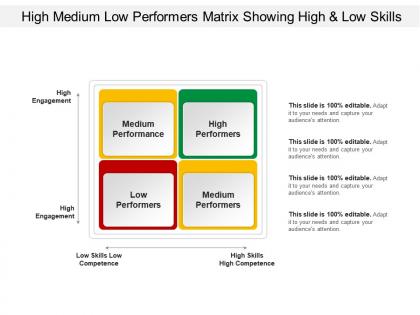
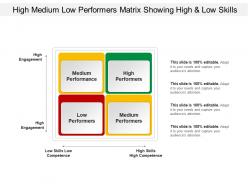
High medium low performers matrix showing high and low skills




Try Before you Buy Download Free Sample Product
 Impress Your
 Audience
 100%
100% Editable
 Save Hours
 of Time


Ensure control over your expenses with our High Medium Low Performers Matrix Showing High And Low Skills. It helps curtail costs.
People who downloaded this PowerPoint presentation also viewed the following :
High medium low performers matrix showing high and low skills with all 5 slides:
Create meaningful and cohesive presentations with our exclusive High Medium Low Performers Matrix Showing High And Low Skills. They are designed to meet the client's needs and are aligned to work specifically for them.
FAQs for High medium low performers matrix showing high
You need solid performance metrics and rating scales with specific examples for each level. Mix quantitative stuff (sales numbers, deadlines) with qualitative measures like communication and leadership skills. The behavioral examples are honestly crucial - without them, everything becomes way too subjective and inconsistent. I've seen so many companies mess this up by being too vague. Weight your priorities so people actually know what matters most. Include space for development goals and feedback too. Oh, and keep it simple enough that managers won't just ignore it - complexity kills adoption every time.
Honestly, you gotta pick metrics that actually matter for your specific industry. Retail? Track customer acquisition cost, inventory turnover, same-store sales growth - that stuff. Tech companies are totally different though - they're all about user engagement and churn rates. Healthcare's weird because they focus on patient satisfaction and readmission rates instead. I'd say find 3-5 metrics that directly tie to how your industry makes money. Oh, and check what your biggest competitors are publicly tracking - that's usually a good starting point for figuring out what actually moves the needle.
Honestly, charts and graphs are game-changers for performance data. You'll spot trends instantly instead of staring at endless spreadsheet rows. Heat maps are my favorite - outliers just jump out at you. Bar charts work great too for starting simple. Your stakeholders will actually pay attention when you're not showing them raw numbers (trust me on this). Plus you can see how different KPIs connect to each other way better visually. Makes presenting so much less painful.
Here's the thing - start with your big goals and break them into stuff each team can actually control. Pick 2-3 metrics per goal that show real progress, not just busy work numbers. I swear, half the companies I know track metrics that make them feel productive but mean nothing to the business. Every metric needs an owner, and it better connect to something your boss actually gives a damn about. Check quarterly if things still make sense since priorities shift constantly. Honestly? If a metric isn't helping you decide what to do next, just drop it.
Don't cram like 20 different metrics into one scorecard - people's eyes will glaze over and nothing actually gets done. Vague stuff is the worst too. "Good communication skills" means what exactly? Be specific about everything. Your rating scales need to be super clear so everyone's measuring the same way. Weight things properly because obviously closing deals matters more than showing up on time (usually anyway). Short sentences work. Longer ones can flow naturally when you're explaining something more complex. Oh and update it regularly! What mattered in Q1 might be completely irrelevant by summer.
So instead of just tracking quarterly stuff, add monthly check-ins where your results actually change what you're targeting next. I'd start with a "lessons learned" column that connects back to your main metrics - super simple but it works. The whole thing should feel like a living document that evolves, not some spreadsheet you dread opening. Make sure whatever feedback you get directly impacts your future goals or where you're putting resources. Honestly, those static tracking sheets are the worst. Monthly touchpoints are way more realistic than pretending everything stays the same for three months straight.
Honestly just use Excel or Google Sheets first - they work great for most stuff and you already know how to use them. Tableau and Power BI are worth looking at if you need fancier charts or you're dealing with tons of data. Monday.com has some matrix features if your team's already on there, but it's not super flexible. Oh, and if this is for employee reviews specifically, BambooHR is pretty solid. I'd definitely start with spreadsheets though - no point paying for fancy tools until you figure out what you actually need. You can always switch later.
Don't just hand them a finished matrix - that's where I messed up big time! Get them involved from the start. Have them help define what success actually looks like for their teams and which metrics really matter. Walk through how you'll collect the data together. This way they'll feel like they own it instead of having something dumped on them. Connect their performance to company goals so they see the bigger picture. Oh, and definitely schedule a follow-up to tweak things based on their input - trust me, you'll need it.
Goal achievement and job knowledge are the big ones most places use. Communication skills, teamwork, leadership potential too. Companies usually throw in productivity numbers and quality of work - plus that whole "company values" thing, which honestly depends on whoever's doing your review that year. I'd mix quantitative stuff (sales figures, project deadlines) with the softer skills like problem-solving. Just don't go overboard - stick to maybe 5-7 metrics tops or you'll be drowning in data come review time.
So with remote teams, ditch all that "time in office" stuff and focus on actual results instead. Track deliverables and project completion rates - way more useful than meeting attendance anyway. Communication quality matters too, plus how well people collaborate virtually. Oh, and definitely add response times since that's huge when you're all scattered. The whole butts-in-seats thing is so outdated now. Start by looking at your current metrics and swap out anything presence-based for outcome-focused ones. Maybe throw in some knowledge sharing scores too?
Oh man, this is such a real problem! Different cultures approach self-promotion and feedback completely differently. You'll have some employees who downplay their achievements because that's how they were raised, while others list every small win. Communication styles vary wildly too - what looks like "leadership material" in one culture might seem pushy in another. I learned this the hard way at my last job, honestly. The tricky part is your evaluation criteria probably has hidden cultural bias baked in. You've gotta train managers on this stuff and actually build cultural awareness into how you measure performance. Otherwise you're just perpetuating unfairness without meaning to.
Honestly? I'd say monthly if you can manage it, but quarterly at the bare minimum. Companies move so damn fast these days - priorities flip overnight, people switch teams, and suddenly half your metrics are measuring stuff nobody cares about anymore. Don't get precious about it either. If something's clearly not working or the business does a complete 180, just change it right away instead of waiting for your next scheduled review. Oh, and definitely set a calendar reminder because this stuff is way too easy to forget about when you're buried in day-to-day work.
Honestly, these things are game-changers for getting teams on the same page. Everyone looks at identical metrics instead of arguing over different numbers. You'll start noticing weird stuff - like how marketing's lead quality totally messes with sales conversion rates. The visual layout makes it super obvious where bottlenecks are hiding between departments. I swear, meetings become way more productive when you're all staring at the same data. Less "but our numbers show..." and more actual problem-solving. Oh, and don't try to roll it out everywhere at once - that's a nightmare. Just pick one other team to start with.
Check if your matrix actually changes how people act and what results you're getting. High scorers should be the ones crushing revenue or customer satisfaction - whatever you care about most. Managers need to use it consistently, and employees should get feedback they can actually do something with. Honestly, the real test? People bring it up in normal conversations, not just during review season. I've seen too many that just collect dust between formal reviews. Also watch if the scores match real performance - that correlation tells you everything.
Honestly, OKRs are pretty solid - Google made them famous and they're way better than boring old targets. Netflix does this brutal "keeper test" where managers ask if they'd fight to keep someone (yikes but apparently effective). You could try the balanced scorecard thing too, it covers financial stuff plus customer/process metrics all at once. Oh and ditch annual reviews! Continuous feedback is where it's at now. I'd probably start with OKRs though - they're more exciting than whatever spreadsheet nightmare you're using now.
-
Top Quality presentations that are easily editable.
-
It saves your time and decrease your efforts in half.