


Activities For Conflict Management Training Ppt




Try Before you Buy Download Free Sample Product
 Impress Your
 Audience
 100%
100% Editable
 Save Hours
 of Time


This set of slides contains activities that a trainer can use in the conflict management training session to explain different concepts and engage the audience. The activities are Everything Before the BUT is Nonsense, Self-Reflective Questionnaire, Conflict Management Styles, Positive Definitions, Debate vs Dialogue, Active Listening, and Conflict Escalating and Reducing Behavior.
People who downloaded this PowerPoint presentation also viewed the following :
Content of this Powerpoint Presentation
Slide 2
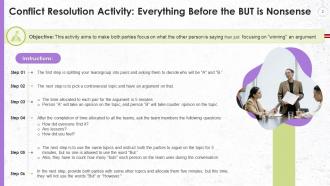
This slide illustrates the activity for everything before the but is nonsense. It also explains the different steps that are required to conduct the activity.
Instructor’s Notes:
Multiple questions asked after completing the activity are as follows:
- Did you find that you listened harder?
- Did you find that you had to respond to what the other person was saying?
- Were you taking turns to talk or did you have a more constructive conversation?
- What learning can you take forward?
Slide 3
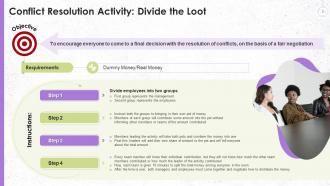
This slide elaborates upon the activity an activity 'Divide the Loot’ to train employees on how to resolve workplace conflicts in an amicable manner. It also explains key instructions that are required to conduct the activity.
Instructor’s Notes:
Ask these questions post completion of the activity:
- How did they feel during the exercise?
- Did anyone feel uncomfortable during the exercise?
- Did anyone take control of the conversation?
- How did the team distribute the money and resolve the conflict?
- Would you do anything differently?
- What did you learn during this exercise?
Important to keep the atmosphere in the room friendly
Slide 4 and 5
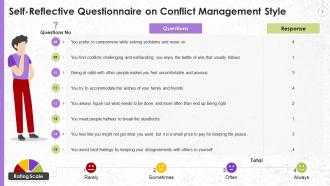
These slides showcase the questionnaire on styles of conflict management. It also illustrates the scale to be used to get a response from trainees.
Instructor’s Notes:
- The questionnaire informs attendees on which of the five styles of conflict management is the closest to their way of working. Remember, this is a spectrum, not absolute brackets.
- Collaborating
- Competing
- Avoiding
- Harmonizing
- Compromising
- Ask trainees to answer the situation-based questions as per their comfort level
- Guide them to answer the questions honestly without overthinking as there are no right or wrong answers
- Once answered, ask them to calculate the score
- If any situation does not apply to them, ask them to mark it as N/A
Slide 6
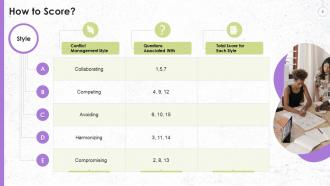
This slide tabulates the scores for different conflict management styles questionnaire such as collaborating, competing, avoiding, harmonizing, and, compromising.
Instructor’s Notes:
The style with the highest score is the dominant conflict management style or approach of an individual.
Slide 7 to 10
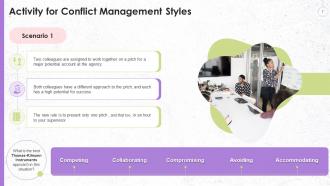
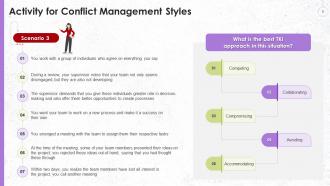
This slide illustrates an activity based on Thomas Kilmann conflict management styles.
Slide 11
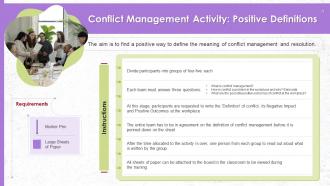
This slide explains the activity on conflict management named “positive definitions.” It also explains the requirements and instructions that are required to conduct the activity in a successful manner.
Slide 12
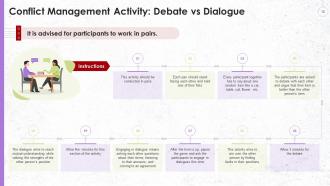
This slide illustrates the debate vs dialogue conflict management activity. It also contains instructions that are required to conduct the activity successfully.
Instructor’s Notes:
Questions you can ask to start the discussion are as follows:
- What are your opinions on each situation?
- How you react to each situation?
- What changed in the activity when you switched from debate to dialogue?
- Why is it difficult to listen when somebody disagrees with you?
- How did you reach a conclusion that both of you agreed upon?
Slide 13
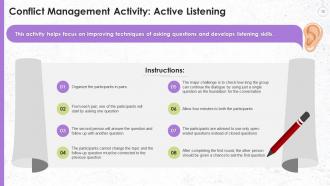
This slide illustrates the active listening conflict management activity. It also contains required instructions for successful execution.
Instructor’s Notes:
At the end of both rounds, start a discussion regarding the activity. You can ask questions such as:
- How difficult was this activity?
- What are the learnings?
- Why use open-ended questions during a conflict?
- How will the questioning technique help during a conflict?
Slide 14 to 15
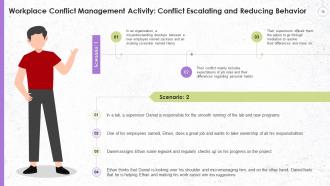
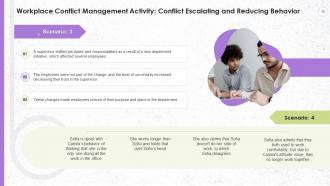
These slides list the multiple scenarios that trainer can use to conduct workplace conflict management activity.
Slide 16
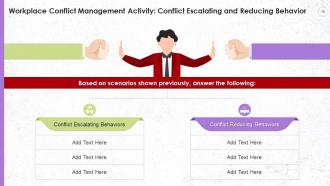
This slide showcases the answers based on multiple scenarios shown previously.
Activities For Conflict Management Training Ppt with all 32 slides:
Use our Activities For Conflict Management Training Ppt to effectively help you save your valuable time. They are readymade to fit into any presentation structure.














FAQs for Activities For Conflict
Honestly, catch these things before they blow up - that's half the battle right there. Don't go after who they are as a person, stick to what they actually did. Listen first even though you'll want to jump right in with your side (I'm terrible at this btw). Stay calm and ask stuff like "help me understand where you're coming from." You're not trying to win here. Find something you both agree on and work from there. I've learned it's way better when you separate the actual problem from the person. Makes everything less personal and you can actually solve things together.
Look, team-building stuff actually works because people get to practice dealing with drama when the stakes are low. Your team builds trust and learns how to talk things out properly. When real conflict hits, they'll hash it out instead of being all passive-aggressive about it. Role-playing awkward conversations sounds cheesy but it's weirdly effective - suddenly everyone sees disagreements as puzzles to solve together rather than fights to win. I'd say try doing something monthly, even just 30 minutes. Oh, and pick activities that don't totally suck or people will just mentally check out.
Honestly, emotional intelligence makes or breaks conflict situations. I've seen managers completely lose their teams because they can't handle tension. The trick is catching your own triggers before you blow up - like that pause you mentioned really works. Most arguments aren't even about what people are actually saying anyway. Someone's mad about deadlines but they're really stressed about looking incompetent, you know? When you can pick up on that stuff and respond to the real issue instead of just the surface drama, everything shifts. It's weird how much calmer things get when you stop reacting automatically.
OK so basically you want to get everyone together and set some ground rules first - like no cutting people off, stick to the actual issues instead of getting personal. Let each person explain their side while you just listen and repeat back what you're hearing. People just want to feel heard honestly, and that fixes most of the drama. Then help them figure out what they actually agree on and brainstorm fixes together. Don't try to solve it for them though - that never works. Just stay neutral and ask questions that get them thinking. Works way better than you'd expect.
Look out for raised voices and when people start attacking each other personally instead of talking about the actual problem. Body language gets tense, people shut down or just walk away entirely. Here's the thing though - the biggest warning sign is when that original issue gets completely buried under a pile of new complaints. That's your cue to jump in fast. Call a pause and acknowledge everyone's frustrated. Sometimes just saying "hey, we're all getting pretty heated here" helps reset things. Get each person to explain their main concern again, but without the blame game this time. Don't let it become about personalities - keep it focused on the actual problem at hand.
Yeah, culture totally affects how people deal with conflict. Americans love the whole "let's hash this out" thing, but that can come off as super aggressive to someone from a culture that values harmony. Hierarchical cultures make it way harder to challenge your boss compared to more egalitarian ones. Some people want conflicts resolved immediately while others need time to process - honestly, the timing thing trips people up more than you'd think. My advice? Ask your teammates upfront how they like handling disagreements. Way easier than guessing later when things get tense.
Oh man, active listening is like magic for defusing situations. When you actually listen - not just plot your comeback - people drop their guard instantly. They feel heard, you know? I've seen the weirdest arguments just... deflate when someone finally goes "oh wait, you're upset about X, not Y." Plus you'll catch the real issue hiding underneath all the surface drama. Here's what works: repeat back what they said but in your own words. Sounds simple but honestly? It's wild how well it works. People just want to feel understood most of the time.
Honestly, conflict training is a game changer. Your team learns to hash out disagreements without everything spiraling into workplace drama. Short sentences work better sometimes. People get way better at actually listening instead of just waiting for their turn to talk - which, let's be real, most of us are guilty of. Teams that can handle tough conversations don't waste time tiptoeing around issues or letting the loudest person run the show. You'll see productivity jump because people aren't spending half their day dealing with interpersonal garbage. I'd probably start with basic communication stuff if you're considering it.
Start with a solid conflict resolution policy - lay out the steps for escalation and when to bring in mediators. The Thomas-Kilmann thing is actually pretty great for figuring out if someone's an avoider or always wants to compete (I was definitely an avoider for years). Regular team check-ins help you catch stuff before it gets messy. Train your managers on mediation basics. Having neutral people available for the big blowups is clutch too. Multiple ways to address problems means they don't sit there getting worse until someone finally loses it.
Role-playing is honestly such a game-changer for conflict training. Set up scenarios based on real workplace drama - you know, like when departments fight over resources or dealing with angry customers. People remember way more when they're actually doing something instead of zoning out during presentations. Mix up the roles so everyone gets different perspectives. After each scenario, spend time talking through what happened and brainstorming better approaches. Oh, and definitely start simple - don't throw them into the deep end right away. Build up to the messy, complicated situations once they're comfortable with the basics.
Honestly, conflict-positive culture is a game changer for teams. Your people stop tiptoeing around problems and actually start tackling them head-on. Innovation gets way better because everyone's comfortable challenging ideas. Relationships grow stronger too - weird but true. I've seen teams become so much more resilient when they're used to working through disagreements instead of pretending everything's fine. Oh, and engagement shoots up when people know they can speak up without getting their heads bitten off. Best way to start? Just model it yourself. Call out conflicts when you see them and focus on fixing things, not pointing fingers.
Make feedback part of the whole process, not just something you do at the end. Weekly check-ins work great when things are heated. Anonymous surveys are solid if people feel weird speaking up directly. One-on-ones work too - honestly whatever fits your team's vibe. I've watched so many "resolved" conflicts blow up again because everyone just assumed things were cool. Don't do that. Keep asking how it's going even after you think you've fixed it. Oh and actually do something with what people tell you - otherwise they'll just stop being real with you next time.
Honestly, how you communicate makes or breaks conflict resolution. Being direct can solve stuff fast, but you might sound like a total asshole. Passive people just dodge the actual problem - super annoying. Aggressive folks steamroll everyone else's feelings. The trick is being assertive instead. Say what you need but don't trash other people's perspectives. Actually listen too - like really listen, not just waiting for your turn to talk. People won't budge until they feel heard. Sometimes you gotta switch up your usual style depending on what's happening.
Honestly, conflicts can be gold mines for fixing stuff that's been broken anyway. Instead of dodging the drama, dive in and see what's really going on underneath. I've watched teams go from wanting to murder each other to actually working better together - weird but true. The trick is treating disagreements like clues about what's screwed up in your communication or workflow. Set up time where everyone gets to vent without being interrupted. Then figure out where you actually agree and what you'll do differently. It's messy but it works.
You need clear escalation steps first - like who handles minor stuff versus the big blowups. Set specific timelines too, or things just drag on forever. Train your managers on basic mediation (the documentation part is tedious but saves your butt later). Give people options - sometimes informal chats work, other times you need formal mediation or bringing in outside help. Honestly, the trick is mapping this out before drama hits, not when everyone's already freaking out. Look at what your team does naturally when conflicts pop up and build your policy around that.
-
Great product with effective design. Helped a lot in our corporate presentations. Easy to edit and stunning visuals.
-
Keep doing the good work guys. Surpass the needs and expectations always!!