


Managing Conflict With Stress Management Training Ppt




Try Before you Buy Download Free Sample Product
 Impress Your
 Audience
 100%
100% Editable
 Save Hours
 of Time


This set of slides provides information on the impact of stress on conflict resolution and techniques to handle it by managing stress triggers and engaging one or more senses. Further, it lists the strategies to handle stress in the workplace by setting work-life boundaries, practicing problem-solving, talking to someone, practicing mindfulness, exercising regularly, and eating healthily.
People who downloaded this PowerPoint presentation also viewed the following :
Content of this Powerpoint Presentation
Slide 1
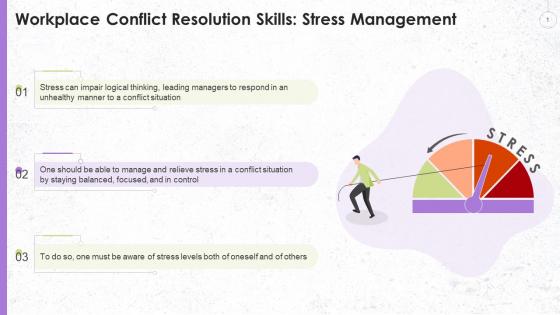
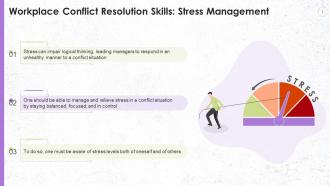
This slide provides information on adverse impacts of stress, i.e., impairment of logical thinking. It also contains details on how effectively releasing stress in a tense situation can prevent conflicts from escalating.
Slide 2
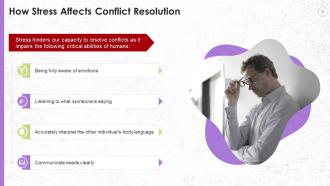
This slide lists the multiple ways in which stress hampers workplace conflict resolution. Stress directs hits our ability to detect and be aware of emotions; interpreting the other person's body language; communication of our needs in a clear manner.
Slide 3
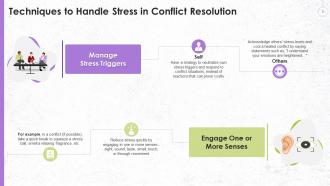
This slide highlights multiple methods to handle stress in conflict resolution, i.e., managing stress triggers and engaging one or more senses while interacting with parties in conflict.
Slide 4
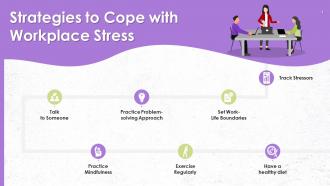
This slide illustrates multiple approaches to handling workplace stress effectively. The strategies are tracking stressors, setting work-life boundaries, practicing problem-solving, talking to someone, practicing mindfulness, exercising regularly, and eating healthily.
Instructor's Notes:
Strategies to deal with workplace stress are:
- Track Stressors: Keep a note of things that cause you stress; it may be activity, a person a situation. Identify a pattern, if any, and limit exposure to these stressors. Limit exposure to such activities
- Set Work-Life Boundaries: Draw well-defined work-life boundaries and stick to these. For example, avoid checking work emails at home
- Practice Problem-solving Approach: Deploy the problem-solving approach to complex tasks using specific steps like defining a problem, brainstorming solutions, and developing an action plan.
- Talk to Someone: Seek guidance from someone senior in the organization to put things in perspective
- Practice Mindfulness: Practice mindfulness to tackle stress at work as it allows you focus on the present with a mindset of openness, acceptance, and curiosity.
- Exercise Regularly: Do regular exercise to lift mood and increase energy levels; physical activity releases endorphins that act as natural painkillers.
- Balanced Diet: Stress can lead to chronic overeating, especially food with high sugar. Regular consumption of unhealthy food in an invite to ill-health
Managing Conflict With Stress Management Training Ppt with all 20 slides:
Use our Managing Conflict With Stress Management Training Ppt to effectively help you save your valuable time. They are readymade to fit into any presentation structure.








FAQs for Managing Conflict With Stress
Key principles of effective conflict management include active listening, addressing issues early, maintaining neutrality, focusing on interests rather than positions, and encouraging collaborative problem-solving. These approaches streamline team dynamics by reducing workplace tension, improving communication channels, and fostering mutual understanding, with many organizations finding that proactive conflict resolution ultimately delivers enhanced productivity and stronger team cohesion.
Active listening techniques enhance conflict resolution by demonstrating respect, uncovering underlying concerns, and creating psychological safety for all parties involved. Through reflective responses, paraphrasing, and asking clarifying questions, mediators and managers can identify root causes, reduce defensiveness, and build trust, ultimately enabling more collaborative solutions and sustainable agreements in workplace disputes.
Emotional intelligence enables effective conflict management by fostering self-awareness, empathy, and emotional regulation during tense interpersonal situations. Leaders with high emotional intelligence can de-escalate disputes, understand multiple perspectives, and facilitate constructive dialogue, with many organizations finding that emotionally intelligent managers resolve conflicts faster and maintain stronger team relationships.
Cultural differences significantly impact conflict management by influencing communication styles, hierarchy respect, decision-making processes, and relationship priorities across different societies. Organizations operating globally must adapt their approaches accordingly, with many multinational companies finding that culturally-sensitive mediation, flexible negotiation frameworks, and diverse conflict resolution teams deliver more effective outcomes and stronger cross-cultural collaboration.
Common workplace sources include communication breakdowns, resource competition, personality clashes, unclear roles, and differing work styles or values. These conflicts can be mitigated through clear communication protocols, defined responsibilities, regular feedback sessions, and structured mediation processes, with many organizations finding that proactive conflict resolution training ultimately enhances team collaboration and productivity.
Conflict drives positive organizational change by challenging outdated processes, sparking innovation, improving decision-making through diverse perspectives, and strengthening team dynamics. When managed strategically, workplace disagreements enable companies to identify operational inefficiencies, enhance problem-solving capabilities, and build more resilient communication structures, with many organizations finding that constructive conflict ultimately delivers competitive advantage and sustainable growth.
Remote conflict management strategies include establishing clear communication protocols, scheduling regular one-on-one check-ins, utilizing video calls for sensitive discussions, creating structured feedback channels, and implementing collaborative problem-solving frameworks. These approaches enable leaders to address misunderstandings quickly, maintain team cohesion, and foster transparency, with many organizations finding that proactive communication ultimately delivers stronger remote team dynamics and enhanced productivity.
Different conflict resolution styles significantly impact team dynamics through varying approaches to communication, decision-making, and relationship preservation. Collaborative styles enhance trust and innovation by encouraging open dialogue, while accommodating styles maintain harmony but may suppress valuable dissenting views, and competitive approaches can drive results but potentially damage long-term team cohesion, with successful organizations finding that balanced conflict management ultimately delivers stronger performance and sustained collaboration.
Essential conflict management training includes active listening workshops, negotiation techniques, emotional intelligence development, mediation skills, and communication framework programs. These tools enhance team dynamics by fostering empathy, improving dialogue quality, and establishing structured resolution processes, with many organizations finding that comprehensive conflict management training reduces workplace tensions while ultimately delivering stronger collaboration and increased productivity.
Mediation resolves workplace conflicts by providing neutral facilitation, encouraging open dialogue, and focusing on collaborative solutions rather than blame. Through structured conversations, organizations streamline resolution processes while preserving professional relationships, with many companies finding that mediation reduces formal grievances, minimizes litigation costs, and ultimately enhances team productivity and workplace harmony.
Unresolved conflict creates persistent workplace tension, reduces collaboration, increases absenteeism, and leads to higher turnover rates, ultimately eroding team cohesion and organizational culture. These sustained disruptions significantly decrease productivity, with many companies finding that unaddressed interpersonal issues compound over time, resulting in reduced innovation, compromised customer service, and substantial costs from recruitment and retraining.
Organizations create healthy conflict resolution cultures through clear communication protocols, structured mediation processes, psychological safety initiatives, and leadership modeling of constructive dialogue techniques. These approaches enable teams to address disagreements productively, with many companies finding that regular conflict resolution training, open feedback systems, and collaborative problem-solving frameworks ultimately deliver improved team cohesion and enhanced organizational performance.
Feedback serves as an early warning system that addresses misunderstandings, clarifies expectations, and resolves issues before they escalate into major conflicts. Through regular performance reviews, team check-ins, and open communication channels, organizations can identify tension points early, correct course quickly, and maintain productive relationships, with many companies finding that structured feedback processes reduce workplace disputes by up to 40%.
Technology facilitates workplace conflict management through AI-powered mediation platforms, real-time communication analytics, sentiment analysis tools, digital feedback systems, and collaborative resolution software. These solutions streamline conflict identification by monitoring communication patterns, enable anonymous reporting mechanisms, and provide structured mediation processes, with many organizations finding that automated escalation protocols and data-driven insights ultimately deliver faster resolutions and improved workplace harmony.
Ethical considerations include maintaining confidentiality, ensuring fair and impartial mediation, respecting individual dignity, avoiding favoritism, and protecting vulnerable team members from retaliation. These principles enable managers to build trust, preserve team cohesion, and create psychologically safe environments, with many organizations finding that ethical conflict resolution ultimately strengthens workplace relationships and enhances overall team performance.
-
Great quality product.
-
I have just started downloading templates for my presentations and I must say this is a great design. It helped accelerate my presentation design process and made it more visually appealing.