


Managing Conflict With Negotiation Training Ppt




Try Before you Buy Download Free Sample Product
 Impress Your
 Audience
 100%
100% Editable
 Save Hours
 of Time


This set of slides provides information about the use of the negotiation approach to resolve workplace conflicts which are win-win, win-lose, and inefficient but equitable. It also covers the negotiation process with stages such as identification of the problem, preparation of negotiation, and negotiation. Further, it contains tips for negotiating effectively and tabulates the difference between negotiation and mediation.
People who downloaded this PowerPoint presentation also viewed the following :
Content of this Powerpoint Presentation
Slide 1
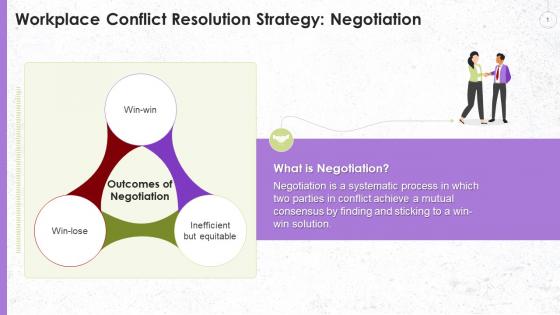
This slide provides information about the definition of negotiation in a conflict situation, i.e., a systematic process in which two parties in conflict achieve a mutual consensus by reaching a win-win solution. It also provides details of the possible negotiation outcomes such as win-win, win-lose, and inefficient but equitable.
Instructor's Notes:
There are three possible outcomes of negotiation in a conflict situation:
- Win-win: In this outcome, both parties win. It is also known as integrative bargaining
- Win-lose: In this, one party wins while the other party loses. It is also known as distributive bargaining
- Inefficient but equitable: In this, agreement is such that all the resources are shared equally while both parties in conflict remain slightly dissatisfied
Slide 2
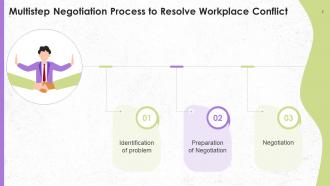
This slide illustrates the major steps of the negotiation process used to resolve workplace conflict. The major steps are identification of the problem, preparation of negotiation, and negotiation.
Instructor's Notes:
The major steps of the negotiation process are:
- Identification of the Problem: Identify the existing sources of brewing resentment, such as salary issues, micromanagement, etc. The correct identification of the cause is crucial as the nature of issues affect the entire negotiation process, i.e., the selection of representatives, period of negotiation, etc.
- Preparation of Negotiation: In this stage, parties in conflict prepare (in advance) the list of issues to be discussed during the negotiation. Each party also appoints representatives to carry out the negotiation
- Negotiation: An appointed chief negotiator presents the issue under consideration in the negotiation meeting. After that, the representatives of both parties put forward their point of view. Discussions continue under the observation of the negotiator till a final settlement is reached
Slide 3
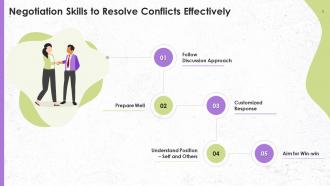
This slide provides information about the multiple negotiation skills that one should develop to effectively resolve workplace conflict. The skills are discussion approach, prepare well, customize response, understand position – self and others, and aim for win-win.
Instructor's Notes:
Negotiation skills needed to resolve workplace conflicts in an effective manner are:
- Follow Discussion Approach: In negotiations, always follow the discussion style while conversing. Remaining rigid about your own perception and not understanding the other party's viewpoint result in failure
- Prepare Well: Preparation leads to success. Before entering into a negotiation, research the subject of conflict well
- Customize Response: Tailor replies in accordance with the person in front of you. Use nonverbal cues to support verbal communication and make a lasting impact
- Understand Position – Self and Others: Avoid making unrealistic demands as it will surely lead to failure of talks
- Win-win for Everyone: Always aim for integrative bargaining so that everyone leaves the negotiation table on a happy note
Slide 4
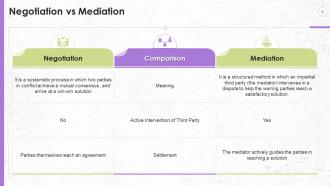
This slide tabulates the difference between negotiation and mediation as techniques for workplace conflict resolution. The primary difference between negotiation and mediation is that in mediation, there is an active intervention of a third party, i.e., the mediator that actively guides the parties to arrive at an amicable solution.
Managing Conflict With Negotiation Training Ppt with all 20 slides:
Use our Managing Conflict With Negotiation Training Ppt to effectively help you save your valuable time. They are readymade to fit into any presentation structure.












FAQs for Managing Conflict With
Honestly, prep work makes or breaks everything - know what they want and figure out your absolute limit beforehand. When you're actually in there, listen way more than you talk. I swear most people just word-vomit their whole pitch instead of actually hearing the other side. Look for wins that help both of you instead of trying to crush them. Get creative with solutions too. Always write down what you agreed on after (learned that one the hard way). Oh, and practice this stuff on low-stakes things first. Like convincing your coworkers where to order takeout or whatever. Then work up to the bigger negotiations.
Honestly, body language is huge in negotiations - way more than people realize. Good eye contact and sitting straight makes you look confident and trustworthy. If you're fidgeting or have your arms crossed, you'll come across as nervous or defensive, which isn't great when you're asking for that raise. Your facial expressions can totally back up what you're saying or make it fall flat. I learned this the hard way in my last performance review, haha. Mirror their positive body language and keep your hands where they can see them. Trust me, it works.
Ugh, those people are the worst but here's what actually works: Stay calm no matter what they throw at you. Don't take their crap personally - some folks just think being aggressive gets results. Ask questions to figure out what they really want underneath all the drama. Listen actively so they feel heard. Half the time they're just testing you anyway. Set boundaries though! Be ready to walk away if they're being totally unreasonable. Focus on interests, not just positions. Oh, and try flipping it - frame things like you're solving a problem together instead of fighting. Works better than you'd think.
Oh man, negotiating across cultures is tricky stuff. Some people are brutally direct while others dance around their point forever - honestly, the hinting thing drives me crazy but you gotta roll with it. Western folks usually want decisions yesterday, but in many Asian and Latin cultures they're all about building relationships first. Here's the kicker though - in hierarchical societies, the person with actual power might not even show up to your meeting. My advice? Do your homework on their communication style beforehand, and if it's a big deal, maybe bring someone who gets their culture.
Dude, emotions can totally make or break negotiations. Stay calm and you'll think clearer, plus you can actually read what the other person's feeling. But if you get frustrated or too excited? You'll mess up big time with stupid decisions. Here's the thing though - their emotions are like a cheat sheet. Sometimes someone's anger or how eager they seem tells you way more than whatever they're actually saying. Just don't be a robot about it, you know? I've learned to catch myself when I'm getting heated and just pause for a sec before I respond.
Okay so first thing - figure out your absolute bottom line before you even walk in there. Research the hell out of whoever you're dealing with, like what they've done before and what they actually need. I always practice my main points out loud (sounds dumb but trust me). Think about what you can give up and what you want back for each thing. Oh and rank your priorities 1-2-3 so you don't get sidetracked by random stuff when the important things are on the table. Also know your backup plan if everything goes sideways - that's your BATNA thing. Running through different scenarios in your head helps too.
Look for stuff you both connect on right away - maybe you went to similar schools or know the same people. Ask them real questions about their background and don't just sit there planning what you'll say next. Match how they talk too. Formal person? Stay professional. Laid back? You can chill a bit. Just don't be weird about it lol. When it feels right, share something real about yourself. Oh and show up like 10 minutes early next time - use that buffer to actually get to know them before jumping into business stuff.
Dude, the worst thing you can do is just ramble on without actually listening to what they want. Ask questions that get them talking - half the time it's not even about the money, which honestly surprised me when I first figured that out. Don't get married to your opening offer either. That's literally just where you start. People also lose their shit way too fast and take everything personally. It's just business though. Think about what everyone actually needs, not just the positions you're stuck on. Oh, and never back someone into a corner - give them a way to say yes without looking stupid.
Looking, win-win negotiations just make people feel respected instead of screwed over. Both sides walk away happy, which is honestly pretty rare these days. People don't forget when you treat them fairly - they'll actually want to deal with you again later. Compare that to someone who nickels and dimes every detail. Next time you're stuck in one, try flipping the script: "What do we both need to make this work?" It's way better than the usual back-and-forth battle. You'll build actual relationships instead of burning bridges left and right.
Dude, active listening is such a game-changer in negotiations. Most people just wait for their turn to talk, but when you actually listen to what they're saying, you catch their real concerns and what they actually need. That info is gold. Plus - and this might sound obvious but whatever - people notice when you're really hearing them out. They get way less defensive and more willing to work with you. Oh, try repeating back what you heard before jumping into your response. Sounds weird but it totally works. Trust me on this one.
Dude, you gotta throw out the first number - and make it extreme but not totally insane. Research what similar deals actually went for so when they freak out, you're not just pulling stuff out of thin air. Here's the thing though - even a crazy high anchor works because it gets stuck in their brain. Everything after that feels "reasonable" by comparison. Honestly, I've seen people accept way worse deals just because the initial ask wasn't AS bad. You'll probably meet somewhere in the middle anyway, but now that middle is way closer to what you actually wanted. Just don't be so ridiculous they walk away laughing.
So there's competitive and collaborative negotiation, right? Competitive is basically "I win, you lose" - you're fighting for the biggest piece. Collaborative means finding ways where everyone benefits. Like, competitive would be "I'm getting that promotion over you." Collaborative is more "what if we both found ways to move up here?" Honestly, collaborative takes way more time and effort. But it's worth it if you'll work with these people again - builds better relationships. Plus you often end up creating more value than just splitting what's there. Really depends on whether this is a one-time thing or not.
Honestly, tech can make negotiating way less stressful. First thing I'd do is use data tools to research market rates - having actual numbers makes you look legit instead of just winging it. Recording video calls helps too (ask first obvs), since you'll forget half of what was said. There are AI platforms that let you practice different scenarios beforehand, which sounds nerdy but actually works. Oh, and sharing docs digitally beats passing papers around like it's 1995. Really though, just pick whatever part of negotiating stresses you out most and find an app for that specific thing.
Honestly, I judge negotiation success by a few things. Did we both walk away feeling like we got something good? That's huge. Also - and this might sound weird - would I want to sit across from this person again? If the answer's no, something went wrong even if I "won" on paper. Speed matters too because nobody wants to drag things out forever. Obviously check if you hit your minimum requirements, then see what actually happens after. Sometimes deals look amazing until implementation falls apart completely. I track the hard numbers like savings, but also the softer stuff - do we trust each other more now?
Honestly, preparation is everything. Research their company, know market rates, figure out what you'll actually walk away from. Practice your pitch out loud - yeah it feels ridiculous but it works. I'd write down your three strongest points first and lead with those. Role-play the tough questions with someone you trust beforehand. Here's the thing though - they need something from you too or you wouldn't be sitting there, right? High-stakes doesn't mean life-or-death. Oh, and use contractions when you talk - sounds way more natural than being all formal.
-
The website is jam-packed with fantastic and creative templates for a variety of business concepts. They are easy to use and customize.
-
Thanks to SlideTeam, we have an ideal template to present all the info we need to cover. Their slides give our numbers and projections a more clear and enchanting look.