


Managing Conflict With Emotional Intelligence Training Ppt




Try Before you Buy Download Free Sample Product
 Impress Your
 Audience
 100%
100% Editable
 Save Hours
 of Time


This set of slides provides information about using emotional intelligence to resolve workplace conflict. It includes EI Matrix with four quadrants self-awareness, self-management, social awareness, and relationship management to solve work disputes. It also has techniques to become aware of the teams emotions by conducting meetings and developing informal communication channels. Further, it tabulates the comparison of low and higher emotional intelligence.
People who downloaded this PowerPoint presentation also viewed the following :
Content of this Powerpoint Presentation
Slide 1
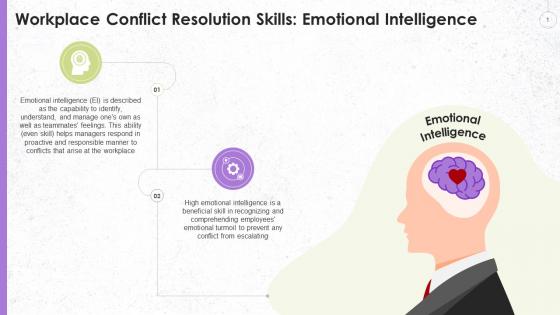
This slide provides information about the definition of emotional intelligence i.e., the capability to identify, understand, and manage one's own as well as teammates' feelings to respond in a proactive and non-reactive way in conflict situations at the workplace. It also explains how high EI is a beneficial skill in recognizing and comprehending employees' emotional turmoil and use this to prevent any conflict from escalating.
Slide 2
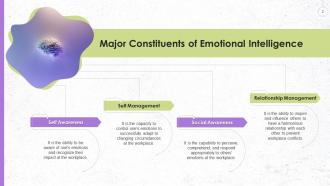
This slide provides an overview of major components of emotional intelligence as a skill. These are self- awareness, self- management, social awareness, and relationship management.
Slide 3
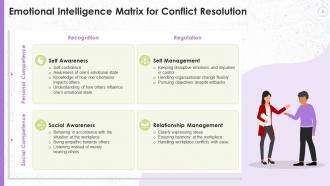
This slide presents the four-quadrant matrix to resolve workplace conflict using Emotional Intelligence. The major quadrants of 2-by-2 EI framework are self-awareness, self-management, social awareness, and relationship management.
Slide 4
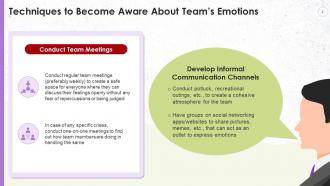
This slide indicates the strategies to become aware of the team’s emotions to minimize workplace conflict. The techniques highlighted are conducting team meetings and developing informal communication channels.
Slide 5
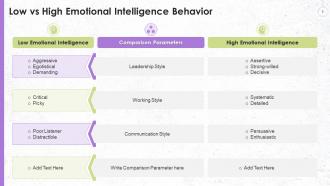
This slide showcases the difference between low and high emotional intelligence people at the workplace in terms of leadership, working, and communication style.
Managing Conflict With Emotional Intelligence Training Ppt with all 21 slides:
Use our Managing Conflict With Emotional Intelligence Training Ppt to effectively help you save your valuable time. They are readymade to fit into any presentation structure.






FAQs for Managing Conflict With Emotional
Honestly, emotional intelligence is like having a cheat code for conflicts. First step? Get a handle on your own emotions - way easier said than done, I know. But once you do that, you'll start picking up on what's actually going on with the other person. Maybe they're not just being a pain - they could feel ignored or backed into a corner. Watch their body language too, that tells you everything. I've learned to hit pause and ask myself "what are they really feeling here?" before I say something I'll regret. Works pretty well most of the time.
Honestly, self-awareness is like having a cheat code for conflicts. You start catching yourself before you blow up or get all defensive. I used to lose it whenever someone questioned my ideas - super annoying habit. But once I noticed that pattern, I could actually pause and think instead of just reacting. The weird thing is you'll also read other people better when you're not drowning in your own emotions. Try just naming what you're feeling during arguments. Sounds simple but it creates this little gap where you can choose how to respond instead of going on autopilot.
Honestly, empathy is like a cheat code for workplace drama. People get so much less defensive when they feel like you actually get their frustration - even if you think they're being ridiculous. I've noticed that just listening and acknowledging their side first makes them way more open to hearing yours. Plus you'll often discover the real problem isn't what you thought it was anyway. My advice? Next time someone's upset, try repeating back what you heard before diving into your own perspective. It's weirdly effective.
Listen, first thing - just mirror back what they're saying before you jump in with your own stuff. "So you're saying..." kind of thing. Try to keep your voice steady even when they're heated (way harder than it sounds, trust me). Don't rush to fix everything right away. Ask questions that get them talking more about why they feel that way. Even if you think they're totally wrong, acknowledge the emotion - like "I get why that would piss you off." Sometimes people just need to get it all out first. Once they've cooled down a bit, then you can actually work on solving whatever's going on.
Look, I've watched so many workplace arguments blow up just because people couldn't keep their emotions in check. The whole thing spirals fast. But when you can stay calm during tense moments? That's when real solutions happen. You'll actually listen instead of just waiting for your turn to attack back. Plus emotions spread like crazy - if you're regulated, others follow suit. Honestly, the three deep breaths thing sounds cheesy but I swear it works. Gives your brain a second to catch up before you say something you'll regret later.
Oh man, the usual suspects - feeling disrespected, misunderstood, or when someone questions if you actually know what you're doing. Getting interrupted is the WORST, especially when you're already on edge. Here's what helps me: notice your specific triggers before they blow up. When that anger starts bubbling up, just pause for a sec. Ask yourself what exactly set you off and if your reaction actually fits the situation. I literally say the emotion out loud sometimes - sounds weird but it works. Then focus on what you actually need, like "I need them to listen to me" instead of just reacting.
Honestly, the best leaders I've worked with just stay super calm when things get heated. They acknowledge people's feelings instead of jumping straight to problem-solving mode. One manager I had would actually say stuff like "I screwed up here too" which made everyone relax. Your team needs to see you pause before reacting - it teaches them to do the same. Instead of getting defensive, try asking "help me understand where you're coming from." Sounds cheesy but it works. The whole thing falls apart though if people don't feel safe speaking up. Make that your main focus and conflict becomes way less dramatic.
So EQ training actually works if you do it right. Get your team doing self-awareness stuff first - like spotting their own triggers when things get heated. Role-playing is honestly amazing for this (I know it sounds cheesy but whatever). People get to practice reading emotions and responding better instead of just reacting. Daily emotion check-ins during meetings help too - keeps it consistent rather than some one-off workshop thing. EQ assessments are solid for showing people where they're starting from. Oh, and regular feedback sessions where everyone reflects on recent conflicts. The trick is making it ongoing practice.
So active listening is basically emotional intelligence in action, right? You're managing your own reactions while actually tuning into what they're feeling. Most people just wait for their turn to talk - guilty as charged sometimes! But when you really listen, you catch those underlying emotions behind their words. That's where the magic happens. It sounds super simple but honestly takes practice. Stay curious instead of getting defensive. Oh, and try reflecting back what you heard before jumping to solutions. Shows you get both the facts and the feelings.
When you feel that heat rising, just pause and name it out loud - "I'm pissed because..." Sounds dumb but it actually works. Your logical brain needs a sec to catch up with all those feelings. Deep breaths help too (yeah, yeah, I know). What do you actually want out of this fight? That's the real question. For huge decisions, sleep on it - emotions make us do stupid stuff. When you do talk, stick to "I feel" instead of "you always." Actually listen to their side too, even if they're being ridiculous. Don't stuff your feelings down, just don't let them drive the bus.
You know how your team freaks out when deadlines hit? EI training teaches people to actually notice their stress before they blow up at each other. People start recognizing their triggers and - this sounds cheesy but it works - they genuinely get better at reading the room. Instead of just losing it, they pause and think first. During arguments, they'll actually listen instead of planning their comeback. Honestly, the best part is stress stops spreading like wildfire through the whole group. Start by having everyone just name what they're feeling in real time.
Honestly, emotional intelligence is like having a superpower for reading people. You'll catch those subtle cues when someone's getting frustrated before they blow up. I used to be terrible at this - always planning my next point instead of actually listening, which is so counterproductive. When you understand your own triggers, you won't get all defensive when someone questions your ideas. The whole "wait, that's not what I meant" thing happens way less. Try just taking a beat before responding in meetings. Sounds simple but it's a game changer for team dynamics.
Okay so here's the thing - once you figure out what sets you off during arguments, you can actually catch yourself before you lose it. Like when you feel that frustration building up? That's your cue to just pause for a sec and think instead of saying something you'll regret. Some people are honestly just masters at hitting your buttons (my ex was terrible for this). But spotting those moments changes everything. You can steer things back to actually solving the problem instead of getting trapped in drama. Next time you're in a disagreement, just mentally note what emotions pop up. Trust me, it'll totally shift how you handle it.
Oh man, emotional intelligence is SO important when you're dealing with cross-cultural stuff. Different cultures express emotions totally differently - like some are super indirect while others are way more upfront. I've learned you basically have to be a detective, figuring out if someone's actually upset or if it's just their communication style. The trick is hitting pause before you react. Ask yourself: "Wait, is this person being rude or is this just how they communicate?" It saves you from so many awkward misunderstandings, trust me.
Wait for everyone to chill out first - seriously, nothing good happens when people are still mad. Then go in with genuine curiosity, not like you're about to prove a point. I always mess this up when I'm still annoyed! Try "I felt confused when..." instead of "You always do this" type stuff. Ask what they were thinking before you dump your feedback on them. Stick to what they actually did, not their whole personality. The trick is making it feel like you're both trying to figure something out together. Start with "Help me understand..." - it's way less confrontational than launching into what went wrong.
-
Awesomely designed templates, Easy to understand.
-
Their designing team is so expert in making tailored templates. They craft the exact thing I have in my mind…..really happy.