

Effective Communication Is Key To Resolve Conflicts Training Ppt




Try Before you Buy Download Free Sample Product
 Impress Your
 Audience
 100%
100% Editable
 Save Hours
 of Time


This set of slides provides information on the usage of verbal and nonverbal communication skills to resolve workplace conflicts. In verbal communication, ask the right questions and rephrase what others say. In nonverbal communication, mirror reactions, maintain eye contact, nodding, use facial expressions, and adopt a calm tone of voice.
People who downloaded this PowerPoint presentation also viewed the following :
Content of this Powerpoint Presentation
Slide 1
This slide showcases key skills that an individual should develop to resolve workplace conflicts successfully. The key skills listed are effective communication, emotional intelligence, stress management, empathy, and impartiality.
Slide 2
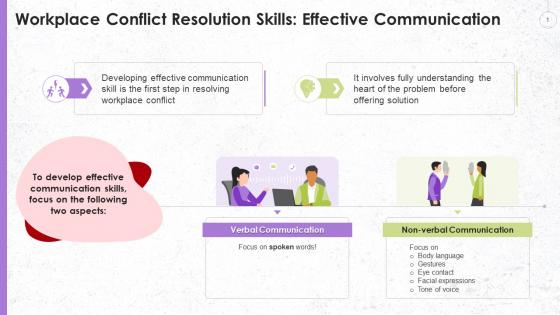
This slide provides an overview of the significance of effective communication in resolving workplace conflict. It also includes information about both the verbal and non-verbal components of communication.
Slide 3
This slide indicates how to prevent workplace disagreements from escalating by asking the right questions, and rephrasing what the other person is saying to showcase your genuine interest in resolving the conflict.
Slide 4
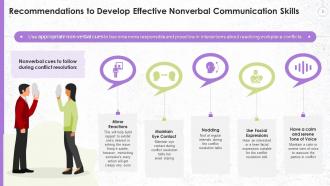
This slide lists multiple nonverbal cues that prove to be effective in resolving workplace conflicts, such as mirroring reactions, maintaining eye contact, nodding, using facial expressions, and adopting a calm tone of voice.
Slide 5
This slide provides information about the definition of emotional intelligence i.e., the capability to identify, understand, and manage one's own as well as teammates' feelings to respond in a proactive and non-reactive way in conflict situations at the workplace. It also explains how high EI is a beneficial skill in recognizing and comprehending employees' emotional turmoil and use this to prevent any conflict from escalating.
Slide 6
This slide provides an overview of major components of emotional intelligence as a skill. These are self- awareness, self- management, social awareness, and relationship management.
Slide 7
This slide presents the four-quadrant matrix to resolve workplace conflict using Emotional Intelligence. The major quadrants of 2-by-2 EI framework are self-awareness, self-management, social awareness, and relationship management.
Slide 8
This slide indicates the strategies to become aware of the team’s emotions to minimize workplace conflict. The techniques highlighted are conducting team meetings and developing informal communication channels.
Slide 9
This slide showcases the difference between low and high emotional intelligence people at the workplace in terms of leadership, working, and communication style.
Slide 10
This slide provides information on adverse impacts of stress, i.e., impairment of logical thinking. It also contains details on how effectively releasing stress in a tense situation can prevent conflicts from escalating.
Slide 11
This slide lists the multiple ways in which stress hampers workplace conflict resolution. Stress directs hits our ability to detect and be aware of emotions; interpreting the other person's body language; communication of our needs in a clear manner.
Slide 12
This slide highlights multiple methods to handle stress in conflict resolution, i.e., managing stress triggers and engaging one or more senses while interacting with parties in conflict.
Slide 13
This slide illustrates multiple approaches to handling workplace stress effectively. The strategies are tracking stressors, setting work-life boundaries, practicing problem-solving, talking to someone, practicing mindfulness, exercising regularly, and eating healthily.
Instructor's Notes:
Strategies to deal with workplace stress are:
- Track Stressors: Keep a note of things that cause you stress; it may be activity, a person a situation. Identify a pattern, if any, and limit exposure to these stressors. Limit exposure to such activities
- Set Work-Life Boundaries: Draw well-defined work-life boundaries and stick to these. For example, avoid checking work emails at home
- Practice Problem-solving Approach: Deploy the problem-solving approach to complex tasks using specific steps like defining a problem, brainstorming solutions, and developing an action plan.
- Talk to Someone: Seek guidance from someone senior in the organization to put things in perspective
- Practice Mindfulness: Practice mindfulness to tackle stress at work as it allows you focus on the present with a mindset of openness, acceptance, and curiosity.
- Exercise Regularly: Do regular exercise to lift mood and increase energy levels; physical activity releases endorphins that act as natural painkillers.
- Balanced Diet: Stress can lead to chronic overeating, especially food with high sugar. Regular consumption of unhealthy food in an invite to ill-health
Slide 14
This slide provides information regarding the definition of empathy. It also details habits/strategies that can help one become more empathetic towards others. These are offering trust, support, respected, shared experiences and responses that come from kindness and caring.
Slide 15
This slide highlights how empathy can be used to resolve workplace conflicts. The key is retaining objectivity no matter how difficult the conversation becomes; being non-judgmental in understanding the other's stated position or point of view.
Slide 16
This slide showcases the empathy mind map to understand employee behavior better to prevent workplace conflicts. The major sections of the empathy mind map are who are we empathizing with? What do they need to do? What do they think and feel?
Slide 17
This slide showcases the strategies to make conflict resolution talks more empathetic, such as practicing active listening, asking questions, using conversation fillers, and body language that welcomes and encourages others to vent out. Appropriate eye contact is an absolute must.
Slide 18
This slide highlights the major empathy blockers that one must be careful about such as domination, manipulation, disempowerment, and denial. When empathy blocker statements are used, it leads to conversation closure. These are a complete NO-NO during conflict resolution talks.
Instructor's Notes:
The major empathy blockers that limit conflict resolution conversations are:
Domination:
- Threatening: “Do it or else.”
- Ordering: “Don’t ask me why. Just do it because I said so.”
- Criticizing: “You don’t work hard enough.”
- Name-Calling: “You’re neurotic.”
Manipulation:
- Withholding Relevant Information: “If you knew the “big picture” you would see it differently.”
- Interrogating (Micro-managing): “How many hours did this take you?”
- Praising to Manipulate: “You are so good at report writing, I would like you to do this one.”
Disempowerment:
- Diagnosing Motives: “You are very possessive.”
- Untimely Advice: “Why didn’t you do it this way?”
- Changing the Topic: “Yes, it is a worry…by the way, did I tell you I applied for a new job?”
- Persuading with Logic: “There’s nothing to be upset about, and it’s all quite reasonable. We do this, and then we do that.”
- Topping: “I crashed the car last week,” and you follow with “When I smashed up my car.”
Denial:
- Refusing to Address the Issue: “There is nothing to discuss as I cannot see any problem.”
- Reassuring: “Don’t be nervous.”
When empathy blocker statements are used, it leads to conversation closure, so one must avoid them as much as possible during conflict resolution talks.
Slide 19
This slide lists the multiple tips to practice impartiality during conflict resolution talks, such as staying calm and mindful of tone, not involving past issues in an ongoing conflict, and never turning the conflict as being only about an individual.
Effective Communication Is Key To Resolve Conflicts Training Ppt with all 19 slides:
Use our Effective Communication Is Key To Resolve Conflicts Training Ppt to effectively help you save your valuable time. They are readymade to fit into any presentation structure.













FAQs for Effective Communication Is Key To Resolve
Here's what's worked for me: First, figure out the real problem - not just what people are complaining about on the surface. Then get everyone to actually share their side of things. This part's honestly the most crucial because half the time people are arguing about totally different issues without even knowing it. Ask what each person thinks the main problem is before you start throwing solutions around. Brainstorm fixes together, pick something everyone can live with, then implement it. Don't skip the follow-up though - conflicts love to creep back if you're not paying attention.
Okay so here's the thing - when you actually listen to someone (like really listen, not just prep your comeback), they instantly chill out. People just want to feel heard, you know? I swear, the moment you start reflecting back what they're saying or asking questions about their point, their whole energy shifts. They stop being so defensive because they realize you actually give a shit about understanding them. Then boom - you're both working together instead of against each other. Next time you're arguing with someone, try repeating their main concern back to them first. It's weirdly effective.
Dude, emotional intelligence is like having a superpower in fights. You can actually read the room and figure out what's really bugging everyone - including yourself. I swear, half the arguments I see blow up because people just react without thinking. When you stay calm and don't get all defensive, solutions basically find themselves. The empathy thing is huge too. Even when someone's being a total pain, understanding where they're coming from flips the whole script. Next time things get heated, just take a breath and tune into what's happening emotionally underneath all the yelling.
Honestly, just let everyone vent first without jumping in - people need to feel heard. Then dig for what they actually want underneath all the drama. I swear, half the time their real goals aren't even that different. Don't make it personal either. Like instead of "Mike's being a pain," try "we see the deadline differently." Oh, and use "yes, and" instead of "but" when responding - sounds less combative. The trick that works best? Ask each person what outcome they're really after. You'd be shocked how often they want similar things but just can't see past their own position.
Oh man, cultural stuff makes conflict resolution way trickier than people think. Like, being super direct might work great in some Western settings, but it'll totally blow up in cultures where saving face matters more. I learned this the hard way once - anyway, you've gotta switch up your whole approach depending on who you're dealing with. Some groups want the boss to step in and mediate. Others prefer talking it out peer-to-peer. Timing's different too. Best bet? Just ask people upfront what works for their culture instead of assuming your usual tactics will fly.
Honestly? Just talk to people upfront about what you expect. Define who's doing what early on. I've seen too many teams blow up because nobody bothered with this basic stuff. Regular check-ins help catch problems while they're small - way better than waiting for things to explode. Watch for weird signs too, like people suddenly going quiet in meetings or avoiding each other completely. Those are major red flags. The whole thing comes down to making people feel safe enough to actually speak up when something's bugging them. Once trust breaks down, you're basically screwed.
Honestly, most fights happen because people aren't actually hearing each other - they're just waiting for their turn to talk. When you're super direct about what's bugging you AND actually listen back, you'll figure out the real problem instead of going in circles. I've learned the hard way that "I feel like..." works way better than "You always..." because nobody gets defensive. Oh, and try repeating back what they said before jumping into your response. Sounds weird but it works. Those stupid misunderstandings that blow everything up? Yeah, this prevents most of them.
Ugh, workplace drama is the worst. When conflicts don't get resolved, morale tanks and people start calling in sick just to avoid each other. Communication completely falls apart, then stress levels go through the roof. Your good employees will bounce if they're constantly dealing with BS - honestly, who can blame them? The toxic vibe spreads like wildfire to other teams too. Higher turnover, zero collaboration, everyone walking on eggshells. It gets way more expensive to fix the longer you wait. My take? Jump on issues fast before they snowball into something massive.
Honestly, collaboration works so well because it gets people to stop fighting each other and start tackling the actual problem together. You'll get way better ideas when everyone's throwing out solutions - stuff you'd never think of solo. People actually stick to agreements they helped make, which makes sense if you think about it. The crazy part? Most of the time these conflicting groups want similar things, they just can't agree on how to get there. Try asking "what does winning look like for all of us?" next time you're stuck mediating something. Totally changes the whole vibe of the conversation.
First thing - build trust so people actually speak up before stuff gets messy. When conflict does hit, listen to everyone without jumping straight into fix-it mode (I'm terrible at this too, honestly). Ground rules help a ton for keeping discussions productive instead of turning into blame fests. Model what you want to see from them. Focus on the real problem, not personal drama. Oh, and here's something people skip - check back in later! Just because someone says "yeah we're good" doesn't mean they actually are. Sometimes it takes a few days for the real feelings to surface.
Crossed arms are the dead giveaway - plus eye rolling and that thing where people suddenly find the table super interesting during meetings. Watch their faces too. Tight lips, frowns, or that barely-contained "I'm about to snap" expression. People start turning away from each other or doing aggressive finger taps (honestly the worst). Voice changes matter just as much - getting all clipped and sarcastic, or going weirdly quiet. The second you spot this stuff, jump in with "hey let's take a step back" before it all goes sideways.
Honestly, it's all about picking the right approach for the situation. Avoiding stuff just makes problems worse later - learned that the hard way. Accommodating can work if you don't really care about the outcome, but you'll get bitter if you do it too much. Sometimes you gotta compete and just fight for what you need, even if it pisses people off. Compromising is fine but kinda meh since nobody gets exactly what they want. Collaboration takes forever but usually works best because you're actually solving the real problem underneath. Just don't be that person who collaborates over where to grab lunch.
Okay so there are a few different approaches that work really well. "Getting to Yes" from Harvard is solid - it's all about separating the actual problem from personality clashes. The Thomas-Kilmann thing is perfect for team drama because it helps you decide if you should fight, work together, meet halfway, or just back off completely. DESC method (Describe, Express, Specify, Consequences) is my go-to when someone's being emotional and you need structure. Sometimes I literally just grab a whiteboard and map everything out - sounds dumb but it works. Pick whatever feels right for how you naturally talk to people.
Honestly, feedback is like your cheat code for turning fights into actual productive talks. Focus on what they *did* rather than who they are - say "you cut me off three times in that meeting" not "you're such a rude person." People screw this up all the time, it's wild. If you need to soften it, do that sandwich thing: something positive first, then the real issue, then wrap up with teamwork vibes. The whole point is solving it together, not being right. Oh, and ask stuff like "how should we handle this next time?" - flips the whole conversation into fix-it mode instead of blame-game mode.
Okay so ground rules are honestly a game changer - they stop fights from turning into total shitshows where people attack each other personally. You want maybe 3-4 basic ones everyone agrees on first. Like no interrupting, focus on what someone *did* not who they are as a person, take breaks if it gets too heated. It's weird but it actually makes people way more comfortable being real about stuff. Without them? Things just escalate instead of getting solved. Think of it as having invisible guardrails - everyone feels safer being vulnerable when they know the boundaries upfront.
-
Unique research projects to present in meeting.
-
Great experience, I would definitely use your services further.