


Workplace Conflict Resolution For Managers And Supervisors Powerpoint Presentation Slides




Try Before you Buy Download Free Sample Product
 Impress Your
 Audience
 100%
100% Editable
 Save Hours
 of Time


Workplace conflict arises when there is a dispute amongst team members because of different personalities, attitudes, and viewpoints. To help you avoid such conflicts, our professionals at SlideTeam have curated this customizable Workplace Conflict Resolution for Managers and Supervisors template. The main purpose of this PowerPoint presentation is to assist businesses in resolving interpersonal conflicts, which will eventually strengthen team relationships, improve employee morale, reduce employee absenteeism, and improve productivity. Grab this professionally designed PPT, which begins with the latest organizational conflict trends, statistics, and different phases. Secondly, the complete deck caters to a section through which managers can highlight the impact of unresolved team conflict on the companys financial performance. Additionally, there are some common scenarios of workplace conflict and how corporates can overcome them. Furthermore, businesses can overcome employee conflict either by developing an in house strategy or by taking the assistance of a third party. At last, the module showcases a key performance indicator KPI dashboard through which firms can analyze the impact of conflict resolution strategies on employees and the companys performance. Get access to this powerful template now.
People who downloaded this PowerPoint presentation also viewed the following :
Content of this Powerpoint Presentation
Slide 1: This slide displays the title Workplace Conflict Resolution for Managers and Supervisors.
Slide 2: This slide displays the title Agenda.
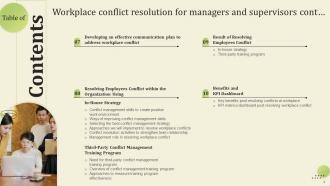
Slide 3: This slide exhibit table of content.
Slide 4: This slide exhibit table of content.
Slide 5: This slide exhibit table of content- Workplace Conflict Trends and Statistics.
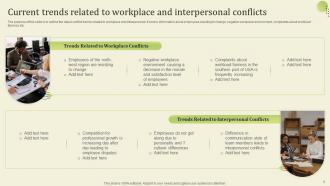
Slide 6: The purpose of this slide is to outline the latest conflict trends related to workplace and interpersonal.
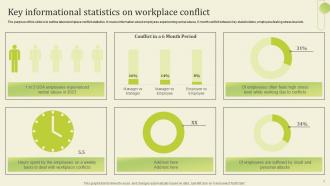
Slide 7: The purpose of this slide is to outline latest workplace conflict statistics.
Slide 8: This slide exhibit table of content- Defining the Phases of Workplace Conflict.
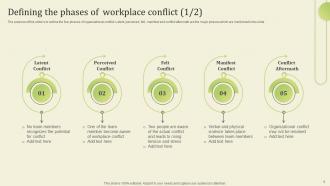
Slide 9: The purpose of this slide is to outline the five phases of organizational conflict.
Slide 10: The purpose of this slide is to outline a diagrammatic representation of workplace conflict stages.
Slide 11: This slide exhibit table of content- General Overview About Workplace Conflicts.
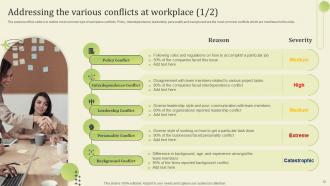
Slide 12: The purpose of this slide is to outline most common type of workplace conflicts.
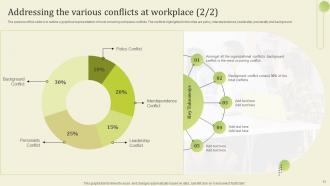
Slide 13: The purpose of this slide is to outline a graphical representation of most occurring workplace conflicts.
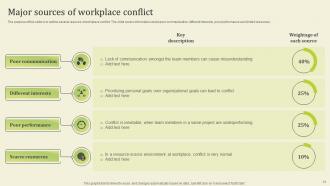
Slide 14: The purpose of this slide is to outline several reasons of workplace conflict.
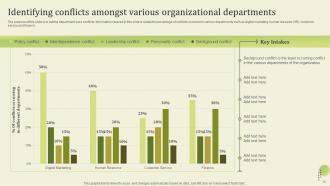
Slide 15: The purpose of this slide is to outline department wise conflicts.
Slide 16: This slide exhibit table of content- Consequences of Conflicts within the Workplace.
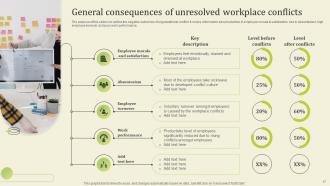
Slide 17: The purpose of this slide is to outline the negative outcomes of organizational conflict.
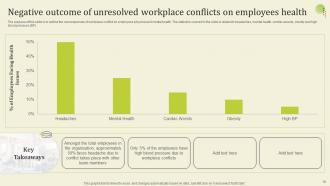
Slide 18: The purpose of this slide is to outline the consequences of workplace conflict on employees physical and mental health.
Slide 19: The purpose of this slide is to outlines the conflict impact on organizational financial performance.
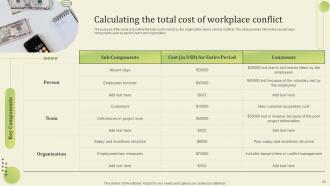
Slide 20: The purpose of this slide is to outline the total cost incurred by the organization due to several conflicts.
Slide 21: This slide exhibit table of content- Common conflict scenarios in the workplace and how to overcome them.
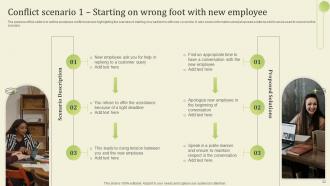
Slide 22: The purpose of this slide is to outline workplace conflict scenario highlighting the overview of starting on a bad terms with new co-worker.
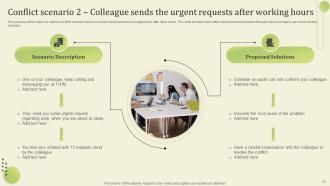
Slide 23: The purpose of this slide is to outline a conflict scenario where co-worker send some piece of urgent work after office hours.
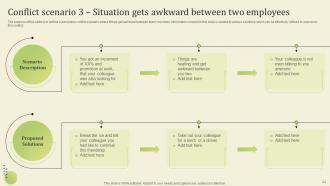
Slide 24: The purpose of this slide is to outline a workplace conflict scenario where things get awkward between team members.
Slide 25: This slide exhibit table of content- Selecting the goals for workplace conflict management.
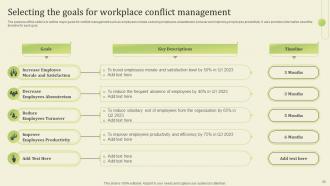
Slide 26: The purpose of this slide is to outline major goals for conflict management.
Slide 27: This slide exhibit table of content- Developing an effective communication plan to address workplace conflict.
Slide 28: The purpose of this slide is to outline a comprehensive communication plan which can be used to highlight various kinds of workplace conflicts.
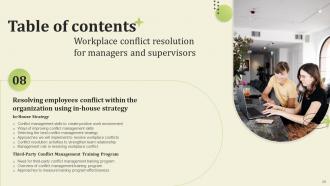
Slide 29: This slide exhibit table of content- Resolving employees conflict within the organization using in-house strategy.
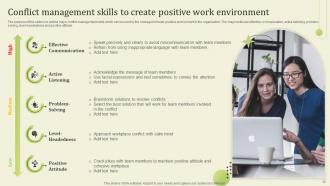
Slide 30: The purpose of this slide is to outline major conflict management skills which can be used by the manager to foster positive environment in the organization.
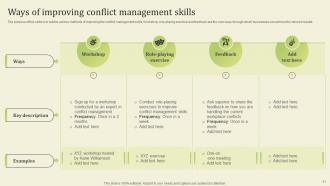
Slide 31: The purpose of this slide is to outline various methods of improving the conflict management skills.
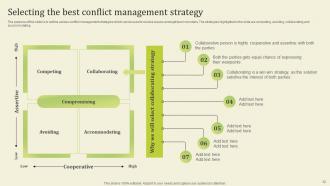
Slide 32: The purpose of this slide is to outline various conflict management strategies which can be used to resolve issues amongst team members.
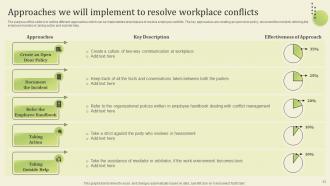
Slide 33: The purpose of this slide is to outline different approaches which can be implemented at workplace to resolve employee conflicts.
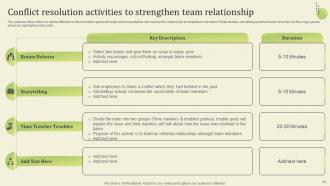
Slide 34: The purpose of this slide is to outline different conflict resolution games through which organization can improve the relationship amongst team members.
Slide 35: The purpose of this slide is to outline management role to resolve organizational conflicts. The key roles are defined for top, middle and lower level management.
Slide 36: The purpose of this slide is to outline the need for external training program for conflict management.
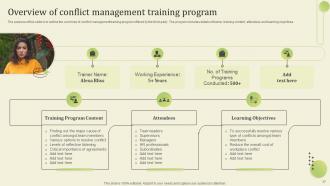
Slide 37: The purpose of this slide is to outline the summary of conflict management training program offered by the third-party.
Slide 38: The purpose of this slide is to outline a comprehensive model which can be used to measure the success of conflict management training effectiveness.
Slide 39: The purpose of this slide is to outline a survey form which can be used to evaluate the conflict management training program effectiveness.
Slide 40: This slide depicts the heading for the content that to be discussed further.
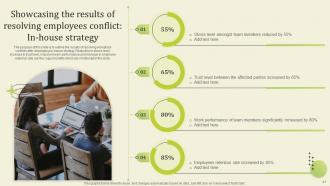
Slide 41: The purpose of this slide is to outline the results of resolving workplace conflicts after developing in-house strategy.
Slide 42: The purpose of this slide is to outline results of conflict management training program.
Slide 43: This slide exhibit table of content- Benefits and KPI dashboard.
Slide 44: The purpose of this slide is to outline the positive result of resolving employees conflicts at workplace.
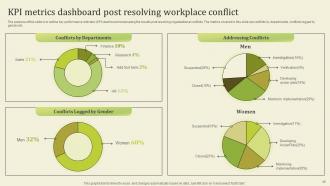
Slide 45: The purpose of this slide is to outline key performance indicator (KPI) dashboard showcasing the results post resolving organizational conflicts.
Slide 46: This is the icons slide.
Slide 47: This slide presents title for additional slides.
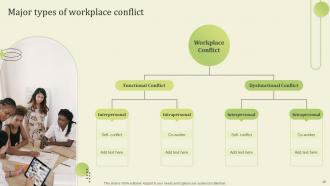
Slide 48: This slide presents Major types of workplace conflict.
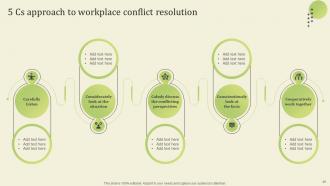
Slide 49: This slide presents 5 Cs approach to workplace conflict resolution.
Slide 50: This slide presents Healthy vs unhealthy workplace conflict.
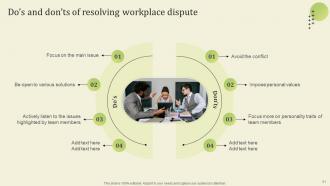
Slide 51: This slide presents Do’s and don’ts of resolving workplace dispute.
Slide 52: This slide presents your company's vision, mission and goals.
Slide 53: This slide exhibits yearly timeline of company.
Slide 54: This slide depicts posts for past experiences of clients.
Slide 55: This slide presents Magnifying glass.
Slide 56: This slide presents Our goal.
Slide 57: This is thank you slide & contains contact details of company like office address, phone no., etc.
Workplace Conflict Resolution For Managers And Supervisors Powerpoint Presentation Slides with all 62 slides:
Use our Workplace Conflict Resolution For Managers And Supervisors Powerpoint Presentation Slides to effectively help you save your valuable time. They are readymade to fit into any presentation structure.


















FAQs for Workplace Conflict Resolution For Managers And Supervisors
Ugh, it's usually the classic stuff - people not talking to each other, nobody knows who's supposed to do what, personalities that just clash, or everyone fighting over the same resources. You'll notice the vibe gets weird first, honestly. Meetings feel tense, people start avoiding each other, or suddenly everyone's being super formal in emails when they used to joke around. I always watch for patterns too - like are the same two people constantly butting heads? Missing deadlines because teams won't coordinate? One-on-ones are your best friend here. People will actually tell you what's up before it all blows up.
Okay so three main things help: listen actively, stay calm, and ask open-ended questions. When they're pissed off, just let them vent completely without cutting them off - seriously, it works way better than you'd think. Don't get defensive. Instead try "Help me understand where you're coming from." Keep your voice steady and acknowledge how they feel, even if you think they're wrong about the actual issue. You're not trying to "win" here - you want to find some middle ground. Oh, and repeat back what you heard like "So you're saying..." It shows you actually listened and helps avoid misunderstandings.
Dude, emotional intelligence is such a lifesaver at work. You know how some people just lose it during meetings? When you can actually read what's bothering someone - like maybe they're stressed about deadlines or feel ignored - you can tackle the real problem instead of arguing about random stuff. I've noticed that staying chill when things get heated prevents those cringe moments where everyone says things they don't mean. Active listening works too. Even if someone's totally wrong, just acknowledging their feelings usually cuts the drama in half. It's weird how well that works.
Start with yourself - if you're losing your cool during arguments, they'll copy that behavior. Set up regular check-ins so issues don't fester. Actually listen when people complain instead of getting defensive (I've watched so many managers mess this up). Make it obvious that disagreeing respectfully is totally fine. Maybe train everyone on giving better feedback? Set some basic ground rules for tough conversations. Oh, and ask each person what would help them speak up more. That last part's surprisingly effective.
Stop making it "me vs you" and start treating it like "us vs this annoying problem we're dealing with." First thing - let everyone explain their side without anyone jumping in to argue. Honestly, that step alone fixes most office BS. Then get everyone throwing out ideas together, even the weird ones. Ask stuff like "how do we make this work for all of us?" and use "we" constantly when you're talking. Focus on what you all actually want to achieve instead of who's right. People usually realize they're on the same team, just took different paths to get there.
Dude, mediation is seriously underrated for work drama. Way better than letting people stew in their feelings or going nuclear with HR right away. I'd push for it when you've got team members who can't seem to get along, or when communication just keeps breaking down - you know how that goes. The key is doing it early, before someone files an actual complaint. Having that neutral person there helps people actually listen instead of just plotting their comeback. My old job waited too long on stuff like this and it always blew up worse. Get your company to do mediation training if they haven't already.
Document that stuff right away while it's fresh in your mind - trust me on this one. Jot down who was involved, what actually went down (facts, not feelings), and any witnesses. I totally blanked on details from a team blowup last year and regretted it later. Dates, times, exact quotes if you remember them. When you reach a solution, write down who agreed to do what and when you'll check back in. Keep everything in one spot where you can find it easily - honestly, I just use a Google doc. Creates a solid record and you might start noticing patterns if the same drama keeps happening.
Oh yeah, personality definitely affects how you handle work drama! Introverts usually want to talk things through one-on-one or even over email. Extroverts? They'd rather get everyone in a room and just deal with it head-on. Some people are super logical about it - they'll pull out spreadsheets and data to prove their point, which honestly can be pretty effective. Others care more about not hurting anyone's feelings. I'm totally a compromiser myself, but my coworker just says exactly what she thinks. Both work! You just gotta read the room and figure out what works with whoever you're dealing with.
Start with hands-on workshops - role-playing, active listening, that whole thing. Peer mediation works great too since people honestly trust coworkers more than HR half the time. Pick a few "conflict champions" for each team to handle small stuff before it blows up. Give them actual scripts they can use, not just theory. Oh, and do refresher sessions every few months because people forget this stuff quickly. The main thing is catching problems early - saves everyone a massive headache later. Make it practical or people won't use it.
Oh man, this is so true. In some cultures people are super direct about conflict, but others? They'd rather die than confront someone publicly. I made this mistake once - called out a colleague in a team meeting thinking we'd just work it out, but it totally backfired because his culture handles disagreements behind closed doors. Hierarchy plays a huge role too. Some people literally can't speak up to their boss even if they disagree. Instead of assuming everyone's cool with your approach, just ask them straight up how they prefer handling these situations. Works way better.
Ugh, the warning signs are pretty obvious once you know what to look for. Raised voices, personal attacks, people literally avoiding each other in the hallway. I've watched teams completely implode over this stuff. Productivity tanks, sick days go up, everyone starts picking sides. The moment you see aggressive body language or emails getting nasty? Jump in immediately. Don't wait around hoping it'll fix itself - spoiler alert, it won't. HR complaints mean you're already too late, honestly. Get them in a room for mediation before things get worse.
Honestly, jump on a video call ASAP - don't try to hash this out over Slack because that never goes well. When you talk, use "I" statements instead of making it sound like you're blaming them. Screen sharing actually works great for showing exactly what you mean. Figure out what the real problem is first before you start brainstorming fixes. Remote work makes everything way more confusing than it needs to be, I swear. After you talk, send a quick message summarizing what you agreed on. You'll need to be way more deliberate about communicating than if you were just walking over to their desk.
So here's the thing - your team literally copies how you handle conflict, whether you notice or not. If you get defensive or dodge difficult conversations, they will too. But when you actually listen to different opinions instead of shutting people down? Game changer. I've watched entire teams flip their dynamic just because their manager started staying calm and focusing on solutions instead of pointing fingers. People are always watching how you react to disagreements. The trick is being deliberate about showing the behavior you want back - active listening, keeping your cool, that kind of stuff.
So basically, don't just resolve conflicts and move on - circle back with people after 30 and 90 days to see how things are going. You'll probably notice the same drama keeps happening in slightly different ways, which is actually useful intel. Set up monthly reviews where your team can be like "okay, what was a total disaster and what actually worked?" Document that stuff and tweak your approach based on real feedback, not just theory. Oh and don't wait for people to volunteer complaints - they won't. Make check-ins part of your regular process.
So for tracking workplace drama digitally, you've got a few routes. BambooHR and Workday have those built-in incident modules if you want something official. Monday.com or Asana work great too - just set up custom workflows for conflict stuff. Honestly? A shared spreadsheet isn't glamorous but it'll do the job when you're starting out. The real trick is picking whatever your team won't ignore after week two. I'd probably just use whatever project management thing you already have going and make a private section for tracking this stuff. Way easier than learning something totally new, you know?
-
It’s really cool, and you can find pretty much everything you could need for your work or school.
-
What a stunning collection of customizable templates! Really a time-saver..