


Guide To Effective Sales Negotiation Training Ppt




Try Before you Buy Download Free Sample Product
 Impress Your
 Audience
 100%
100% Editable
 Save Hours
 of Time


This set of slides introduces the concept of sales negotiations. It discusses the importance of negotiation in sales along with its process. It also mentions some essential negotiation strategies and closing techniques in sales.
People who downloaded this PowerPoint presentation also viewed the following :
Content of this Powerpoint Presentation
Slide 1
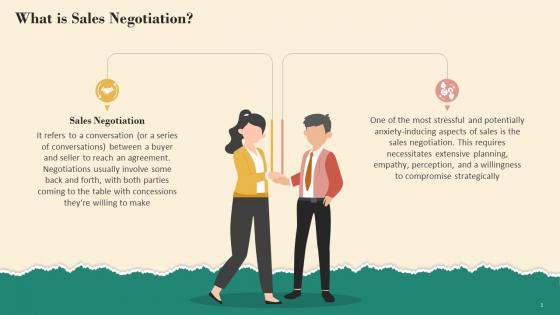
This slide provides information about sales negotiations. It emphasizes that sales negotiation is a conversation between a buyer and seller to reach an agreement. These negotiations, typically, involve some back and forth, with both parties bringing concessions to the table.
Slide 2
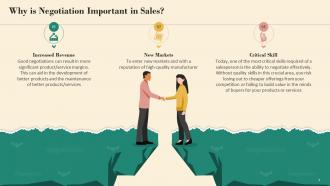
This slide explains the importance of negotiation in sales. It mentions that good negotiations can result in more significant product/service margins which can aid in the development of better products and the maintenance of better products/services. It also highlights that today, one of the most critical skills required of a salesperson is the ability to negotiate effectively. Without quality skills in this crucial area, you risk losing out to cheaper offerings from your competition or failing to build value in the minds of buyers for your products or services.
Slide 3
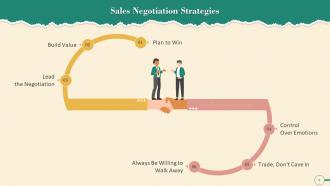
This slide depicts the most common sales negotiation strategies. The strategies are: Plan to win, Build Value, Lead the Negotiation, Control Over Emotions, Plan to Win, Trade, Don't Cave In, and Always Be Willing to Walk Away
Slide 4
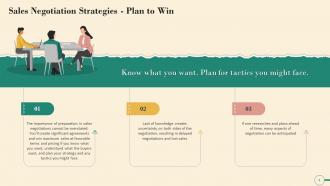
This slide demonstrates the importance of planning as a sales negotiation strategy. It emphasizes that the importance of preparation in sales negotiations cannot be overstated. Lack of knowledge creates uncertainty on both sides of the negotiation, resulting in delayed negotiations and lost sales. Many aspects of negotiation can be anticipated, if one conducts research and plans ahead of time.
Slide 5
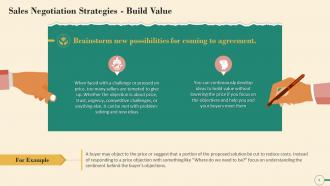
This slide depicts Building Value as a sales negotiation strategy. It emphasizes that when confronted with a challenge or under pressure to sell, far too many sellers are tempted to give up. Whether the objection is based on price, trust, urgency, competitive challenges, or something else, it can be met with problem-solving and new ideas. It also mentions that if you focus on objectives and help you and your buyers meet them, you can continuously develop ideas to build value without lowering the price.
Slide 6
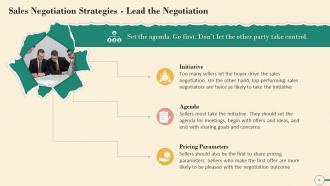
This slide showcases Leading the Negotiation as a sales negotiation strategy. It highlights that many sellers let the buyer drive the sales negotiation. On the other hand, top-performing sales negotiators are twice as likely to take the initiative. Sellers must take the initiative. They should set the agenda for meetings, begin with offers and ideas, and end with sharing goals and concerns. It also mentions that sellers who make the first offer are more likely to be pleased with the negotiation outcome.
Slide 7
This slide explains how emotions can be used as a sales negotiation strategy. It emphasizes the fact that sales negotiations are highly emotional events. The best sales negotiators intentionally manipulate buyers emotions and are more likely to be emotionally prepared during negotiations. It also mentions that the best negotiators manage their anger and frustration, which allows them to focus. When they are worried or anxious, they smoothen themselves out to do what needs to be done without conflict or fear of loss.
Slide 8
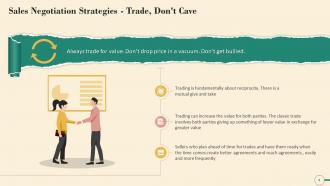
This slide tells the importance of Not Caving In as a sales negotiation strategy. It emphasizes the importance of reciprocity in trading. There is an exchange of goods/services, and trading has the potential to increase the value for both parties. Both parties give up something of lower value in exchange for something of greater value. It also emphasizes that sellers who prepare for trades ahead of time and have them ready when the time comes create better, more frequent agreements and reach agreements more frequently.
Slide 9
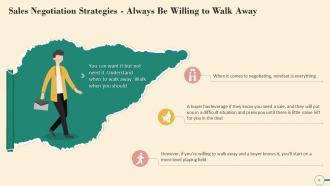
This slide explains always being Willing to Walk Away as a sales negotiation strategy. It mentions that mindset plays a significant role when it comes to negotiating. If a buyer has leverage if they know you need a sale, they will put you in a difficult situation and press you until there is very little value in a deal. It also highlights that you'll start on a more level playing field, if you're willing to walk and a buyer knows it.
Slide 10
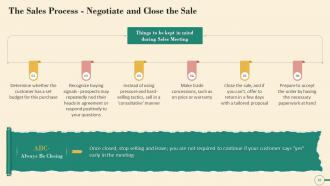
This slide provides information about what to be kept in mind during a sales meeting. The points are: Determining whether the customer has a set budget for this purchase, recognizing buying signals, Selling in a 'consultative' manner, Making trade concessions, such as on price or warranty, Close the sale, and if you can't, offer to return in a few days with a tailored proposal. It also highlights the ABC (Always Be Closing), which explains that once closed, stop selling and leave; you are not required to continue if your customer says "yes" early in the meeting.
Slide 11
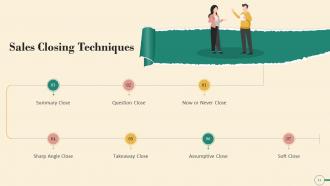
This slide showcases kinds of Sales Closing Techniques. The techniques are: Now or Never Close, Question Close, Summary Close, Sharp Angle Close, Takeaway Close, Assumptive Close, and Soft Close.
Slide 12
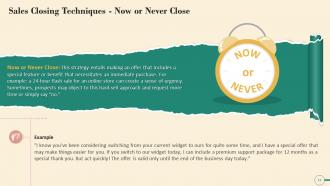
This slide explains the Now or Never sales closing technique, which entails making an effort that includes a special feature or benefit that requires an immediate purchase. A twenty-four -hour flash sale for an online store can instill a sense of urgency. It also emphasizes that sometimes prospects may object to this aggressive sales approach and ask for more time or simply say "no."
Slide 13
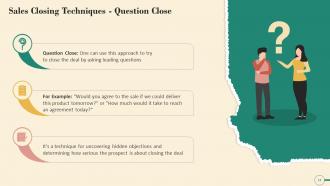
This slide depicts question close, a sales closing technique. The technique includes closing the deal by asking leading questions, e.g., "Would you agree to the sale if we could deliver this product tomorrow?" or "How much would it take to reach an agreement today?". It also highlights that this technique uncovers hidden objections and determines how serious the prospect is about closing the deal.
Slide 14
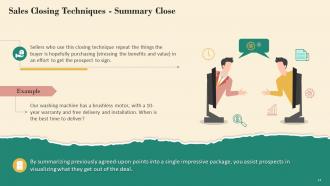
This slide describes the Summary Close, which is a sales closing technique. In this technique, sellers repeat the items the buyer is likely to purchase to entice the prospect to sign. It also mentions that by condensing agreed-upon points into a single impressive package, you help prospects visualize what they genuinely get out of the deal.
Slide 15
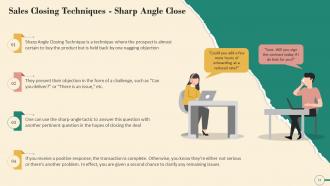
This slide describes a sales closing technique known as the sharp angle close. A sharp angle closing technique is used when a prospect is almost certain to purchase a product but is held back by one nagging objection. They present their objection as a challenge, such as “Can you deliver?" or “There is an issue," etc. It also mentions using the sharp-angle tactic to answer this question with another relevant question to close the deal.
Slide 16
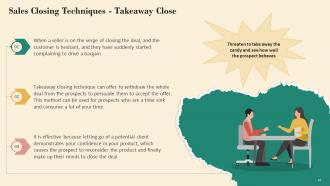
This slide depicts a sales closing technique known as the takeaway close. When a seller is on the verge of closing the deal, and the customer is hesitant, he/she suddenly starts complaining to drive a bargain. Takeaway closing technique can offer to withdraw the whole deal from the prospects to persuade them to accept the offer. This method can be used for prospects who are a time sink and consume a lot of your time.
Slide 17
This slide provides information on assumptive close that is a sales closing technique. The assumptive close or the presumptive close is a closing technique in which phrases and questions imply that your prospect will make a purchase. It also highlights that in this technique instead of asking the prospect if they want to buy, ask how they want to buy.
Slide 18
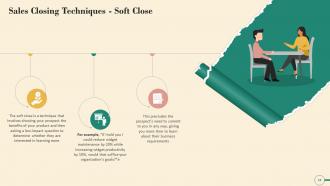
This slide explains the "soft close," a sales closing technique. The soft close is described as a technique that involves showing your prospect the product's usefulness and then asking a low-impact question to determine whether they are interested in learning more. It also emphasizes how this technique precludes the prospect's need to commit to you in any way, giving you more time to learn about their business needs.
Guide To Effective Sales Negotiation Training Ppt with all 34 slides:
Use our Guide To Effective Sales Negotiation Training Ppt to effectively help you save your valuable time. They are readymade to fit into any presentation structure.









FAQs for Guide To Effective Sales
Honestly, research their situation first so you're not going in blind. Listen way more than you talk - I can't stress this enough because everyone screws this up when they get excited about their pitch. Figure out what's actually bothering them, not just what you want to sell. Build some rapport but stay laser-focused on creating scenarios where you both win something real. Oh, and always give them an out to save face if they need to back down. Most crucial thing though? Know your walk-away point before you even walk in there.
Here's the thing - buyers don't actually care about features nearly as much as we think they do. They're making emotional decisions first, then finding logical reasons to back it up later. So instead of rattling off what your product does, figure out what keeps them up at night. What happens if they stick with the status quo? I've noticed people reveal way more when you ask "what would happen if you don't fix this?" rather than just pitching them. Listen to how they talk about their problems - that's your roadmap right there. Price matters, but it's usually not the real deciding factor.
Ugh, biggest mistake is talking too much - you'll literally argue yourself out of a good deal. Never take their first offer, even when it sounds amazing. Don't give concessions without getting something back either. People get way too hung up on price though. Think about timing, payment terms, other stuff you can negotiate. Oh and don't take their pushback personally! I've watched deals completely blow up because someone got their feelings hurt. Take time to figure out what they actually need before rushing to close. Makes everything way easier.
Honestly, prep work is like 70% of winning any negotiation. I learned this after completely screwing up a few calls early on - so embarrassing! You've got to research their company, figure out what's bugging them, and know your walk-away point before you even dial. Having backup options helps too. The crazy thing is, when you're actually prepared, you stop scrambling for words and can really hear what they're saying. Makes handling their pushback way easier. I'd say spend at least 30 minutes prepping for every hour you'll be on the call. Trust me on this one.
Oh man, body language is huge for negotiations! Honestly, it can tank your whole thing before you even speak. Sit up straight and make good eye contact - not the creepy staring kind though lol. Slouching makes you look weak AF. Pay attention to their signals too. Arms crossed? They're probably resisting something. Leaning in means they're interested. I always try to subtly mirror how they're sitting - builds rapport without being obvious about it. Keep your hands where they can see them and avoid pointing or making fists. Practice your confident posture beforehand so you don't feel awkward.
Dude, tech can totally transform how you negotiate. Start with your CRM - dig into their history and pain points before jumping on calls. Game changer right there. AI pricing tools are clutch during actual negotiations because you can run different scenarios super fast instead of doing math in your head like some kind of maniac. Screen sharing during video calls lets you edit proposals together live, which feels way more collaborative. Honestly, just connecting your CRM to a decent proposal tool will probably cut your timeline in half. The automation handles all the boring prep stuff so you can focus on the actual relationship building.
Look, start with stuff that actually matters to them - ask about their work challenges or what they're up to this weekend if it feels right. People buy from folks they genuinely like, so be curious about who they are, not just their wallet. Match how they talk too. Formal types want formal energy, casual people want you to chill out. I'm terrible at names but good with details - write down what they tell you and bring it up later. That "wait, you remembered?" reaction is gold. Honestly? Ditch your script and just have a real conversation.
Honestly, just listen to what they're actually saying first. Don't jump straight into arguing back - I learned that the hard way lol. Most objections are really just fear or uncertainty dressed up as a "no." So dig deeper with stuff like "what's your biggest concern about the timeline?" Once you get to the real issue, acknowledge it before trying to fix it. Like "yeah, I get why budget approval feels sketchy right now." Then hit them with specific examples that address their actual worry. People need to feel heard before they'll listen to you change their mind. It's way more effective than whatever logical argument you think will work.
Don't jump straight into haggling over price - that's amateur hour. First, dig into what they actually need beyond their initial ask. What's their timeline? What does winning look like for them? I swear this approach works so much better than most people think. Once you understand their real challenges, you can get creative. Maybe they care more about speed than cost, or you can throw in some low-cost extras that they'll love. Always give them a few options to choose from. Makes them feel in control while you're still steering the ship.
Oh man, cultural stuff makes or breaks negotiations. Japanese clients want relationship-building first - like, don't even think about diving into business talk. Germans? Complete opposite. They want facts, zero fluff. Americans love rushing to close (guilty as charged), but that attitude bombs in consensus cultures. I watched a colleague blow a deal once because he didn't get the handshake thing - felt bad for him honestly. Do your homework on their norms beforehand. Small changes show respect and people notice. Worth it.
Focus on win rate, average deal size, and how long deals take to close - that's your bread and butter right there. Discount percentages are huge too because winning unprofitable deals is basically losing with extra steps. Don't forget customer satisfaction after negotiations wrap up. Burned relationships come back to bite you later. Monthly tracking works well, and honestly? Start small with maybe 3 metrics max. You can always add more once you've got the hang of it. I learned that the hard way by trying to track everything at once.
Honestly, team negotiation is a game changer if you do it right. Get your tech person to jump in when they start asking detailed product stuff - lets you stay focused on the relationship side. Before you even walk in, pump your teammates for intel. Has anyone dealt with this client? What makes them tick? Practice the hard conversations together first. I can't tell you how many times role-playing saved my butt when they threw curveballs. The trick is knowing who's driving the conversation so you're not all talking over each other. One person leads, others jump in strategically when their expertise matters.
Honestly, preparation is everything. Research their pain points, budget, and who actually makes decisions before you walk in there. I almost blew a huge deal last year because I didn't do my homework - learned that lesson the hard way! Have backup proposals ready so you can switch gears fast. Anchor high but don't be ridiculous about it. Here's the thing though - don't rush them. These big buyers need time to think, so get comfortable with awkward silence after your pitch. Oh, and talk to everyone involved, not just your main contact. Trust me on that one.
Definitely shoot them a follow-up within 24-48 hours while it's all still fresh. Write up what you guys agreed on, who's handling what, and when stuff needs to happen. Trust me, people remember conversations totally differently - I've watched deals completely implode over this! Address anything you didn't resolve and throw out ideas for next steps. Don't be pushy about it though. Oh, and always nail down what happens next and exactly when. Saves everyone the awkward "so... where are we on this?" texts later.
Look, pricing basically controls how your whole negotiation plays out. Start high and you've got wiggle room to give concessions while still hitting your numbers - but price it too crazy and you'll scare them off immediately. Go low? Sure, you might close faster, but you're literally throwing money away and making your product look cheap. I've watched so many reps get completely screwed because they never figured out their pricing flexibility ahead of time. You need a rock-bottom number you won't go below. Also know exactly what you can give up without tanking your margins completely.
-
Awesomely designed templates, Easy to understand.
-
SlideTeam, Please don’t stop sharing discount coupons! I love your occasional discounts and tend to buy your products around that corner.