

Learning The Five Styles Of Negotiation Training Ppt




Try Before you Buy Download Free Sample Product
 Impress Your
 Audience
 100%
100% Editable
 Save Hours
 of Time


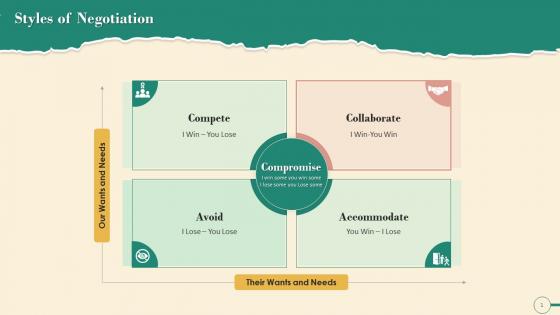
This set of slides discusses the five styles of negotiation along with how and where to use them. These are Compete, Compromise, Accommodate, Avoid, And Collaborate.
People who downloaded this PowerPoint presentation also viewed the following :
Content of this Powerpoint Presentation
Slide 1
This slide showcases five negotiation styles that are: Compete, Compromise, Accommodate, Avoid, And Collaborate.
Slide 2
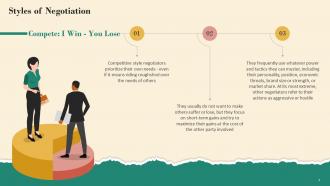
This slide explains the competitive negotiation style. It emphasizes that competitive style negotiators prioritize their own needs, even if it means sacrificing the needs of others. It also mentions that they do not want to make others suffer or lose, but they are more concerned with short-term gains at the cost of the other party involved.
Slide 3
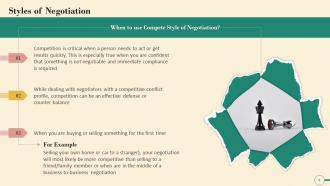
This slide illustrates information about when to use competitive style of negotiation. It emphasizes the importance of competition when a person needs to act or obtain results quickly. This is especially true when you are confident that something is not negotiable and immediate compliance is required.
Slide 4
This slide depicts information on accommodating negotiation styles. It emphasizes the opposite of competing. For accommodating style negotiators, the relationship is everything. It also mentions that accommodating negotiators believe that giving people what they want is the most effective way to win them over.
Slide 5
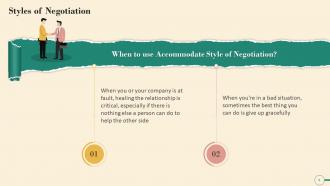
This slide depicts information on when to use accommodating style of negotiation. It emphasizes that the accommodating style is used when a person or the company is at fault, and repairing the relationship is critical, especially if there is nothing else a person can do to help the other side. It also mentions that when a person is in bad situation, the best thing he/she can do is to give up gracefully.
Slide 6
This slide depicts information on avoid negotiation style. It mentions that avoiding negotiation style is known as "passive-aggressiveness." People who use this style avoid conflict. It also emphasizes people adopting this style may seek revenge without your knowledge instead of confronting you directly about the issue.
Slide 7
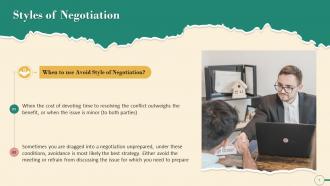
This slide depicts information about when to use avoiding style of negotiation. It mentions that the avoiding negotiation style can be used when the cost of devoting time to resolve the conflict outweighs the benefit, or when the issue is minor (for both parties).
Slide 8
This slide depicts information about the compromise negotiation style. It emphasizes that a compromising negotiator's primary concern is to find a middle ground and do what is fair for both parties. It also states that main drawback of a compromising negotiator can be that sometimes they rush into negotiations and make too many concessions, leading to a loss.
Slide 9
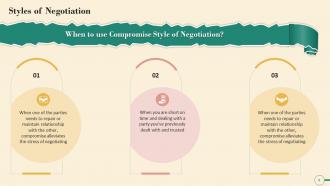
This slide depicts information about when to use the compromise style of negotiation. It mentions that when one of the parties need to repair or maintain relationship with the other, compromise reduces the stress of negotiating. It also highlights that compromise negotiation style can be used when you are short on time and dealing with a party you've previously dealt with and trusted.
Slide 10
This slide showcases information about the collaborative negotiation style. Collaborative negotiation is a strategy in which both parties have a common goal. They attempt to achieve their objective by extracting more value from the transaction to benefit both parties. It is also known as integrative, interest-based, or problem-solving negotiation.
Slide 11
This slide explains when to use a collaborative negotiation style. It emphasizes using collaborative style when a relationship is important to you, as is your market reputation, and when both parties require their objectives to be met.
Learning The Five Styles Of Negotiation Training Ppt with all 27 slides:
Use our Learning The Five Styles Of Negotiation Training Ppt to effectively help you save your valuable time. They are readymade to fit into any presentation structure.
















FAQs for Learning The Five Styles Of
So there are basically five negotiation styles worth knowing. Competitive people push hard and don't back down from conflict. Then you've got collaborative types who want everyone to win through honest communication. Accommodating negotiators care more about keeping relationships smooth than getting their way, while avoiders just... well, avoid the whole mess (totally get that sometimes). Compromising folks split things down the middle for quick deals. Match your approach to what's happening - go collaborative for long-term stuff, competitive when it really matters, accommodating when you can't afford to burn bridges. Figure out your natural style first, then practice switching it up.
Dude, figuring out how people negotiate literally changed everything for me. You've got some coworkers who want all the data and spreadsheets first, right? Then others who need to chat and build trust before any real work happens. Once I started paying attention to this stuff, conversations got way easier. Like, watch who jumps straight into problem-solving versus who asks a million questions first. Then just match their vibe - speak their language basically. Competitive types want different things than people who hate conflict. It's kinda obvious once you think about it, but game-changing when you actually do it.
Look, going hard in negotiations works great when you've got the upper hand and don't need these people again. You'll probably score better deals by pushing for what you want. The downside? You might torch relationships in the process - and honestly, that's not always worth it. Creates this whole win-lose thing instead of finding solutions that work for everyone. Sometimes the other person just gets defensive and fights back harder, which makes everything messier. I'd say save the aggressive approach for high-stakes situations where it's truly one and done.
Dude, collaborative negotiation is such a game-changer. Instead of trying to "win" against someone, you're actually working together to find solutions that work for both of you. People totally remember how you made them feel during these conversations - and if they felt heard, they'll definitely want to work with you again. Takes more time upfront, I'll admit that. But you're basically building relationships that pay off later. Your reputation starts spreading too, which honestly opens doors you didn't even see coming. Just start with "how can we both win here?" Works every time.
Honestly? Use accommodating when the relationship matters way more than whatever you're fighting about. Like if you're clearly wrong, or they care about something 10x more than you do. Sometimes it's worth letting someone "win" just to calm them down - I've seen people get so worked up over tiny stuff. Plus it can build goodwill for later when you actually need something important. But don't become a pushover. Pick your moments strategically. Give in now so you're in a better position next time.
Look back at how you handle conflict - are you the type who fights hard for what you want, or do you try finding solutions that work for everyone? Maybe you're like me and just give in to avoid drama (honestly, took me forever to realize I wasn't being "collaborative," just scared of confrontation lol). Notice if you care more about the relationship or getting results. Those online assessments aren't terrible either. Ask people you trust how you actually come across when there's disagreement - might surprise you.
Oh man, culture totally changes everything in negotiations! Some people jump straight into business while others need that whole relationship-building thing first (which honestly took me forever to get used to). Your communication style matters too - like how direct you are, your timing, even how comfortable you get with awkward silences. Plus different cultures see negotiating completely differently. Some think it's about working together to solve problems, others treat it more like a competition. I'd definitely look up your counterpart's background beforehand though. Being flexible with your approach makes a huge difference.
You've gotta read their vibe early and match their energy without being fake about it. Aggressive people? Stay calm but firm - it actually messes with their head when you don't take the bait. Collaborative types are easier - just ask tons of questions about what they really want underneath it all. The formal, suit-and-tie negotiators are honestly the worst because you can't tell what they're thinking. Stick to hard facts with those ones. Oh, and here's the thing - you can totally change how you say stuff, but never budge on what you actually need from the deal.
Stop fighting over percentages and start asking "what if" questions instead. Dig into WHY each side wants specific things - that's where the creative solutions live. My first big client deal taught me this the hard way lol. Try "help me understand why this matters to you" or "what would need to happen for this to work?" Share your own constraints too. Shows you want to collaborate, not just win. The whole trick is making the pie bigger before you slice it up. Works way better than the typical back-and-forth nonsense.
Emotional intelligence is like a multiplier for whatever negotiation approach you're already using. Competitive types get better at sensing when to push harder or back off. Collaborative people? They build real connections instead of fake rapport. I've watched super smart engineers totally bomb negotiations because they completely missed obvious emotional signals - it's painful to see. If you tend to accommodate others, high EI helps you spot when someone's trying to manipulate you. Even compromise-focused negotiators win because they can tell when flexibility is real versus just an act. Seriously, start noticing tone shifts and body language. Game changer.
Don't match their energy - that's your secret weapon. Let them blow off steam first, then acknowledge what they're saying before you jump in with your stuff. I had to learn this lesson the hard way during this brutal client meeting last year, ugh. Try saying things like "I get that you feel strongly about this" so they know you're actually listening. You don't have to agree though! Set boundaries on what kind of behavior you'll put up with. If it gets too crazy, just pause the whole thing. Usually they'll chill out when they see you staying calm.
Honestly, I used to think being empathetic meant just backing down all the time - total mistake. You've gotta be straight up about what you need ("I need X because...") but also actually listen to their side. Like, ask real questions about what's tying their hands or what they're trying to accomplish. The magic happens when you really get their perspective - suddenly you can brainstorm solutions that don't screw anyone over. Here's what helped me: before you go in, write down your non-negotiables AND try to imagine what winning looks like from where they're sitting. Game changer.
Oh man, people think you're stuck with one negotiation style the whole time - like you pick "nice guy" or "hardball" and that's it. Not true at all. Aggressive types don't always win either (honestly, they usually just piss people off). Being friendly doesn't automatically make you a pushover. Good negotiators switch it up based on who they're dealing with and what matters most. Sure, you might naturally lean collaborative or whatever, but you can totally learn other approaches. Watch how different styles play out with your team - you'll start noticing patterns pretty quick.
Oh totally - each industry has its own weird unwritten rules about this stuff. Tech people are usually pretty chill and collaborative since everyone's gonna work together again next month. Finance and legal folks? Way more cutthroat with all the formal contracts and power plays. Sales is relationship-heavy but still competitive as hell. Healthcare moves at a snail's pace because of all the compliance stuff (honestly drives me crazy). Government's the same - everything takes forever. My advice? Do some digging on the company culture first. Stalk their LinkedIn or ask around before you go in there blind.
Definitely check out "Getting to Yes" and "Never Split the Difference" - both are solid reads that actually teach you useful stuff. Your local chamber of commerce probably runs workshops too, which beat online courses since you get to practice with real people. Harvard has this negotiation program that's pricey but supposedly amazing. YouTube's got some decent free content if you're broke like I usually am lol. Oh, and Toastmasters is great for getting comfortable with the whole back-and-forth thing. The main thing is you've gotta practice this stuff somewhere, maybe volunteer for negotiations at your job?
-
Great work on designing the presentation. I just loved it!
-
Commendable slides with attractive designs. Extremely pleased with the fact that they are easy to modify. Great work!