


Essential Closing Techniques For Sales Negotiations Training Ppt




Try Before you Buy Download Free Sample Product
 Impress Your
 Audience
 100%
100% Editable
 Save Hours
 of Time


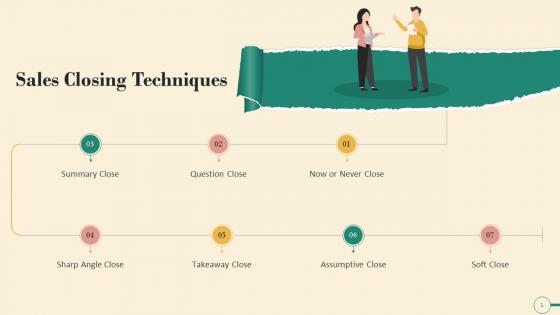
These slides showcase various kinds of Sales Closing Techniques. The techniques are Now or Never Close, Question Close, Summary Close, Sharp Angle Close, Takeaway Close, Assumptive Close, and Soft Close.
People who downloaded this PowerPoint presentation also viewed the following :
Content of this Powerpoint Presentation
Slide 1
This slide showcases kinds of Sales Closing Techniques. The techniques are: Now or Never Close, Question Close, Summary Close, Sharp Angle Close, Takeaway Close, Assumptive Close, and Soft Close.
Slide 2
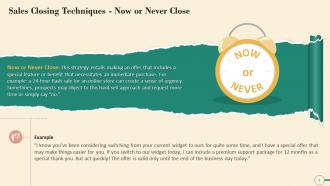
This slide explains the Now or Never sales closing technique, which entails making an effort that includes a special feature or benefit that requires an immediate purchase. A twenty-four -hour flash sale for an online store can instill a sense of urgency. It also emphasizes that sometimes prospects may object to this aggressive sales approach and ask for more time or simply say "no."
Slide 3
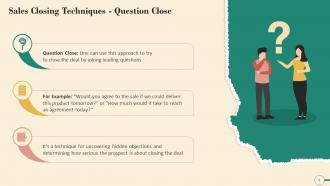
This slide depicts question close, a sales closing technique. The technique includes closing the deal by asking leading questions, e.g., "Would you agree to the sale if we could deliver this product tomorrow?" or "How much would it take to reach an agreement today?". It also highlights that this technique uncovers hidden objections and determines how serious the prospect is about closing the deal.
Slide 4
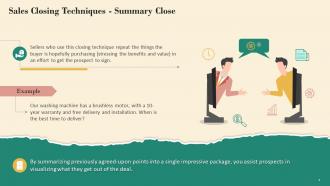
This slide describes the Summary Close, which is a sales closing technique. In this technique, sellers repeat the items the buyer is likely to purchase to entice the prospect to sign. It also mentions that by condensing agreed-upon points into a single impressive package, you help prospects visualize what they genuinely get out of the deal.
Slide 5
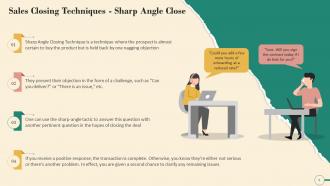
This slide describes a sales closing technique known as the sharp angle close. A sharp angle closing technique is used when a prospect is almost certain to purchase a product but is held back by one nagging objection. They present their objection as a challenge, such as “Can you deliver?" or “There is an issue," etc. It also mentions using the sharp-angle tactic to answer this question with another relevant question to close the deal.
Slide 6
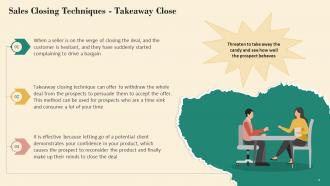
This slide depicts a sales closing technique known as the takeaway close. When a seller is on the verge of closing the deal, and the customer is hesitant, he/she suddenly
starts complaining to drive a bargain. Takeaway closing technique can offer to withdraw the whole deal from the prospects to persuade them to accept the offer. This method can be used for prospects who are a time sink and consume a lot of your time.
Slide 7
This slide provides information on assumptive close that is a sales closing technique. The assumptive close or the presumptive close is a closing technique in which phrases and questions imply that your prospect will make a purchase. It also highlights that in this technique instead of asking the prospect if they want to buy, ask how they want to buy.
Slide 8
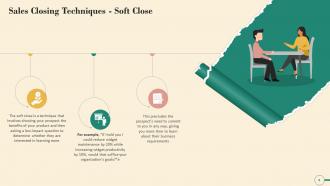
This slide explains the "soft close," a sales closing technique. The soft close is described as a technique that involves showing your prospect the product's usefulness and then asking a low-impact question to determine whether they are interested in learning more. It also emphasizes how this technique precludes the prospect's need to commit to you in any way, giving you more time to learn about their business needs.
Essential Closing Techniques For Sales Negotiations Training Ppt with all 24 slides:
Use our Essential Closing Techniques For Sales Negotiations Training Ppt to effectively help you save your valuable time. They are readymade to fit into any presentation structure.






FAQs for Essential Closing Techniques For Sales
Honestly, the best endings either circle back to your main points with some kind of twist, or they give people something concrete to actually DO. Don't just awkwardly trail off or go "so... questions?" I've watched people crush their whole talk then completely blow the finale - it's rough. Try referencing your opening story again, or do the "if you remember nothing else..." thing. Works every time. Give them clear next steps too. People need to know what they're supposed to do with all this info you just dumped on them.
Dude, stories absolutely crush it in closing because they hit people in the feels, not just the brain. Share a quick customer win right before you ask for the decision - it lets them picture themselves getting those same results. Way more powerful than just listing features, honestly. Keep it short and super relevant to their exact situation though. Like "Sarah's team saw a 40% boost in their first month - want me to get you started so you can hit similar numbers?" That kind of thing just works.
Dude, visual aids can totally make or break your close. People process images way faster than just listening to you talk - ROI charts, before/after shots, simple infographics all work great. I've watched so many pitches crash because they just rambled at the end without showing anything concrete. Keep your closing slide super clean and focused on the main outcome you want. Oh, and here's something most people miss - leave that slide up during Q&A. It keeps your key message right there staring at them while they're asking questions. Trust me on this one.
Dude, you've gotta read the room first. Analytical people want hard numbers and ROI data - they eat that stuff up. But relationship-focused folks? They care more about trust and feeling like you're actually partnering with them. Honestly, the generational thing matters too. Younger clients usually want you to cut the BS and be direct. Older ones might still appreciate those classic assumptive closes. Watch how they talk, how fast they make decisions, what they keep bringing up. Then just mirror their vibe. It's kinda like speaking their language, you know?
Ugh, the worst thing you can do is just suddenly go "any questions?" - totally kills the vibe. Also don't dump new info at the end (should've covered that earlier) and avoid super vague calls-to-action. I've watched people completely bomb by rambling when they should've stopped talking. Never apologize for "taking their time" either - so awkward! You worked hard on this. Instead, hit your main points again, give them one clear next step, and finish strong. Confidence is everything here.
Dude, body language is everything when you're wrapping up. I bombed my first few pitches because I was slouching and looking at my shoes - totally killed my credibility even though my pitch was solid. Stand tall and actually look at people. Use your hands but don't go crazy with it. Here's what really works: lean in a little when you make your final ask. Shows you're serious about it. Oh and stop fidgeting! People pick up on that nervous energy instantly. Your posture needs to scream "I'm 100% confident in this" so they'll feel that confidence too.
Dude, assumptive language is everything - say "when we move forward" not "if you decide." I always use "based on what you've told me" and "this sounds like exactly what you need" to build their confidence. Here's my favorite trick: ask "what questions do you have?" instead of "do you have questions?" Assumes they're already bought in, you know? Create some urgency too. "We can get started next week" or "I've got one calendar spot left." Then finish strong with two good options - "should we kick off Tuesday or Wednesday?" Way better than yes/no questions that give them an easy out.
Dude, your closing needs to actually make people DO something. Skip the weak "maybe consider" stuff and go straight for "Sign up today" or "Call now." FOMO works crazy well here - people hate missing out on good deals. Quick trick: remind them what they're getting, then immediately tell them their next move. Be super specific about what to do. Short sentences hit harder sometimes. Don't make them think too hard about the process either. Honestly, test a few different endings and see what actually gets results. That's the only way you'll know what works.
Honestly, the best closings hit them right in the feels. Don't just recap features - remind them how this fixes their actual problems. Like, are they losing sleep over missed deadlines? Will this make them look amazing to their boss? People buy with their hearts first, then find logical reasons later. Paint that picture of their life being way better. "Picture walking into next quarter with this headache completely gone" - then boom, hit them with your ask. Oh, and throw in some gentle urgency. Works every time.
Honestly, ditch the boring bullet point recap - nobody remembers those anyway. The Rule of Three works great - just group your main ideas into three chunks. I love doing story callbacks too. Like if you started with some example, bring it back and show how your points actually solve that problem. Visual metaphors are gold - comparing stuff to building blocks or whatever makes sense. You could paint that whole "before and after" picture, showing where they started vs. where they'll end up. The trick is making it feel natural, not like you're just repeating everything you already said.
You know how awkward it sounds when someone rushes through "any questions?" at the end? Same thing happens with your whole closing. Slow down before your final message - it builds anticipation and gives people a sec to mentally catch up. When you hit your main points, pause after them. Let that stuff sink in, you know? I always mix up my rhythm: slower for the big asks, bit faster for the smaller details. Honestly, recording yourself is weird but super helpful for hearing where pauses actually work.
Acknowledge their question right away but don't let it derail you. Try something like "Great question - I want to give that the attention it deserves" then suggest talking afterward. This way you're not being dismissive but you keep your momentum. There's always that one person who won't let it go, right? If they keep pushing, give a quick response but then pivot back with "Let me get you more details once we finish up." Before you wrap, make sure to set a specific time for follow-ups. You stay in control while still being responsive.
Honestly, just watch people's body language right after you finish - are they leaning forward or checking their phones? That tells you everything. The numbers don't lie though. Track how many actually follow through on whatever you asked them to do. I'm bad at this, but try sending a quick text or email the next day to see who responds. Keep a simple note in your phone about what worked and what flopped. Ask someone you trust to watch you present sometime - they'll catch stuff you miss. Short closes usually work better than long ones, at least in my experience.
Honestly, virtual presentations are brutal for attention spans - people zone out so fast online. I've learned you gotta be super direct and spell everything out: "Here's exactly what I need from you" works way better than beating around the bush. With in-person stuff, you can actually read faces and have those natural conversations that build up to the close. But virtual? Hit them with smaller closes throughout instead of saving it all for the end. Oh, and definitely send that follow-up summary within 24 hours - trust me on this one, it's saved my butt more times than I can count.
Oh man, context is everything! Business meetings need those hard deadlines - like "we're doing this by Friday, period." But in classrooms? Better to wrap up with questions that get people thinking later. Motivational speeches are where you go all-in emotional. I bombed this once using inspirational closing vibes during a budget review... so cringey. Your energy has to match what people expect walking in. Short presentations work differently than long ones too. Just make sure you give them something they can actually act on afterward - that's honestly the most important part regardless of setting.
-
Fantastic collection of visually appealing PowerPoint templates. They certainly uplift the look of the presentation.
-
“Excellent service from the customer support team when I wanted a slide that was a bit different from those on their standard menu. Super helpful.”