


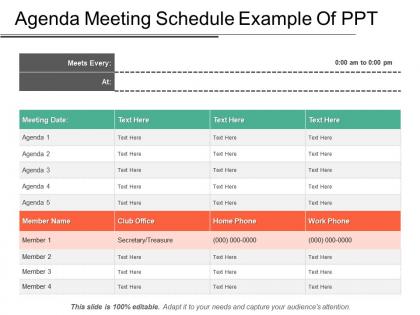
Agenda meeting schedule example of ppt




Try Before you Buy Download Free Sample Product
 Impress Your
 Audience
 100%
100% Editable
 Save Hours
 of Time


Organize your meetings with this Agenda Meeting Schedule Example Of PPT template. Maintain a proper record of your meetings along with the name of the members that must be present in the meeting. This agenda meeting schedule template will help you in reminding the meeting you have lined up. Get this readily available PPT slide and record where you need to be during each part of the day. It allows you to plan your time efficiently. Display the hourly progress and the time spent on each activity. Timekeeping and progress maintaining is easy with this meeting agenda PPT slide. Organize and plan your actions in a synchronized manner and present it in front of your audience. Use this slide as a reminder of what has been discussed in the previous meetings and what is yet to be addressed. Also, you can expect the meeting to start and finish at the scheduled time.
People who downloaded this PowerPoint presentation also viewed the following :
Agenda meeting schedule example of ppt with all 5 slides:
Convince folks that change is generally for the better with our Agenda Meeting Schedule Example Of Ppt. Advise against being inflexible.



FAQs for Agenda meeting schedule
Key components of a successful meeting agenda include clear objectives, designated time allocations, participant roles, discussion topics with supporting materials, and defined action items. These elements streamline meeting efficiency by establishing expectations, maintaining focus, and ensuring productive outcomes, with many organizations finding that structured agendas reduce meeting duration while enhancing decision-making and accountability.
Agenda formats can be tailored by adjusting structure, timing, and content focus to match meeting objectives, whether strategic planning sessions, operational reviews, or creative brainstorming. Formal board meetings require detailed documentation and voting sections, while team standups benefit from streamlined formats emphasizing quick updates, with many organizations finding that customized templates improve engagement and ultimately deliver more productive outcomes across diverse meeting types.
**INPUT**: What best practices should be followed when scheduling a meeting agenda? **OUTPUT**: Meeting agenda best practices include defining clear objectives, allocating realistic time blocks, distributing materials 24-48 hours in advance, prioritizing critical items early, and designating specific action owners for each topic. These scheduling strategies streamline discussions by establishing focused parameters, enabling productive dialogue, and ensuring comprehensive coverage, with many organizations finding that structured agendas reduce meeting duration while significantly enhancing decision-making outcomes. [Word count: 60 words]
Digital tools enhance agenda meeting schedules by automating reminders, enabling real-time collaboration, streamlining document sharing, and providing integrated scheduling across platforms. These technologies deliver improved attendance rates, faster decision-making, and enhanced productivity, with many organizations finding that automated workflows and cloud-based platforms ultimately reduce meeting preparation time while increasing participant engagement and accountability.
Time allocation serves as the structural backbone of effective agenda meetings, ensuring balanced discussion coverage, preventing topic monopolization, and maintaining participant engagement throughout sessions. Strategic time distribution enables facilitators to prioritize critical decisions, accommodate diverse stakeholder input, and deliver productive outcomes, with many organizations finding that structured timing ultimately enhances meeting efficiency and accelerates decision-making processes.
An effective agenda encourages participation by including dedicated discussion segments, assigning specific roles to different attendees, incorporating interactive elements like brainstorming sessions, and allocating sufficient time for Q&A periods. These structural approaches enhance engagement by ensuring every participant has designated speaking opportunities, while many organizations find that rotating facilitation responsibilities and including collaborative decision-making items ultimately delivers more productive meetings and stronger team buy-in.
**INPUT**: What strategies can be employed to ensure that the meeting stays on track according to the agenda? **OUTPUT**: Effective agenda management strategies include appointing a dedicated timekeeper, setting clear time limits for each topic, using parking lot techniques for off-topic discussions, and sending pre-read materials beforehand. These approaches streamline meeting flow by maintaining focus, minimizing tangential conversations, and ensuring productive outcomes, with many organizations finding that structured facilitation ultimately delivers shorter meetings and better decision-making processes. *[Word count: 58 words]*
Action items should be documented with specific assignee names, clear deliverable descriptions, realistic deadlines, and measurable success criteria directly within the agenda template. This structured approach ensures accountability by creating transparent ownership, enabling progress tracking between meetings, and facilitating follow-up discussions, with many organizations finding that documented action items increase completion rates and overall meeting effectiveness.
Common mistakes include creating vague objectives, overloading the schedule, failing to allocate realistic timeframes, omitting key stakeholders, and neglecting follow-up actions. These planning oversights result in unproductive discussions, missed deadlines, and poor participant engagement, with many organizations finding that structured agendas with clear priorities ultimately streamline decision-making and enhance meeting efficiency.
**INPUT**: How can one effectively prioritize topics on an agenda? **OUTPUT**: Effective agenda prioritization involves ranking items by urgency, business impact, decision requirements, time sensitivity, and stakeholder involvement. Organizations streamline meetings by addressing critical decisions first, grouping related topics together, and allocating specific timeframes, with many finding that structured prioritization reduces meeting duration while enhancing outcomes and participant engagement. [Word count: 53 words]
**INPUT**: What strategies can be used to distribute the meeting agenda to participants in advance? **OUTPUT**: Effective agenda distribution strategies include automated email scheduling, shared digital workspaces, calendar integration with attachments, collaborative platforms like Teams or Slack, and mobile-accessible documents. These approaches streamline communication by ensuring consistent delivery, enabling participant preparation, and reducing meeting inefficiencies, with many organizations finding that advance distribution ultimately enhances engagement and decision-making outcomes. [Word count: 54 words]
Feedback on agenda effectiveness can be collected through post-meeting surveys, one-on-one discussions with participants, and structured evaluation forms assessing time allocation, topic relevance, and meeting flow. These methods enable organizations to streamline future meetings by identifying which agenda items drove decisions and which required more discussion time, ultimately enhancing meeting productivity and participant engagement across departments.
A purpose statement clarifies meeting objectives, aligns participant expectations, and ensures focused discussions by establishing clear goals and desired outcomes from the start. This strategic approach streamlines decision-making processes, minimizes off-topic conversations, and enhances meeting productivity, with many organizations finding that well-defined purposes ultimately deliver faster resolutions and improved stakeholder engagement.
Agenda items can be categorized by priority level, topic type, decision requirements, and time allocation, creating clear organizational structure for participants. Strategic categories like action items, discussion topics, informational updates, and approval requests enable meeting leaders to streamline workflow, enhance participant preparation, and ultimately deliver more focused outcomes with better time management across organizations.
Meetings without clear agendas typically result in reduced productivity, unclear outcomes, wasted time, and participant frustration across organizations. These challenges ultimately impact resource allocation, decision-making effectiveness, and team collaboration, with many companies finding that structured agenda frameworks enhance meeting efficiency by 40-60%, streamline communication flows, and deliver measurable improvements in project timelines and strategic alignment.
-
Design layout is very impressive.
-
Unique and attractive product design.