


Daily meeting schedule with agenda sample of ppt




Try Before you Buy Download Free Sample Product
 Impress Your
 Audience
 100%
100% Editable
 Save Hours
 of Time


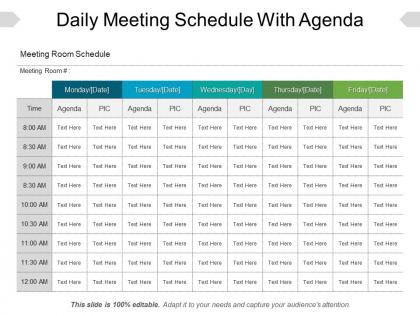
Schedule your meetings effortlessly by using the Daily Meeting Schedule With Agenda Sample Of PPT template. The template can be used for making agenda presentations, project proposals, business plans, and meetings. This PPT template has been designed to cater to the needs of presenters. The template will help you guide your viewers where they need to be during each hour of the day. Plan for the completion of your projects by assigning tasks to your employees on a daily basis using this readily available PowerPoint template. With the help of this template, you can fix the agenda on the basis of hours and dates. Assign the responsibilities to employees and the other staff members through this professionally designed PPT slide. Our designers have designed this PPT slide for your convenience. Download the slide now and manage the tasks and meetings efficiently by saving a lot of your time.
People who downloaded this PowerPoint presentation also viewed the following :
Daily meeting schedule with agenda sample of ppt with all 5 slides:
Discredit brainwashing with our Daily Meeting Schedule With Agenda Sample Of Ppt. Acquaint innocent folks with the facts at hand.
FAQs for Daily meeting schedule with agenda
Key elements include meeting objectives, time allocations for each topic, action item reviews, priority updates, decision points, and next steps assignments. These components streamline discussions by maintaining focus, preventing overruns, and ensuring accountability, with many organizations finding that structured templates reduce meeting duration by 30% while enhancing productivity and team alignment.
A daily meeting agenda template helps set clear expectations by outlining specific topics, time allocations, required preparations, and participant roles before the meeting begins. This structured approach enables team members to prepare relevant materials, understand their contributions, and align on objectives, ultimately delivering more focused discussions and productive outcomes while minimizing time spent on unclear priorities.
Standardized daily meeting agendas deliver consistency, improved time management, enhanced accountability, better cross-team alignment, and increased productivity across organizations. These structured frameworks streamline communication by ensuring uniform information sharing, reducing meeting duration, and enabling seamless collaboration, with many companies finding that standardized approaches ultimately enhance operational efficiency and team performance.
Technology enhances daily meeting agenda templates through real-time collaboration tools, automated action item tracking, and integrated scheduling systems that streamline preparation and follow-up processes. These digital solutions enable teams to update agendas collaboratively, automatically distribute materials, and track progress on deliverables, ultimately delivering more focused discussions and improved accountability across organizations.
Yes, daily meeting agendas should include specific time allocations for each discussion point, typically ranging from 2-5 minutes per item depending on complexity and urgency. This approach streamlines meeting flow, prevents lengthy discussions on minor issues, and ensures comprehensive coverage of priorities, with many teams finding that time-boxed agendas ultimately deliver more focused outcomes and enhanced productivity.
Daily meeting agendas for remote or hybrid teams should include technology check-ins, connection time for relationship building, clear time allocations for each topic, and designated speaking rotations to ensure equal participation. These adaptations address communication challenges inherent in distributed work environments, with many organizations finding that structured agendas ultimately enhance team cohesion and productivity.
Effective strategies include setting strict time limits for each agenda item, assigning a dedicated facilitator to redirect off-topic discussions, and using visual timers or cues to maintain awareness. These approaches streamline meeting flow by establishing clear expectations, minimizing tangential conversations, and ensuring comprehensive coverage of priorities, with many organizations finding that structured facilitation ultimately delivers faster decision-making and enhanced team productivity.
Daily meeting agendas should be reviewed weekly and revised monthly to maintain effectiveness, with additional adjustments made whenever team priorities, project phases, or organizational goals shift significantly. Many organizations find that regular agenda reviews help identify redundant discussion points, missed critical topics, and time allocation issues, ultimately streamlining meetings and enhancing team productivity across departments.
Participant feedback enables continuous refinement of daily meeting agenda templates by identifying inefficient time allocations, missing discussion points, and structural improvements that enhance productivity. Through regular input collection, teams can streamline their templates to better address project needs, reduce meeting duration, and improve engagement, with many organizations finding that feedback-driven adjustments ultimately deliver more focused discussions and actionable outcomes.
A daily meeting agenda template can accommodate last-minute topics by including flexible buffer zones, designated "urgent items" sections, and time-boxed discussion slots that allow for quick additions without derailing planned priorities. Through strategic template design, organizations streamline decision-making processes, maintain meeting efficiency, and ensure critical issues receive attention, while preserving structured workflows that ultimately deliver better team coordination and faster problem resolution.
Common pitfalls include overloading agendas with too many items, failing to allocate realistic time slots, lacking clear objectives for each topic, and neglecting to prioritize urgent matters effectively. These scheduling missteps often result in rushed discussions, incomplete decisions, and team frustration, with many organizations finding that streamlined, focused agendas ultimately deliver better outcomes and higher productivity.
Visuals can be integrated through performance dashboards, progress charts, project timelines, workflow diagrams, and data visualization tools embedded directly within agenda templates. These visual elements streamline information processing, enhance team comprehension, and maintain focus during discussions, with many organizations finding that incorporating charts and infographics reduces meeting duration while significantly improving decision-making speed and participant engagement levels.
A daily meeting agenda promotes accountability by establishing clear expectations, tracking progress on commitments, creating transparent reporting structures, and documenting action items with assigned ownership. Through structured check-ins and status updates, team members maintain visibility into each other's responsibilities and deliverables, while regular follow-ups on previous commitments ensure consistent performance and ultimately strengthen team reliability.
Daily meeting success metrics include agenda completion rates, meeting duration adherence, action item follow-through percentages, participant engagement scores, and decision-making efficiency. These measurements enable organizations to streamline their operations by tracking productivity gains, reducing time wastage, and enhancing team collaboration, with many companies finding that structured evaluation ultimately delivers improved project outcomes and stronger accountability.
Cultural differences influence daily meeting agendas through varying communication styles, hierarchical structures, time orientations, and decision-making approaches. Organizations operating globally adapt their templates by incorporating longer relationship-building segments, flexible timing frameworks, and culturally appropriate participation methods, with many multinational companies finding that customized agendas enhance cross-cultural collaboration and team effectiveness.
-
Very unique, user-friendly presentation interface.
-
Awesome use of colors and designs in product templates.